Been going down the $DUSK Network rabbit hole lately, and there's something about their confidential smart contract setup that keeps nagging at me.
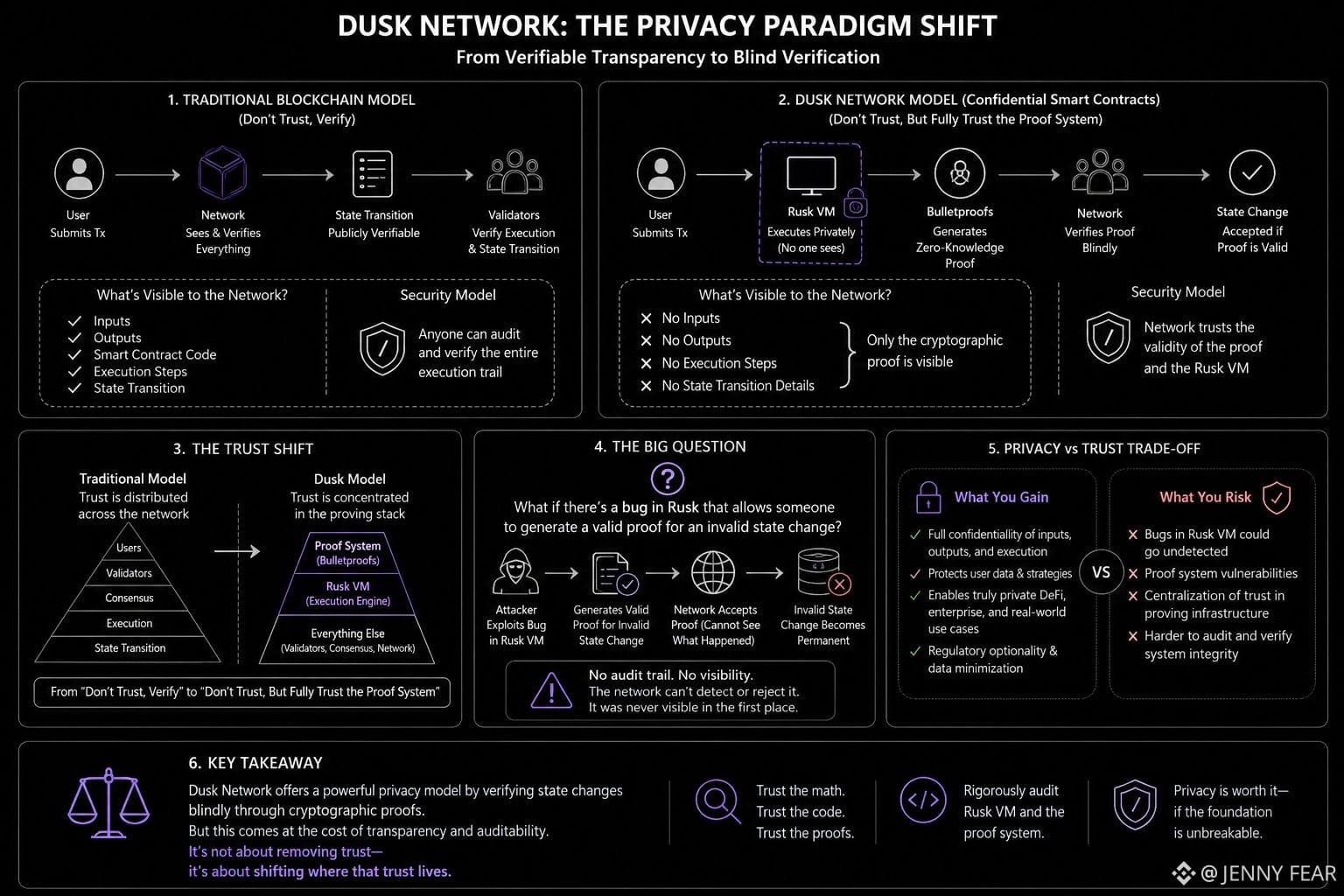
Normally with blockchains, even privacy ones, the network still verifies state transitions publicly. You hide the inputs and outputs, but everyone can check that the transition itself is valid.
Dusk flips this. With bulletproofs and their Rusk VM, the network verifies state changes blindly through cryptographic proofs. The validators never actually see what's being executed.
Here's what gives me pause: if there's a bug in Rusk that lets someone generate a valid proof for an invalid state change, the network would just... accept it. There's no way to audit the execution trail afterward because it was never visible in the first place.
So we've moved from "don't trust, verify" to "don't trust, but fully trust the proof system and the VM generating those proofs."
That feels like a different security model entirely. Not saying it's wrong—privacy has real costs—but I'm genuinely curious how people think about this trade-off. Is the privacy worth shifting that much trust into the proving infrastructure? Or am I overthinking this?
@Dusk #dusk #DUSK $DUSK
Normally with blockchains, even privacy ones, the network still verifies state transitions publicly. You hide the inputs and outputs, but everyone can check that the transition itself is valid.
Dusk flips this. With bulletproofs and their Rusk VM, the network verifies state changes blindly through cryptographic proofs. The validators never actually see what's being executed.
Here's what gives me pause: if there's a bug in Rusk that lets someone generate a valid proof for an invalid state change, the network would just... accept it. There's no way to audit the execution trail afterward because it was never visible in the first place.
So we've moved from "don't trust, verify" to "don't trust, but fully trust the proof system and the VM generating those proofs."
That feels like a different security model entirely. Not saying it's wrong—privacy has real costs—but I'm genuinely curious how people think about this trade-off. Is the privacy worth shifting that much trust into the proving infrastructure? Or am I overthinking this?
@Dusk #dusk #DUSK $DUSK