
The more I read about RWAs, the more I realized that putting an asset onchain can mean very different things.
A token can represent a bond, fund, or other real world asset on a blockchain without the asset itself being created there.
That distinction matters.
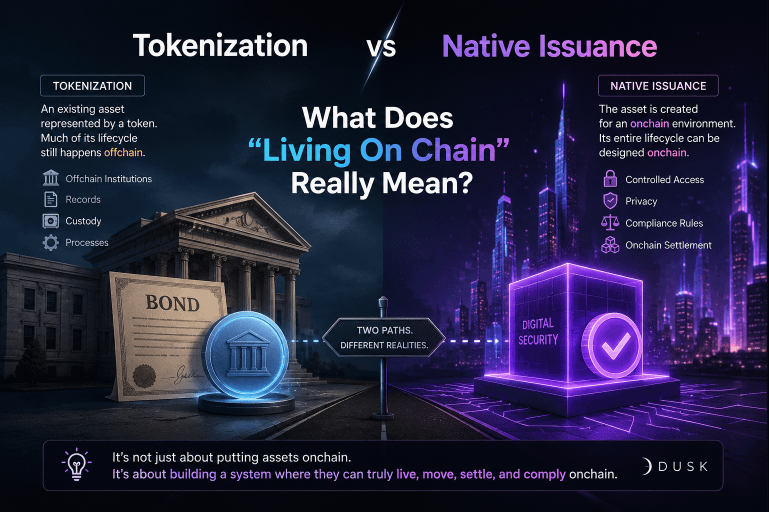
With tokenization, an existing asset is represented by an onchain token. The underlying asset and many parts of its lifecycle can still depend on offchain institutions, records, custody, and processes.
Native issuance starts from a different point. The financial asset is created for an onchain environment, so its issuance, ownership, transfers, and settlement can be designed around blockchain infrastructure from the beginning.
That’s one reason I find Dusk interesting.
Its approach to regulated assets goes beyond simply creating tokens. The network is designed for financial instruments that need controlled access, privacy, compliance rules, and onchain settlement.
This is where Dusk Trade becomes relevant. The goal isn’t just to represent securities on a blockchain, but to build infrastructure where regulated financial assets can actually operate within an onchain system.
I think that changes the question we should be asking.
It’s not only, “Is this asset tokenized?”
It’s also, “Where does the asset actually live, and how much of its lifecycle is really happening onchain?”
For me, that’s the more interesting part of the RWA conversation.
@Dusk #dusk $DUSK
$PROM $PORTAL
A token can represent a bond, fund, or other real world asset on a blockchain without the asset itself being created there.
That distinction matters.
With tokenization, an existing asset is represented by an onchain token. The underlying asset and many parts of its lifecycle can still depend on offchain institutions, records, custody, and processes.
Native issuance starts from a different point. The financial asset is created for an onchain environment, so its issuance, ownership, transfers, and settlement can be designed around blockchain infrastructure from the beginning.
That’s one reason I find Dusk interesting.
Its approach to regulated assets goes beyond simply creating tokens. The network is designed for financial instruments that need controlled access, privacy, compliance rules, and onchain settlement.
This is where Dusk Trade becomes relevant. The goal isn’t just to represent securities on a blockchain, but to build infrastructure where regulated financial assets can actually operate within an onchain system.
I think that changes the question we should be asking.
It’s not only, “Is this asset tokenized?”
It’s also, “Where does the asset actually live, and how much of its lifecycle is really happening onchain?”
For me, that’s the more interesting part of the RWA conversation.
@Dusk #dusk $DUSK
$PROM $PORTAL