
Why do we assume that a blockchain’s most important users will always be the people holding its native token?
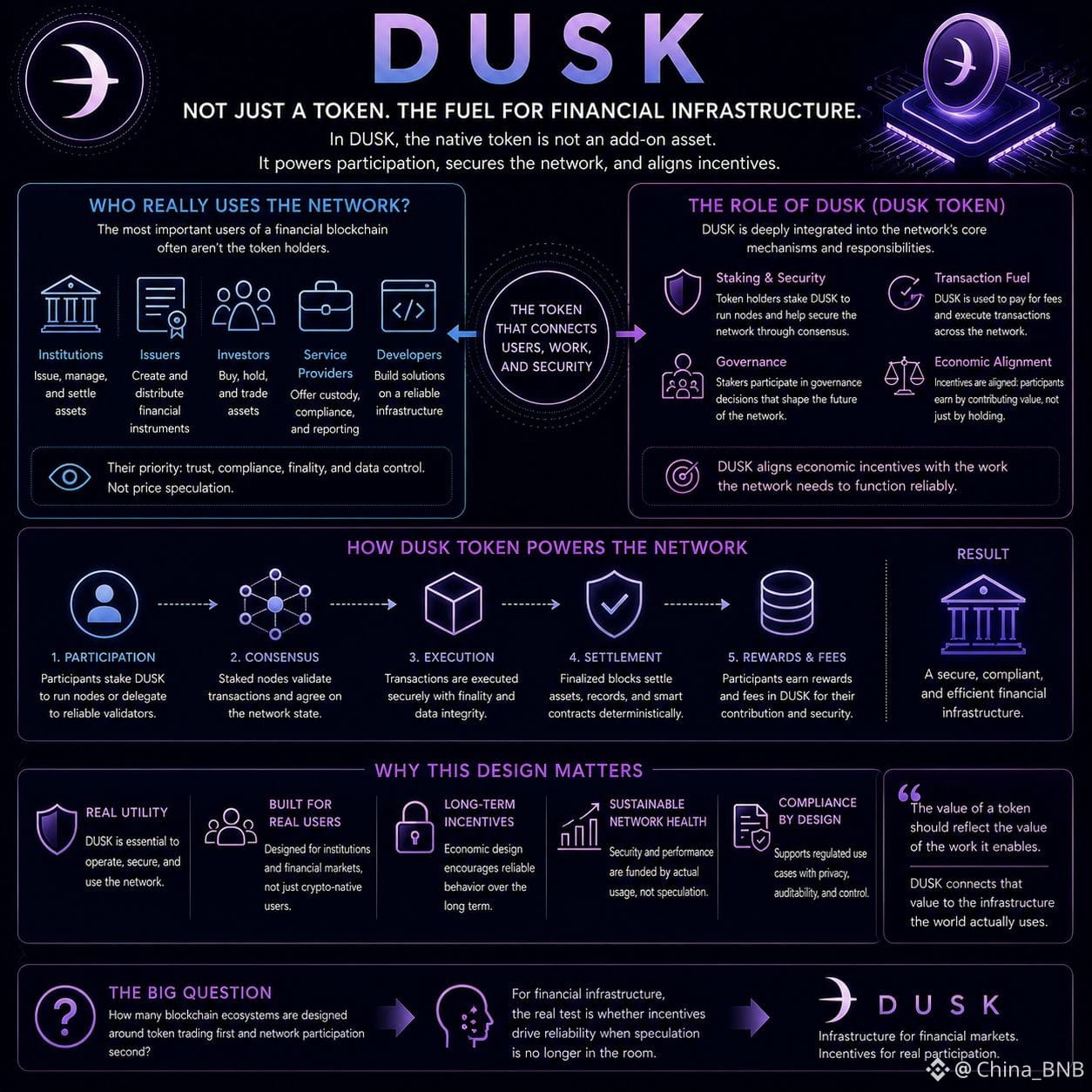
I was exploring DUSK while looking at infrastructure built for financial applications, and that assumption started to feel less convincing. If a network is meant to support serious financial activity, the interesting participants may actually be institutions, issuers, investors, and service providers whose main concern is moving and managing assets rather than speculating on the network itself.
That changes how I think about the role of the underlying token.
In DUSK, the native DUSK token is tied to network participation through staking and transaction activity. What caught my attention was the relationship between using the network and securing it. The token is not merely sitting beside the infrastructure as an unrelated asset; it is connected to the mechanism that keeps participants accountable for their role in the system.
I find that distinction useful because crypto markets often separate “the token” from “the product” when evaluating a project. Sometimes that makes sense. But for infrastructure networks, I think the more interesting question is whether the economic incentives actually correspond with the work the network needs performed.
While researching DUSK, I started wondering how many blockchain ecosystems were designed around token trading first and actual network participation second.
A financial network has to give participants reasons to behave reliably even when speculation disappears from the conversation.
That makes token utility less about creating demand and more about asking whether the asset has a genuine relationship with the system it helps secure.
I’m still curious how that relationship holds up as the network’s users become less crypto-native.
#dusk $DUSK @Dusk
I was exploring DUSK while looking at infrastructure built for financial applications, and that assumption started to feel less convincing. If a network is meant to support serious financial activity, the interesting participants may actually be institutions, issuers, investors, and service providers whose main concern is moving and managing assets rather than speculating on the network itself.
That changes how I think about the role of the underlying token.
In DUSK, the native DUSK token is tied to network participation through staking and transaction activity. What caught my attention was the relationship between using the network and securing it. The token is not merely sitting beside the infrastructure as an unrelated asset; it is connected to the mechanism that keeps participants accountable for their role in the system.
I find that distinction useful because crypto markets often separate “the token” from “the product” when evaluating a project. Sometimes that makes sense. But for infrastructure networks, I think the more interesting question is whether the economic incentives actually correspond with the work the network needs performed.
While researching DUSK, I started wondering how many blockchain ecosystems were designed around token trading first and actual network participation second.
A financial network has to give participants reasons to behave reliably even when speculation disappears from the conversation.
That makes token utility less about creating demand and more about asking whether the asset has a genuine relationship with the system it helps secure.
I’m still curious how that relationship holds up as the network’s users become less crypto-native.
#dusk $DUSK @Dusk