go

نشر

--


VICTORIA _777
·
--
صاعدDusk’s Real Security Test Wasn’t the Cryptography
I went into this thinking I was going to study cryptography.
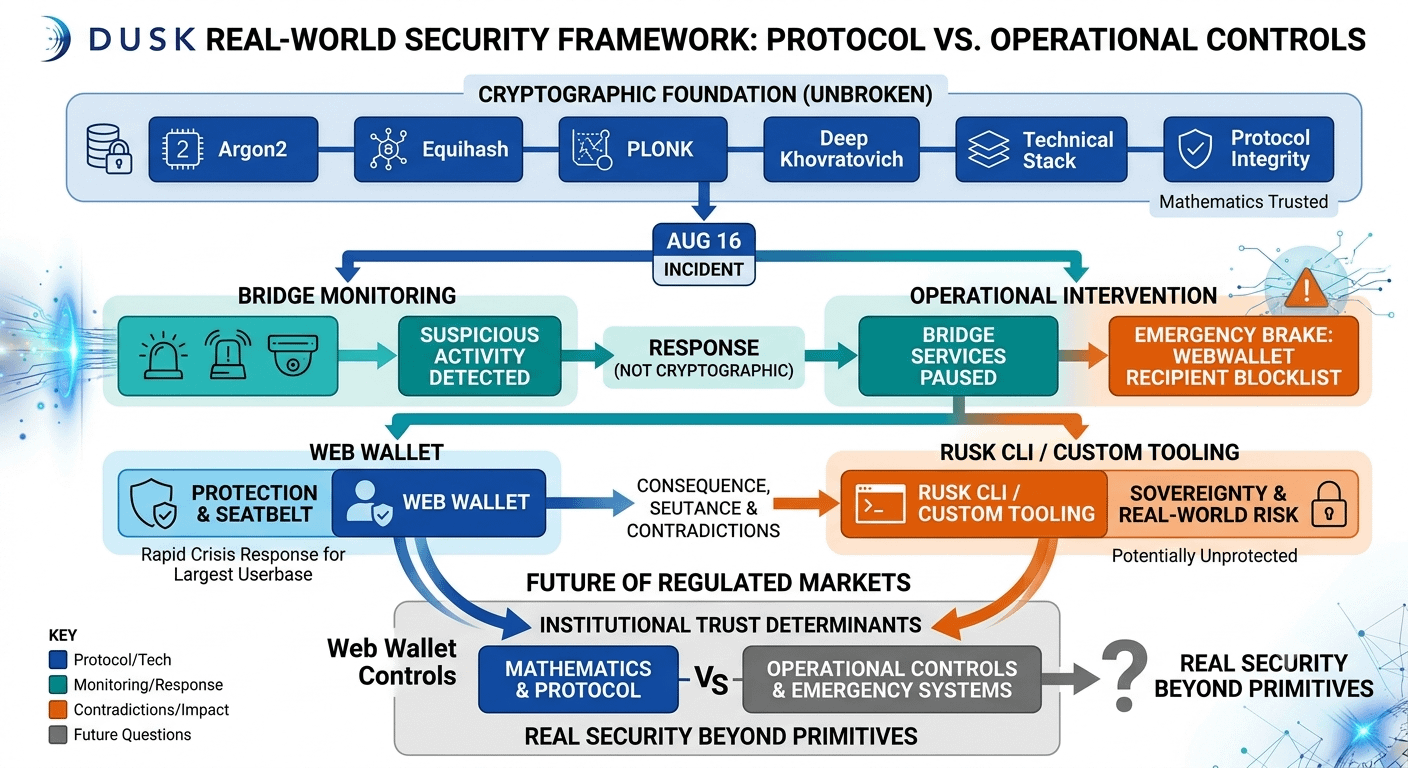
Khovratovich, Argon2, Equihash, PLONK — the kind of stuff that makes you realize how deep Dusk’s technical stack actually goes.
Then I looked at what happened on Aug 16.
And suddenly the most interesting part wasn’t the mathematics.
Bridge services were paused after monitoring detected activity that didn’t fit normal bridge behavior. DuskDS kept producing blocks. There was no protocol-level failure.
The response?
Not a new proof system.
A recipient blocklist in the Web Wallet.
That detail keeps bothering me.
Because it shows where real-world risk actually appears. You can have extremely sophisticated cryptography underneath the chain, but if the user-facing layer is where the attack can reach people, that’s where the emergency brake gets installed.
And it creates a fascinating contradiction.
The Web Wallet gets the seatbelt.
Rusk CLI users and people running their own tooling get sovereignty — but potentially none of that protection.
I’m not saying the approach is wrong. In a crisis, protecting the largest number of users quickly is probably the rational move.
But for a network positioning itself toward regulated markets, I keep coming back to one question:
When institutions arrive, will they trust the mathematics, the protocol, or the operational controls sitting above it?
That answer may matter more than any cryptographic primitive.
@Dusk #DUSK $DUSK
I went into this thinking I was going to study cryptography.
Khovratovich, Argon2, Equihash, PLONK — the kind of stuff that makes you realize how deep Dusk’s technical stack actually goes.
Then I looked at what happened on Aug 16.
And suddenly the most interesting part wasn’t the mathematics.
Bridge services were paused after monitoring detected activity that didn’t fit normal bridge behavior. DuskDS kept producing blocks. There was no protocol-level failure.
The response?
Not a new proof system.
A recipient blocklist in the Web Wallet.
That detail keeps bothering me.
Because it shows where real-world risk actually appears. You can have extremely sophisticated cryptography underneath the chain, but if the user-facing layer is where the attack can reach people, that’s where the emergency brake gets installed.
And it creates a fascinating contradiction.
The Web Wallet gets the seatbelt.
Rusk CLI users and people running their own tooling get sovereignty — but potentially none of that protection.
I’m not saying the approach is wrong. In a crisis, protecting the largest number of users quickly is probably the rational move.
But for a network positioning itself toward regulated markets, I keep coming back to one question:
When institutions arrive, will they trust the mathematics, the protocol, or the operational controls sitting above it?
That answer may matter more than any cryptographic primitive.
@Dusk #DUSK $DUSK
إخلاء مسؤولية: يتضمن آراء جهات خارجية. لا تُعدّ نصيحة. يُمكن استخدام Binance AI دون أي ضمان. اطلع على الشروط والأحكام.