go

نشر

--

Dream Spicer 梦想家
·
--
I’ve been looking at the NPEX × Dusk partnership less from the tokenized securities angle and more from a workflow perspective.
That changes the picture.
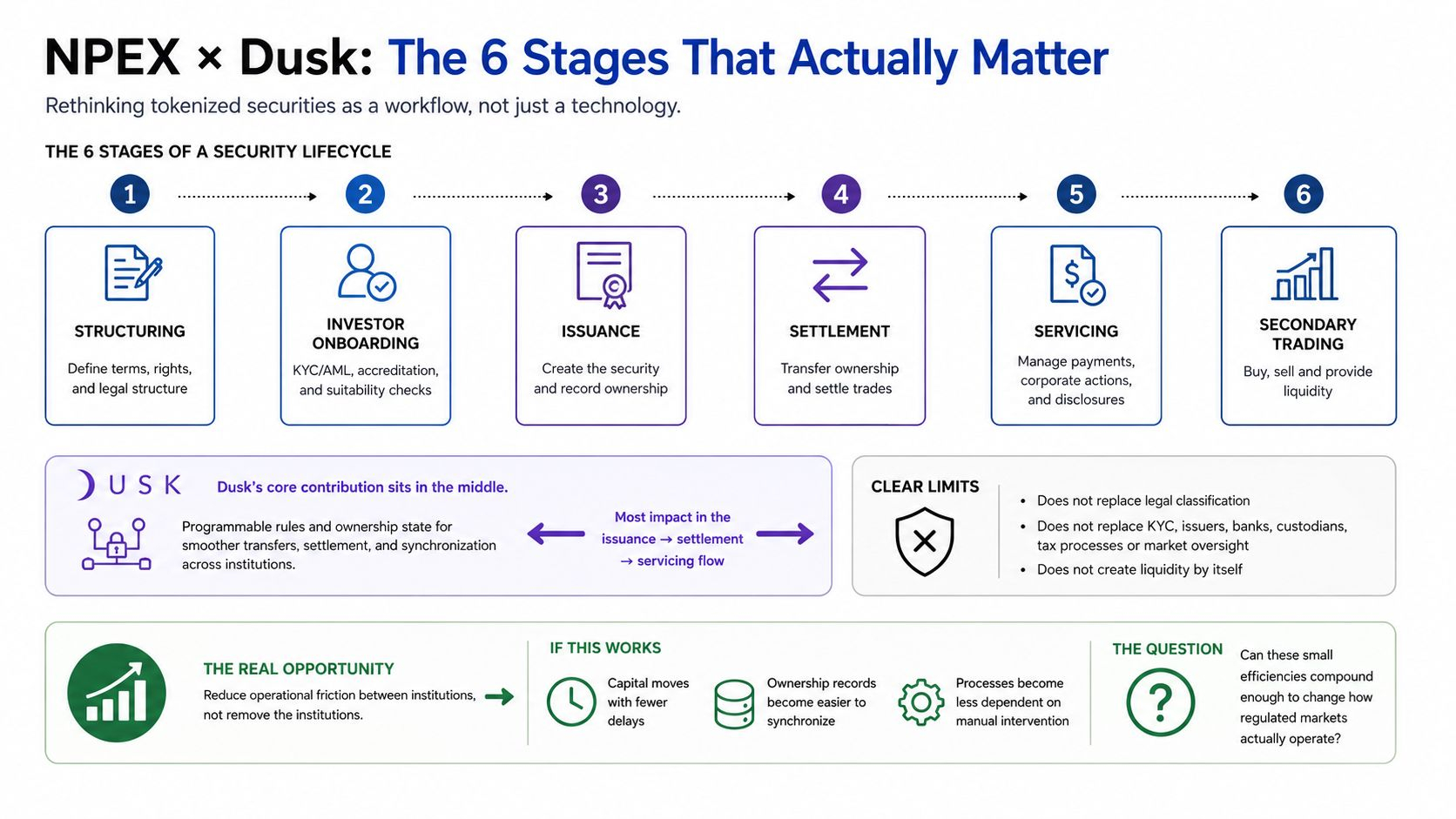
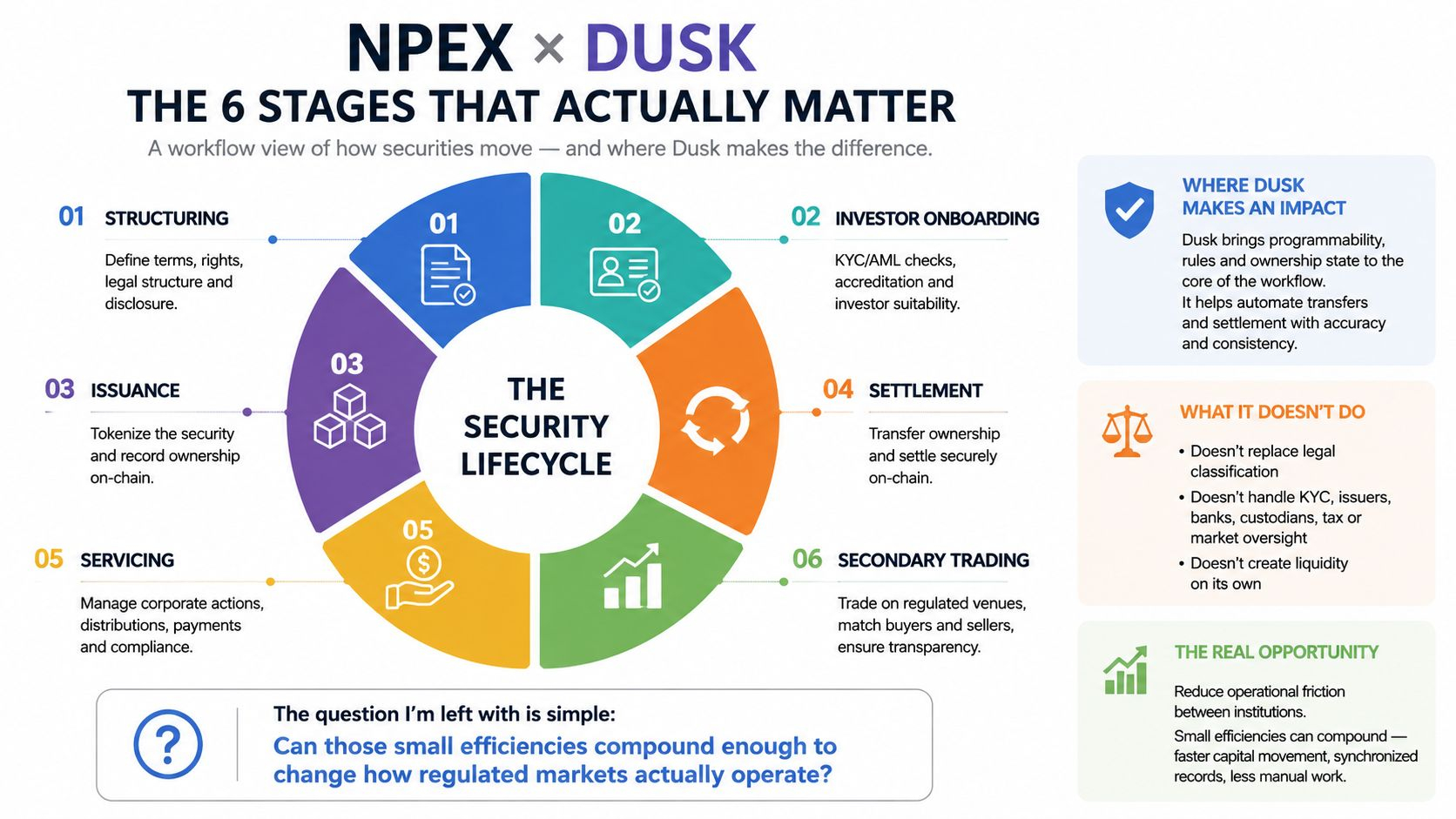
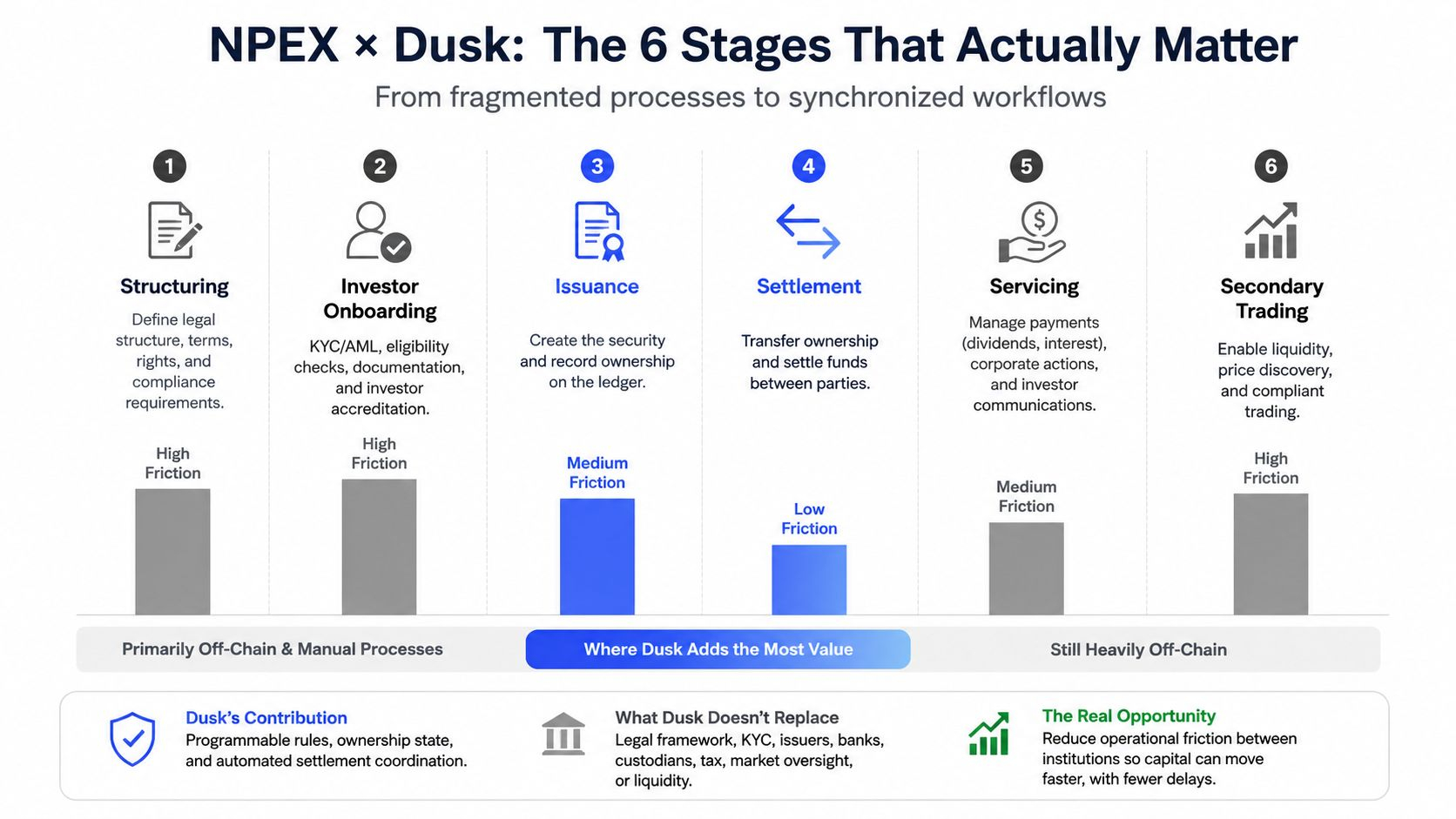
Before $DUSK , a security can move through six separate stages. Structuring, investor onboarding, issuance, settlement, servicing and secondary trading. Each can involve different systems, records and manual reconciliation.
@Dusk ’s contribution is mainly in the middle of that mess. Some rules and ownership state can become programmable, making transfers and settlement easier to coordinate.
But there’s a clear limit.
Dusk doesn’t replace legal classification, KYC, issuers, banks, custodians, tax processes or market oversight. It also can’t create liquidity simply because an asset becomes tokenized.
That distinction is important.
The real opportunity, in my view, is reducing the operational friction between institutions rather than trying to remove the institutions themselves.
If that works, capital could move with fewer delays. Ownership records become easier to synchronize, and certain processes become less dependent on manual intervention.
The question I’m left with is simple.
Can those small efficiencies compound enough to change how regulated markets actually operate?
#dusk #DUSK #Dusk
That changes the picture.
Before $DUSK , a security can move through six separate stages. Structuring, investor onboarding, issuance, settlement, servicing and secondary trading. Each can involve different systems, records and manual reconciliation.
@Dusk ’s contribution is mainly in the middle of that mess. Some rules and ownership state can become programmable, making transfers and settlement easier to coordinate.
But there’s a clear limit.
Dusk doesn’t replace legal classification, KYC, issuers, banks, custodians, tax processes or market oversight. It also can’t create liquidity simply because an asset becomes tokenized.
That distinction is important.
The real opportunity, in my view, is reducing the operational friction between institutions rather than trying to remove the institutions themselves.
If that works, capital could move with fewer delays. Ownership records become easier to synchronize, and certain processes become less dependent on manual intervention.
The question I’m left with is simple.
Can those small efficiencies compound enough to change how regulated markets actually operate?
#dusk #DUSK #Dusk
إخلاء مسؤولية: يتضمن آراء جهات خارجية. لا تُعدّ نصيحة. يُمكن استخدام Binance AI دون أي ضمان. اطلع على الشروط والأحكام.