I was thinking about something while reading through Dusk’s privacy design:
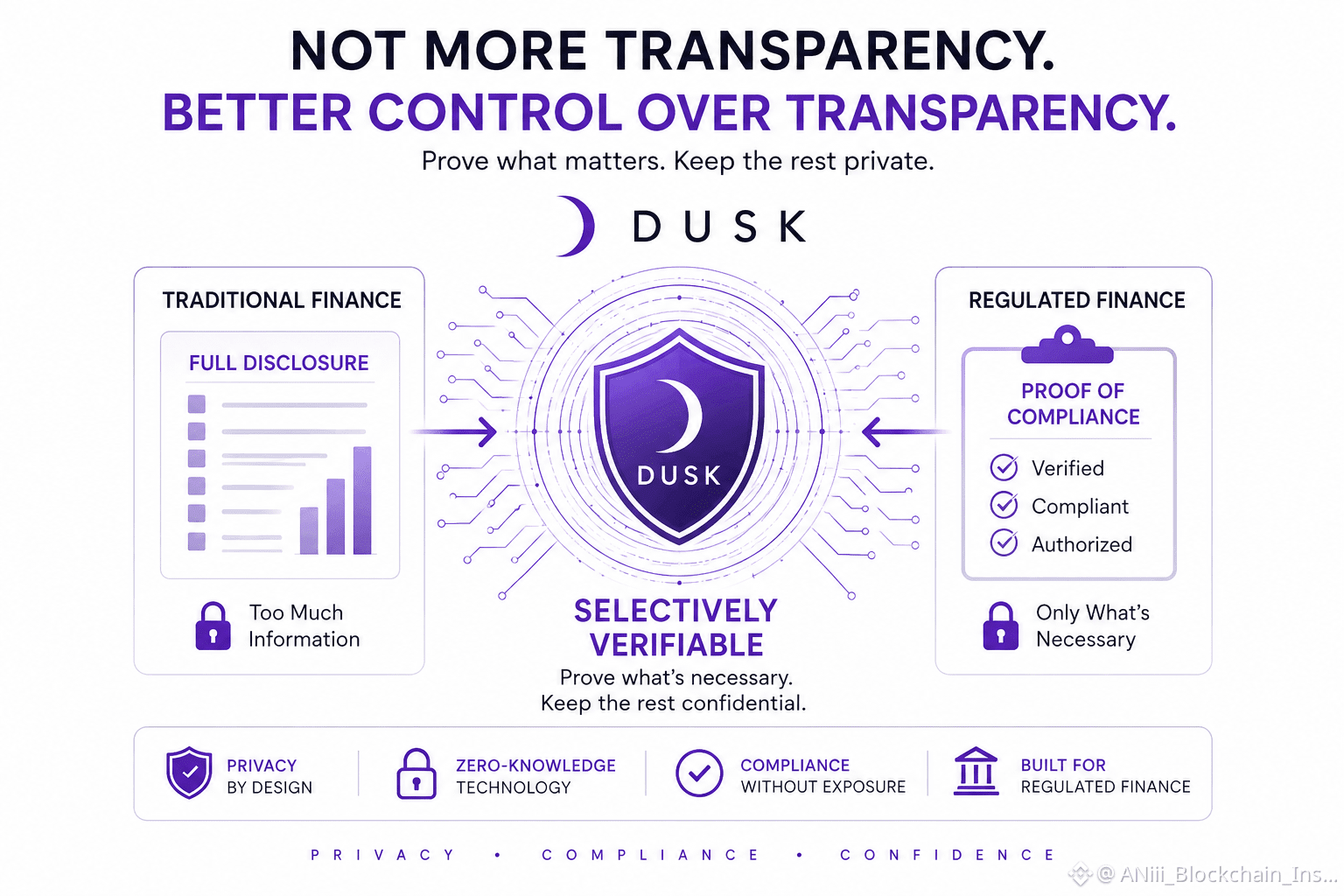
What if the future of finance doesn’t need more transparency, but better control over transparency?
On a public blockchain, making information visible is often the easiest way to make it verifiable.
But financial markets don’t work that way.
A company may need to prove that a transaction follows certain rules without exposing its entire financial position. An investor may need to demonstrate eligibility without making every piece of personal information public.
That creates an interesting middle ground.
Not completely public.
Not completely hidden.
Selectively verifiable.
This is where Dusk’s privacy approach becomes interesting to me. Its use of zero-knowledge technology and controlled disclosure is built around the idea that information can remain confidential while still allowing relevant facts to be verified when necessary.
The more I think about it, the more I see privacy differently.
Privacy isn’t necessarily about preventing anyone from knowing anything.
It can be about giving the right party enough information to verify something — and nothing more.
For regulated finance, that distinction could matter enormously.
Maybe the next generation of financial blockchains won’t compete over who can reveal the most data.
Maybe they’ll compete over who can prove the most while exposing the least.
That’s the Dusk thesis I’m watching.
👀 $GRASS & $UAI already had their run — I’m watching only $DUSK now. 🚀🏆
#dusk @Dusk
What if the future of finance doesn’t need more transparency, but better control over transparency?
On a public blockchain, making information visible is often the easiest way to make it verifiable.
But financial markets don’t work that way.
A company may need to prove that a transaction follows certain rules without exposing its entire financial position. An investor may need to demonstrate eligibility without making every piece of personal information public.
That creates an interesting middle ground.
Not completely public.
Not completely hidden.
Selectively verifiable.
This is where Dusk’s privacy approach becomes interesting to me. Its use of zero-knowledge technology and controlled disclosure is built around the idea that information can remain confidential while still allowing relevant facts to be verified when necessary.
The more I think about it, the more I see privacy differently.
Privacy isn’t necessarily about preventing anyone from knowing anything.
It can be about giving the right party enough information to verify something — and nothing more.
For regulated finance, that distinction could matter enormously.
Maybe the next generation of financial blockchains won’t compete over who can reveal the most data.
Maybe they’ll compete over who can prove the most while exposing the least.
That’s the Dusk thesis I’m watching.
👀 $GRASS & $UAI already had their run — I’m watching only $DUSK now. 🚀🏆
#dusk @Dusk