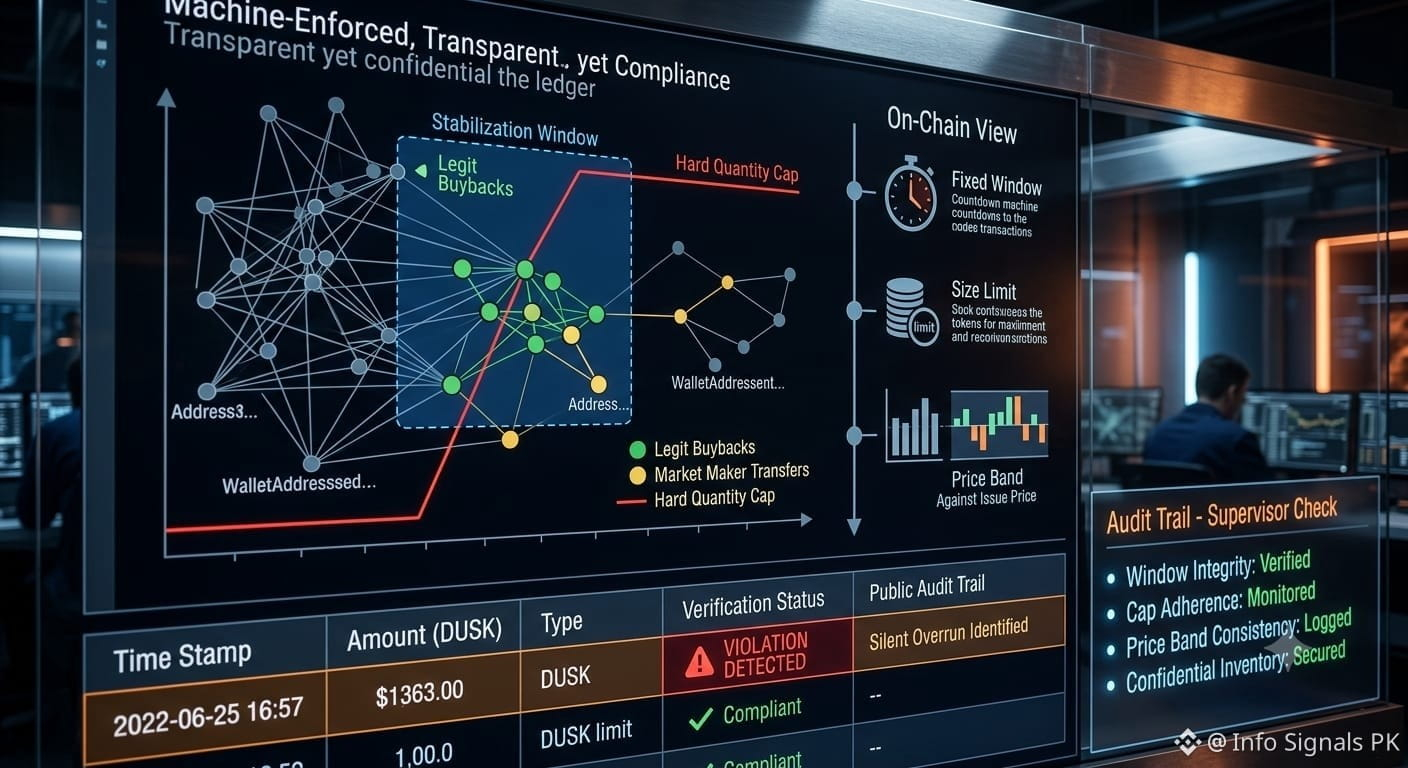
$DUSK Stabilization after a listing is a tight privilege: a fixed window, a hard quantity cap, and a price band against the issue price. On-chain those same moves just look like ordinary transfers unless the scenario itself lives as protocol state.
Without a tagged, auto-expiring context—window, size limit, band—$DUSK’s confidential transfers make legitimate buybacks look identical to insider allocation. Regulators can’t audit what was never recorded as state. Inventory has to stay confidential, but non-breach has to be verifiable. Go over the limit and the transaction should fail in the open. Silent overruns are worse than a public failure.
If that window doesn’t close on its own it quietly turns into standing privilege. Market-making duty and preferential transfers cannot share the same key. Once they do, the stricter reading is the only one that survives scrutiny—and by then it’s already too late. $SPK
Moving trades on-chain is not coverage. Coverage only exists when the window, the cap and the band are actually enforced and leave a trail supervisors can check, not the whole market. Keep the inventory private. Make the violation visible. Short, hard, machine-enforced. That’s the real line between regulated issuance and a ledger full of plausible deniability.
#dusk @Dusk $TUT
Without a tagged, auto-expiring context—window, size limit, band—$DUSK’s confidential transfers make legitimate buybacks look identical to insider allocation. Regulators can’t audit what was never recorded as state. Inventory has to stay confidential, but non-breach has to be verifiable. Go over the limit and the transaction should fail in the open. Silent overruns are worse than a public failure.
If that window doesn’t close on its own it quietly turns into standing privilege. Market-making duty and preferential transfers cannot share the same key. Once they do, the stricter reading is the only one that survives scrutiny—and by then it’s already too late. $SPK
Moving trades on-chain is not coverage. Coverage only exists when the window, the cap and the band are actually enforced and leave a trail supervisors can check, not the whole market. Keep the inventory private. Make the violation visible. Short, hard, machine-enforced. That’s the real line between regulated issuance and a ledger full of plausible deniability.
#dusk @Dusk $TUT