#dusk $DUSK @Dusk
I keep looking at how networks force a rigid choice between total transparency and complete opacity
What caught my attention is how @Dusk bypasses this design bottleneck at the settlement layer. Instead of imposing a single execution rule the protocol integrates a native dual transaction framework on DuskDS.
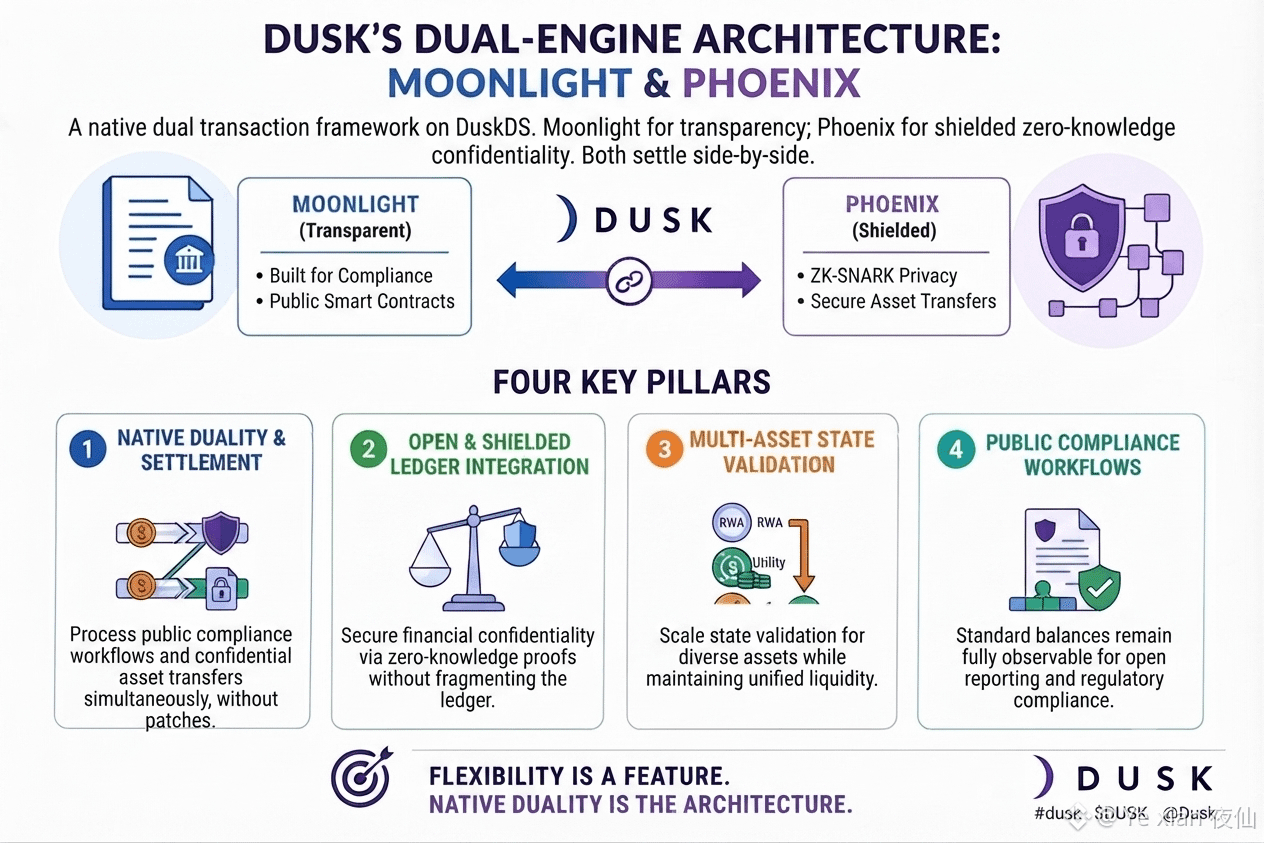
Moonlight operates as a transparent account-based system where standard balances remain fully observable for open reporting. and Phoenix uses a shielded UTXO model with zero-knowledge proofs to keep transactions private while staying on the same underlying ledger
The architectural advantage here is profound. Rather than treating privacy as an external patch both paradigms settle directly side-by-side. This native duality allows applications to coordinate public compliance workflows and confidential asset transfers simultaneously, all secured natively by $DUSK
The question is how can multi-asset settlement layers scale state validation without creating liquidity silos?
@Dusk #dusk $DUSK
I keep looking at how networks force a rigid choice between total transparency and complete opacity
What caught my attention is how @Dusk bypasses this design bottleneck at the settlement layer. Instead of imposing a single execution rule the protocol integrates a native dual transaction framework on DuskDS.
Moonlight operates as a transparent account-based system where standard balances remain fully observable for open reporting. and Phoenix uses a shielded UTXO model with zero-knowledge proofs to keep transactions private while staying on the same underlying ledger
The architectural advantage here is profound. Rather than treating privacy as an external patch both paradigms settle directly side-by-side. This native duality allows applications to coordinate public compliance workflows and confidential asset transfers simultaneously, all secured natively by $DUSK
The question is how can multi-asset settlement layers scale state validation without creating liquidity silos?
@Dusk #dusk $DUSK