
Almost skipped past it in the changelog: zero runtime dependencies. Buried under bigger headlines about the SDK launch.
Easy read: Dusk Connect just makes wallet hookup easier for developers. Fine, that's the pitch lightweight SDK, plug it in, done.
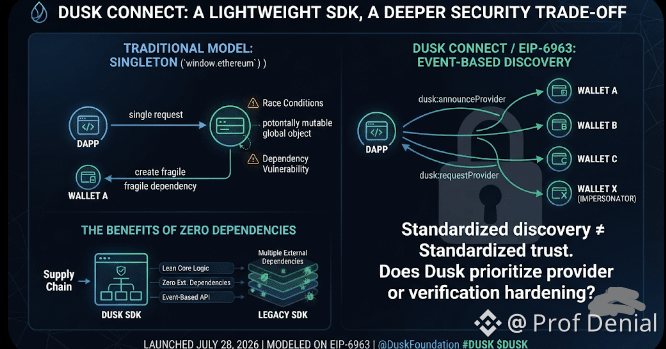
Sit with it a bit longer and it's really about who owns the connection layer. Dusk uses an event-based discovery pattern `dusk:announceProvider`, `dusk:requestProvider` modeled directly on Ethereum's EIP-6963. Instead of a dApp hardcoding around one wallet, it broadcasts a request and lets every compatible wallet answer. The dApp never has to know which wallet wins.
Here's what gets glossed over: standardizing discovery doesn't standardize trust. Any extension can listen for that request event and announce itself as a provider. EIP-6963 solved Ethereum's old window.ethereum race condition, but it didn't solve wallet impersonation it just moved the burden of verifying which providers are legitimate onto the user, one connection prompt at a time.
Same tradeoff shows up in traditional finance. Open banking APIs standardized how third-party apps request account access, but a standardized request format never guaranteed the requester was safe banks still layer on separate consent and verification screens for exactly that reason.
My first instinct was that zero dependencies just meant a leaner install. It's more than that fewer dependencies also means fewer places for a supply-chain compromise to hide, and fewer excuses if one slips through anyway.
Would you rather see Dusk focus next on more wallet providers adopting this, or on hardening how dApps verify which provider they're actually talking to?
@Dusk #dusk $DUSK
Easy read: Dusk Connect just makes wallet hookup easier for developers. Fine, that's the pitch lightweight SDK, plug it in, done.
Sit with it a bit longer and it's really about who owns the connection layer. Dusk uses an event-based discovery pattern `dusk:announceProvider`, `dusk:requestProvider` modeled directly on Ethereum's EIP-6963. Instead of a dApp hardcoding around one wallet, it broadcasts a request and lets every compatible wallet answer. The dApp never has to know which wallet wins.
Here's what gets glossed over: standardizing discovery doesn't standardize trust. Any extension can listen for that request event and announce itself as a provider. EIP-6963 solved Ethereum's old window.ethereum race condition, but it didn't solve wallet impersonation it just moved the burden of verifying which providers are legitimate onto the user, one connection prompt at a time.
Same tradeoff shows up in traditional finance. Open banking APIs standardized how third-party apps request account access, but a standardized request format never guaranteed the requester was safe banks still layer on separate consent and verification screens for exactly that reason.
My first instinct was that zero dependencies just meant a leaner install. It's more than that fewer dependencies also means fewer places for a supply-chain compromise to hide, and fewer excuses if one slips through anyway.
Would you rather see Dusk focus next on more wallet providers adopting this, or on hardening how dApps verify which provider they're actually talking to?
@Dusk #dusk $DUSK