
I went back through the $DUSK documentation last night, and I had to slow down because there is more going on than the basic idea of a privacy-focused blockchain.
What caught my attention was how the protocol separates different parts of the transaction flow and tries to keep sensitive information away from public visibility while still allowing the network to verify what happened. The documentation also made me think more carefully about where the real trust assumptions sit.
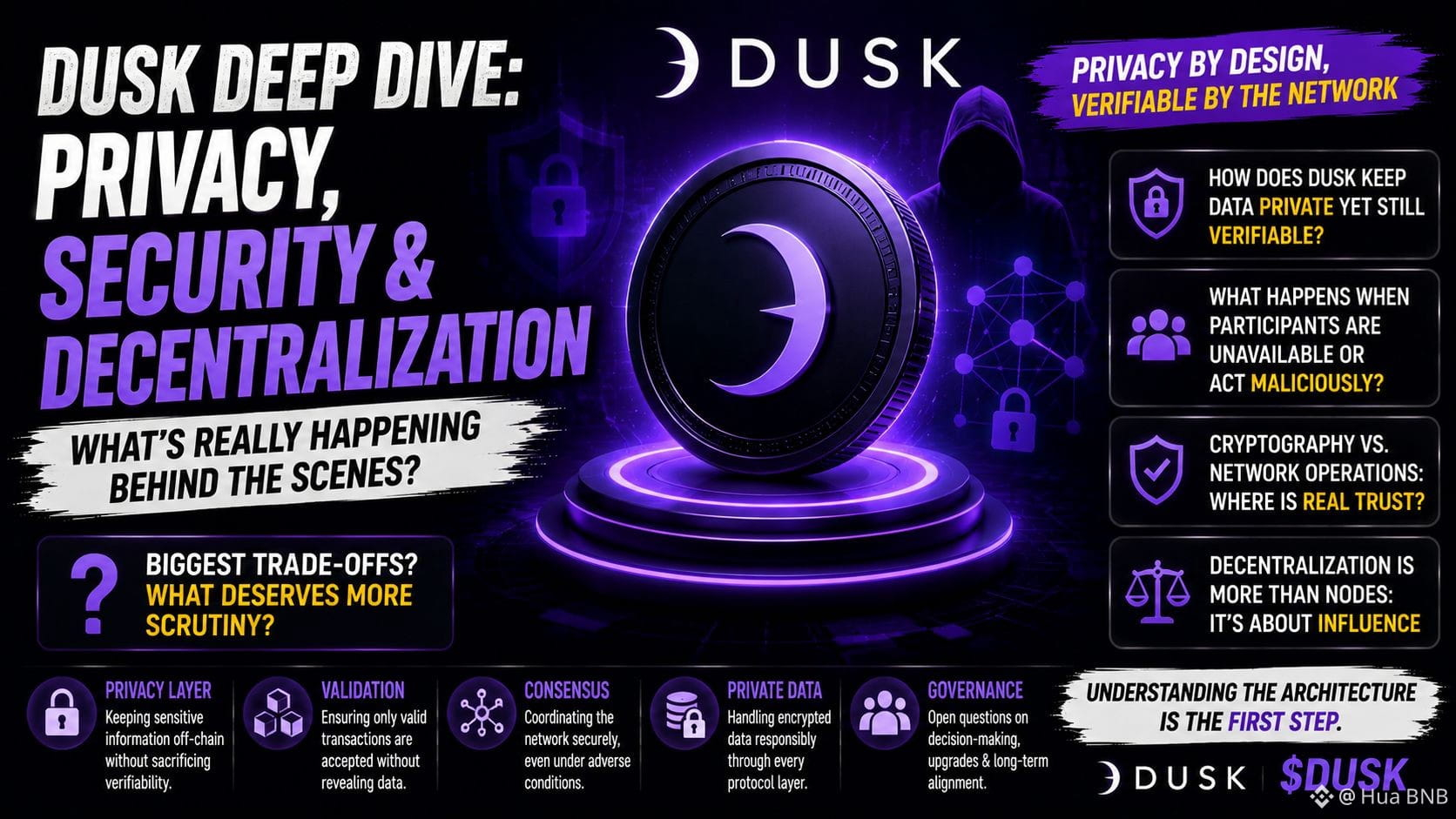
One thing I’m still trying to understand is how these privacy mechanisms behave under different network conditions. What happens if some participants are unavailable or act maliciously? How much of the system’s security depends on cryptographic assumptions versus the way the network is actually operated?
I also noticed the importance of the protocol’s design around validation, consensus and the handling of private data. My interpretation is that decentralization is not just about having many nodes; it also depends on how much influence different participants can realistically have.
I couldn’t find a clear answer to every question, so I’m not treating my reading as a final conclusion.
For those who have studied Dusk more deeply: where do you see the biggest security or governance trade-off? And which part of the architecture deserves more scrutiny?
#dusk $DUSK @Dusk
What caught my attention was how the protocol separates different parts of the transaction flow and tries to keep sensitive information away from public visibility while still allowing the network to verify what happened. The documentation also made me think more carefully about where the real trust assumptions sit.
One thing I’m still trying to understand is how these privacy mechanisms behave under different network conditions. What happens if some participants are unavailable or act maliciously? How much of the system’s security depends on cryptographic assumptions versus the way the network is actually operated?
I also noticed the importance of the protocol’s design around validation, consensus and the handling of private data. My interpretation is that decentralization is not just about having many nodes; it also depends on how much influence different participants can realistically have.
I couldn’t find a clear answer to every question, so I’m not treating my reading as a final conclusion.
For those who have studied Dusk more deeply: where do you see the biggest security or governance trade-off? And which part of the architecture deserves more scrutiny?
#dusk $DUSK @Dusk