#dusk $DUSK @Dusk
**Why Dusk's Confidentiality Bet Is Harder to Pull Off Than It Looks**
I keep coming back to a simple question when I look at Dusk Network: can you actually build regulated finance on top of a system where nobody can see the transactions? That's the tension Dusk is trying to resolve, and it's more structurally interesting than most "privacy coin" narratives give it credit for.
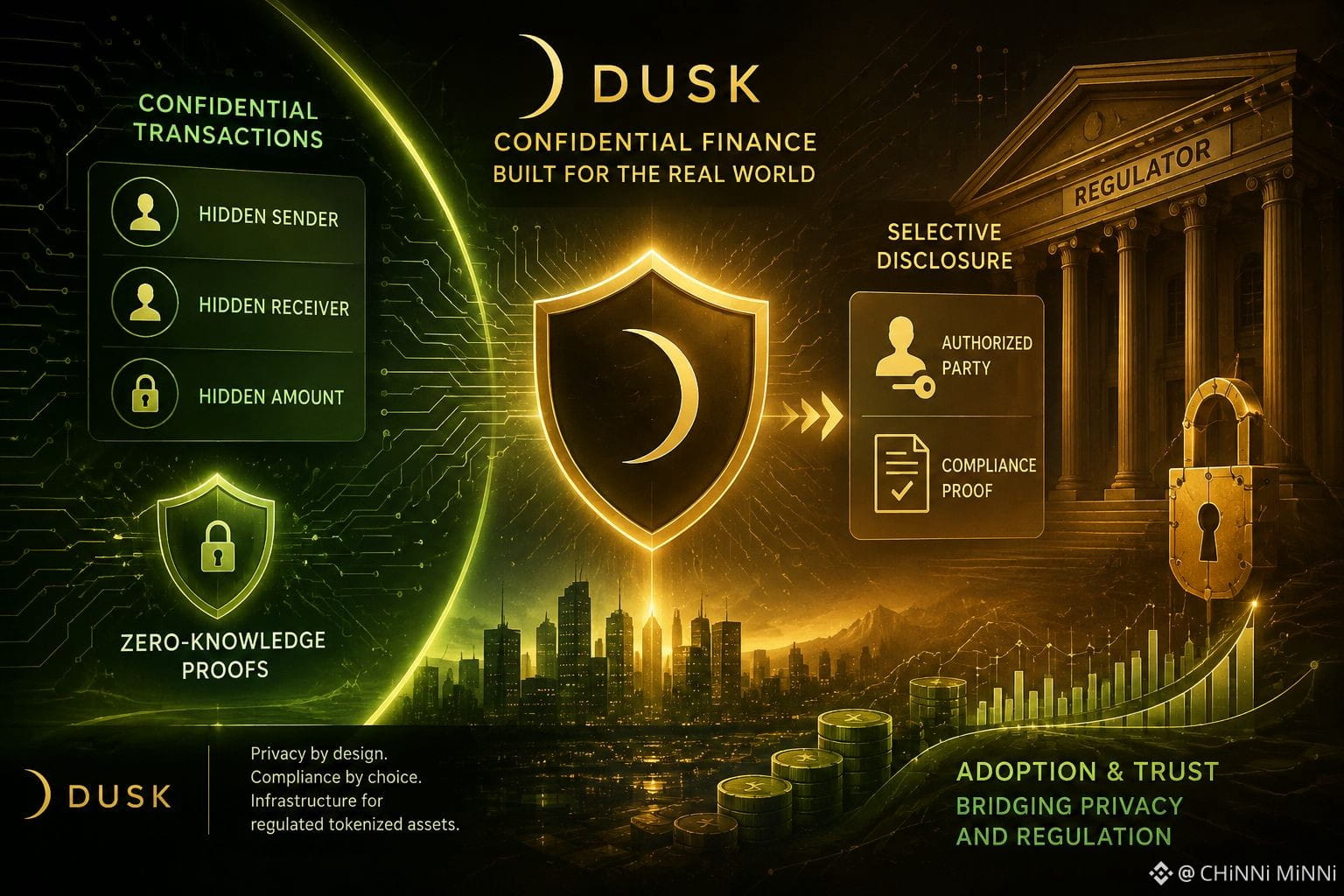
Zero-knowledge proofs, at their core, let one party prove a statement is true without revealing the underlying data. I know the amount sent is valid, I know the sender had sufficient balance, but you don't get to see either. Dusk applies this to confidential transactions through its own proof system, hiding sender, receiver, and amount while still allowing the network to verify correctness.
What makes this a genuine trade-off rather than a pure win is auditability. Regulated securities need selective disclosure, someone with the right key must be able to prove compliance to a regulator without exposing everything to the public. Dusk's architecture leans into this, but it also means the privacy guarantee is conditional, not absolute, which is a different promise than most ZK-privacy projects make.
The real risk isn't cryptographic, it's adoption timing. Building infrastructure for regulated tokenized assets means Dusk's usage curve depends on institutional and legal readiness, not retail speculation. That's a slower, less forgiving path, and it's worth watching whether the technology outpaces the market it was built for.
**Why Dusk's Confidentiality Bet Is Harder to Pull Off Than It Looks**
I keep coming back to a simple question when I look at Dusk Network: can you actually build regulated finance on top of a system where nobody can see the transactions? That's the tension Dusk is trying to resolve, and it's more structurally interesting than most "privacy coin" narratives give it credit for.
Zero-knowledge proofs, at their core, let one party prove a statement is true without revealing the underlying data. I know the amount sent is valid, I know the sender had sufficient balance, but you don't get to see either. Dusk applies this to confidential transactions through its own proof system, hiding sender, receiver, and amount while still allowing the network to verify correctness.
What makes this a genuine trade-off rather than a pure win is auditability. Regulated securities need selective disclosure, someone with the right key must be able to prove compliance to a regulator without exposing everything to the public. Dusk's architecture leans into this, but it also means the privacy guarantee is conditional, not absolute, which is a different promise than most ZK-privacy projects make.
The real risk isn't cryptographic, it's adoption timing. Building infrastructure for regulated tokenized assets means Dusk's usage curve depends on institutional and legal readiness, not retail speculation. That's a slower, less forgiving path, and it's worth watching whether the technology outpaces the market it was built for.