
I’ve been looking at $DUSK lately.
And the more interesting question isn’t simply, “Can a blockchain hide transactions?”
It’s how much financial information should actually be public?
Public blockchains make verification easy because everyone can see the data. But for institutions, that can expose balances, positions, counterparties and trading strategies that were never meant to be public.
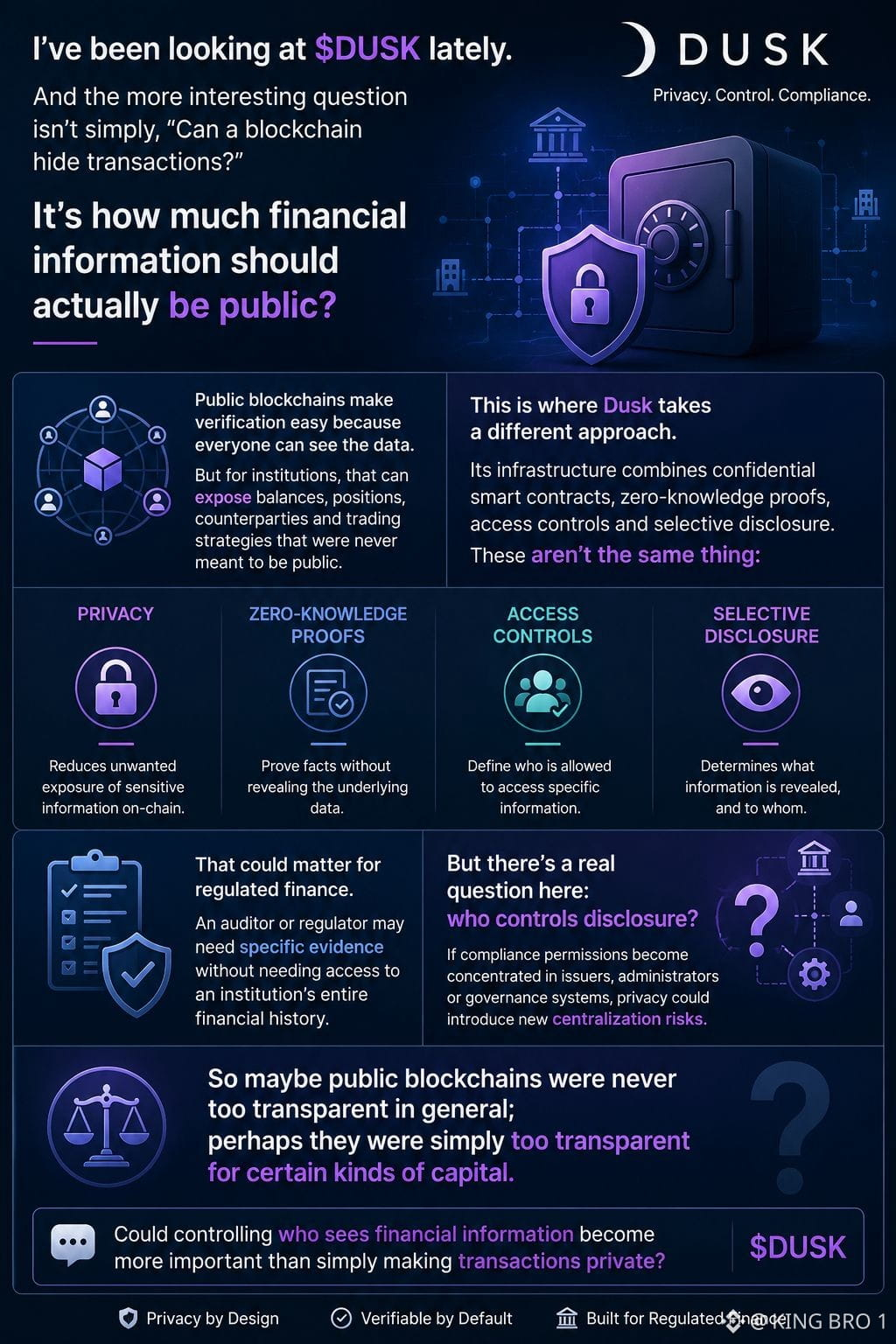
This is where Dusk takes a different approach. Its infrastructure combines confidential smart contracts, zero-knowledge proofs, access controls and selective disclosure. These aren’t the same thing: privacy reduces unwanted exposure, ZK proofs can prove facts without revealing underlying data, while selective disclosure determines what information is revealed, and to whom.
That could matter for regulated finance. An auditor or regulator may need specific evidence without needing access to an institution’s entire financial history.
But there’s a real question here: who controls disclosure?
If compliance permissions become concentrated in issuers, administrators or governance systems, privacy could introduce new centralization risks.
So maybe public blockchains were never too transparent in general; perhaps they were simply too transparent for certain kinds of capital.
Could controlling who sees financial information become more important than simply making transactions private?
@Dusk #dusk $DUSK
And the more interesting question isn’t simply, “Can a blockchain hide transactions?”
It’s how much financial information should actually be public?
Public blockchains make verification easy because everyone can see the data. But for institutions, that can expose balances, positions, counterparties and trading strategies that were never meant to be public.
This is where Dusk takes a different approach. Its infrastructure combines confidential smart contracts, zero-knowledge proofs, access controls and selective disclosure. These aren’t the same thing: privacy reduces unwanted exposure, ZK proofs can prove facts without revealing underlying data, while selective disclosure determines what information is revealed, and to whom.
That could matter for regulated finance. An auditor or regulator may need specific evidence without needing access to an institution’s entire financial history.
But there’s a real question here: who controls disclosure?
If compliance permissions become concentrated in issuers, administrators or governance systems, privacy could introduce new centralization risks.
So maybe public blockchains were never too transparent in general; perhaps they were simply too transparent for certain kinds of capital.
Could controlling who sees financial information become more important than simply making transactions private?
@Dusk #dusk $DUSK