
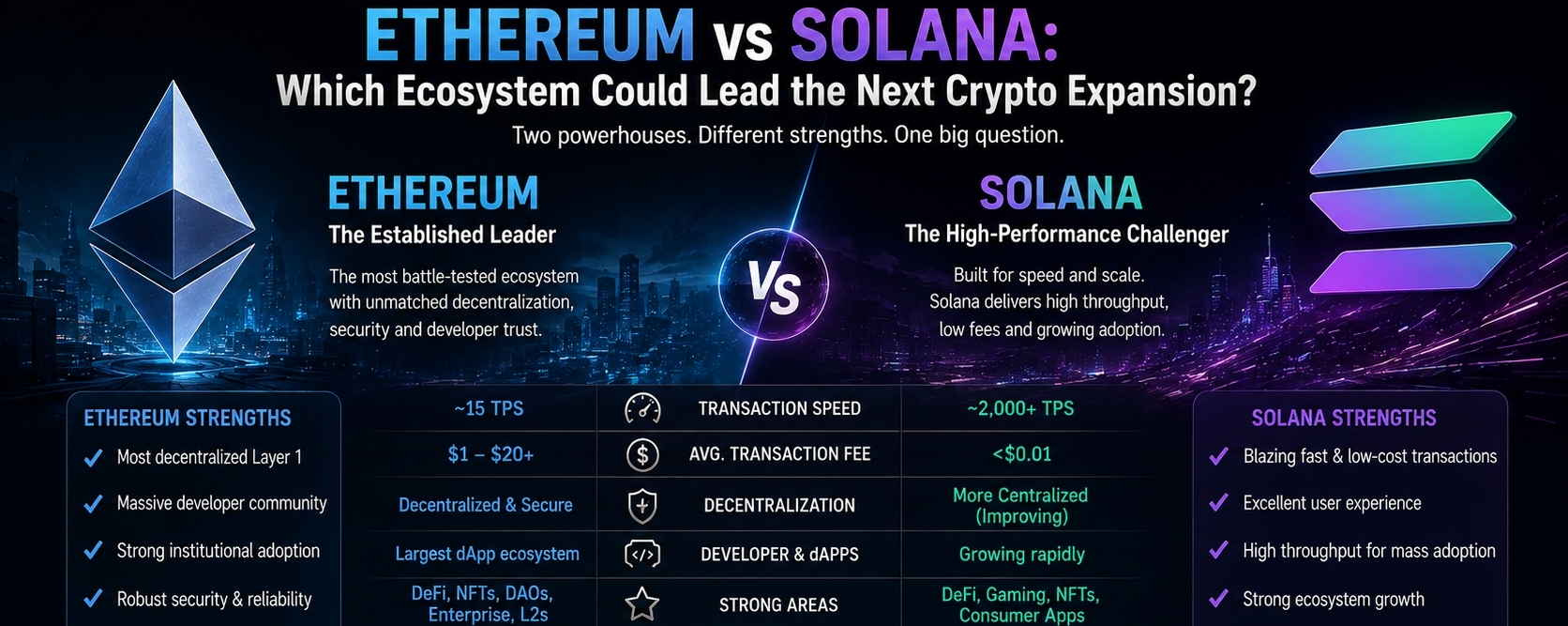

Ethereum and Solana are becoming two of the most important ecosystems to watch as the crypto market enters its next phase.
Ethereum remains the heavyweight of decentralized finance, with deep liquidity, a huge developer ecosystem and years of infrastructure behind it. Solana, meanwhile, has built its reputation around speed, low transaction costs and a smoother experience for high-frequency on-chain activity.
The interesting question is no longer simply which blockchain is “better.”
It is which ecosystem is better positioned to capture the next major wave of crypto users, developers and capital?
Ethereum Still Has the Financial Depth
Ethereum's biggest advantage is its established financial ecosystem.
For years, Ethereum has been the foundation for DeFi applications involving decentralized exchanges, lending, stablecoins, staking and other on-chain financial products. That history has created deep liquidity and a large network of developers, protocols and infrastructure providers.
Ethereum is also increasingly positioning itself as a settlement layer for a much larger network of Layer 2 blockchains.
The Ethereum Foundation's 2026 strategy focuses heavily on scaling both the base layer and blob capacity while improving the overall user experience. Its longer-term vision combines a stronger Ethereum L1 with an expanding ecosystem of interoperable L2 networks.
This approach could allow Ethereum to handle significantly more activity without abandoning the security and decentralization that made it attractive in the first place.
Solana Is Competing With a Different Strategy
Solana approaches scaling very differently.
Instead of relying primarily on a large collection of Layer 2 networks, Solana focuses on providing fast and inexpensive execution through its main ecosystem.
That can make the experience simpler for users.
Someone trading, sending stablecoins or interacting with an application can often complete many transactions without worrying much about transaction costs.
This advantage becomes especially important for applications that require users to interact constantly.
On-chain trading, payments, gaming and consumer applications can benefit from an environment where individual transactions are inexpensive and fast.
That is one reason Solana has become a serious competitor rather than simply another alternative Layer 1.
Ethereum Has Capital, Solana Has Activity
One of the most interesting differences between the ecosystems can be seen in DeFi.
Ethereum continues to hold substantially more capital in decentralized finance, while Solana has become highly competitive in decentralized-exchange activity. Estimates vary depending on whether Ethereum Layer 2 networks are included and when measurements are taken, but the broader pattern remains clear: Ethereum leads in financial depth, while Solana punches above its weight in trading activity.
That creates two very different strengths.
Ethereum can attract applications where deep liquidity, security and large amounts of capital matter most.
Solana can excel where users want to make many fast, inexpensive transactions.
The next crypto expansion could reward both models.
Ethereum's Layer 2 Strategy Is Getting Stronger
Ethereum's biggest weakness historically has been its cost and limited base-layer capacity during periods of heavy demand.
Layer 2 networks are designed to address that problem.
Rollups process transactions away from Ethereum's main chain before settling their results back to Ethereum. According to Ethereum's official scaling roadmap, current rollups can already make transactions significantly cheaper than using Ethereum L1 directly.
Ethereum is also continuing to improve the base layer itself.
Its upcoming Glamsterdam upgrade, currently planned for Q4 2026, focuses partly on increasing Ethereum's ability to process transactions and manage its growing state more efficiently.
If Ethereum can combine cheaper L2 activity with a more powerful base layer, one of Solana's biggest competitive advantages could become less dramatic.
But Ethereum Has a Complexity Problem
Scaling through multiple networks creates another challenge: fragmentation.
Users may encounter different Layer 2 networks, bridges, liquidity pools and applications. Moving assets between these environments can make the experience more complicated than simply interacting with one network.
Ethereum developers are aware of this issue.
The Ethereum Foundation has explicitly emphasized creating a more cohesive L1-and-L2 ecosystem where users and institutions can navigate Ethereum more easily.
Solana's more unified architecture can feel simpler by comparison.
For mainstream adoption, that simplicity could matter enormously.
Solana Could Be Strong in Consumer Crypto
Crypto's next major growth phase may not come entirely from DeFi.
It could come from applications where millions of people use blockchain technology without constantly thinking about the blockchain underneath.
Payments, social applications, gaming, digital assets and other consumer products could become important battlegrounds.
This is where Solana's speed and inexpensive transactions become particularly attractive.
A consumer application potentially needs thousands or millions of small interactions. High transaction costs would make many of those experiences impractical.
Solana's architecture is built around handling that type of high-frequency activity.
That gives it a potentially powerful position if consumer-facing crypto applications become one of the next major narratives.
Stablecoins Could Become a Huge Battlefield
Stablecoins may ultimately become more important than many speculative crypto narratives.
They can be used for payments, trading, savings, international transfers and settlement.
Ethereum currently has the deeper stablecoin base, supported by its large DeFi ecosystem. Solana, however, has become increasingly competitive for high-frequency stablecoin transfers because of its speed and low costs.
This creates an interesting competition.
Ethereum may continue dominating where large amounts of capital need deep liquidity and established financial infrastructure.
Solana could capture more everyday transaction activity if stablecoins increasingly become a payment technology.
The winner may depend on how people actually use stablecoins over the next several years.
Developers Could Decide the Long-Term Winner
Market prices attract attention, but developers build ecosystems.
Every successful blockchain needs people creating wallets, exchanges, lending platforms, games, payment systems and other applications.
Ethereum has a major advantage here because of the enormous EVM ecosystem. Solidity developers can build across Ethereum and numerous compatible networks using mature development tools.
Solana uses a different development environment centered heavily around Rust and the Solana Virtual Machine.
That creates a separate ecosystem, but one that has matured significantly. Developer-focused comparisons in 2026 increasingly treat Solana as an established DeFi environment rather than an experimental Ethereum competitor.
If both developer communities continue expanding, crypto may increasingly develop around two major technical ecosystems rather than one dominant platform.
Institutional Adoption Favors Ethereum — For Now
Ethereum has another important advantage: familiarity.
Large investors and financial institutions have had years to understand Ethereum. Its established DeFi infrastructure and role as a settlement network give it credibility for financial applications.
That matters as tokenization and blockchain-based financial products continue developing.
Ethereum's security-first approach could remain particularly attractive when very large amounts of value are involved.
Solana, however, is increasingly trying to compete for the same market.
If its ecosystem continues proving that high-speed infrastructure can remain reliable while supporting serious financial applications, institutional adoption could become another area where the gap narrows.
Solana's Biggest Advantage Is User Experience
The average crypto user does not necessarily care about blockchain architecture.
They care whether something works.
Transactions should be fast. Fees should be inexpensive. Applications should feel simple.
Solana has built much of its growth around those characteristics.
This can create a powerful network effect. More activity attracts developers. More developers create applications. Better applications attract more users, which can bring even more liquidity into the ecosystem.
If the next crypto expansion is driven primarily by everyday users rather than large financial institutions, Solana could be extremely well positioned.
Ethereum's Biggest Advantage Is Its Network Effect
Ethereum's strength is difficult to replicate.
Years of development have created an enormous network of protocols, liquidity, developers, wallets and infrastructure.
New projects can connect with existing Ethereum applications rather than building everything from scratch.
Ethereum's Layer 2 strategy also means it does not necessarily have to compete with Solana purely on L1 transaction speed.
Instead, Ethereum is trying to become a broader platform where multiple specialized networks operate while ultimately benefiting from Ethereum's underlying infrastructure.
If that strategy succeeds, Ethereum could become less like a single blockchain and more like an interconnected blockchain economy.
The Next Expansion May Not Have One Winner
The Ethereum-versus-Solana debate often assumes that one ecosystem must defeat the other.
Reality could be very different.
Ethereum appears strongest where deep liquidity, established infrastructure and settlement security matter most.
Solana appears particularly competitive where speed, inexpensive transactions and frequent consumer interactions matter.
Those markets can grow simultaneously.
Ethereum could become increasingly important for institutional finance, DeFi and tokenized assets while Solana expands aggressively across trading, payments and consumer applications.
So, Ethereum or Solana?
Right now, Ethereum still has the stronger foundation in terms of financial depth and ecosystem maturity.
Its continuing scaling roadmap could also address some of the performance limitations that originally created opportunities for competing Layer 1 networks.
But Solana has something Ethereum cannot ignore: momentum around fast, inexpensive and highly active on-chain experiences.
If the next crypto expansion is driven by institutional capital and tokenized finance, Ethereum could maintain its leadership.
If it is driven by millions of users making frequent on-chain transactions through trading, payments and consumer applications, Solana could capture a much larger share.
The most interesting possibility is that both win but for different reasons.
The next phase of crypto may therefore be less about Ethereum versus Solana and more about Ethereum and Solana competing to define two different sides of the expanding on-chain economy.