#dusk $DUSK @Dusk
When I first got into Web3, I judged blockchains the way most people did:
TPS.
Gas fees.
How many dApps were being built.
Then I started looking at institutional finance, and that checklist suddenly felt incomplete.
Because a bank bringing a large financial position on-chain has a very different problem.
It can't simply publish every investor detail, balance, transaction, and identity on a public ledger.
But it also can't operate in a system where nobody can verify compliance.
That tension is what made me look closer at @Dusk.
The interesting part isn't simply “privacy.”
It's how Dusk tries to combine privacy with verifiability.
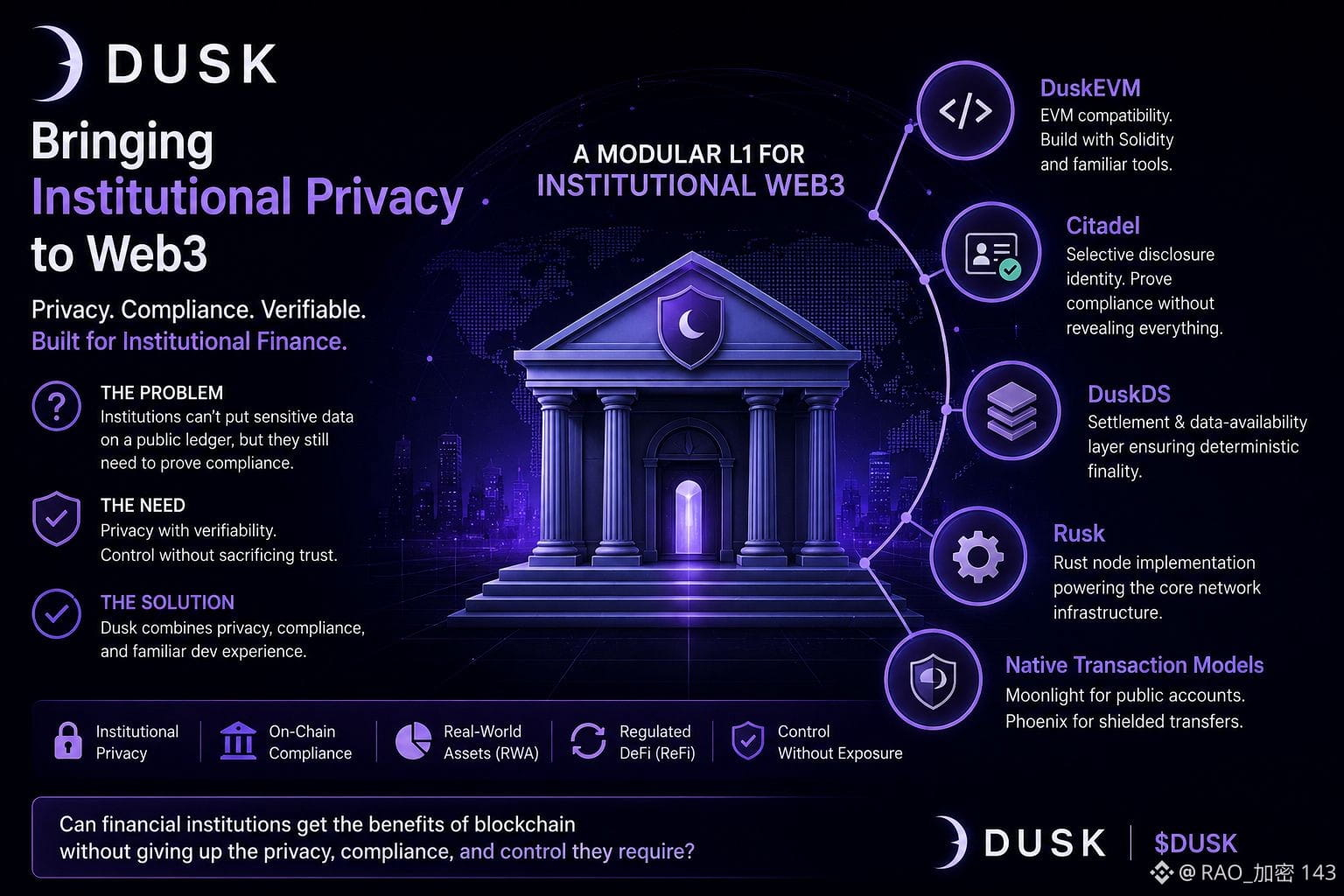
DuskEVM is one piece of that puzzle. Developers can work with Solidity and familiar EVM tooling rather than learning an entirely foreign environment from scratch.
Then there's Citadel.
The idea of selective disclosure caught my attention because compliance doesn't always require revealing everything.
Sometimes you only need to prove that a person meets a specific requirement.
That's a very different approach to identity on-chain.
Underneath that sits DuskDS, the settlement and data-availability layer, with Rusk providing the Rust node implementation that runs the core network infrastructure.
And Dusk also has different transaction models, including Moonlight for public accounts and Phoenix for shielded transfers.
When I put these pieces together, I stopped thinking about Dusk as simply another privacy-focused L1.
I'm more interested in whether this architecture can actually make Institutional Web3 practical.
Because #RWA adoption isn't just about putting assets on-chain.
It's about answering a harder question:
Can financial institutions get the benefits of blockchain without giving up the privacy, compliance, and control their businesses require?
That's the part of Dusk I’m watching.
Do you think Institutional Privacy will become a requirement for serious #RWA adoption, or will public transparency remain the dominant model?
@Dusk $DUSK
#Dusk #RWA
When I first got into Web3, I judged blockchains the way most people did:
TPS.
Gas fees.
How many dApps were being built.
Then I started looking at institutional finance, and that checklist suddenly felt incomplete.
Because a bank bringing a large financial position on-chain has a very different problem.
It can't simply publish every investor detail, balance, transaction, and identity on a public ledger.
But it also can't operate in a system where nobody can verify compliance.
That tension is what made me look closer at @Dusk.
The interesting part isn't simply “privacy.”
It's how Dusk tries to combine privacy with verifiability.
DuskEVM is one piece of that puzzle. Developers can work with Solidity and familiar EVM tooling rather than learning an entirely foreign environment from scratch.
Then there's Citadel.
The idea of selective disclosure caught my attention because compliance doesn't always require revealing everything.
Sometimes you only need to prove that a person meets a specific requirement.
That's a very different approach to identity on-chain.
Underneath that sits DuskDS, the settlement and data-availability layer, with Rusk providing the Rust node implementation that runs the core network infrastructure.
And Dusk also has different transaction models, including Moonlight for public accounts and Phoenix for shielded transfers.
When I put these pieces together, I stopped thinking about Dusk as simply another privacy-focused L1.
I'm more interested in whether this architecture can actually make Institutional Web3 practical.
Because #RWA adoption isn't just about putting assets on-chain.
It's about answering a harder question:
Can financial institutions get the benefits of blockchain without giving up the privacy, compliance, and control their businesses require?
That's the part of Dusk I’m watching.
Do you think Institutional Privacy will become a requirement for serious #RWA adoption, or will public transparency remain the dominant model?
@Dusk $DUSK
#Dusk #RWA