I’ll be honest, I initially looked at $DUSK @Dusk like this: Okay, another blockchain trying to tokenize real world assets.
But after digging deeper, that take feels way too simple.
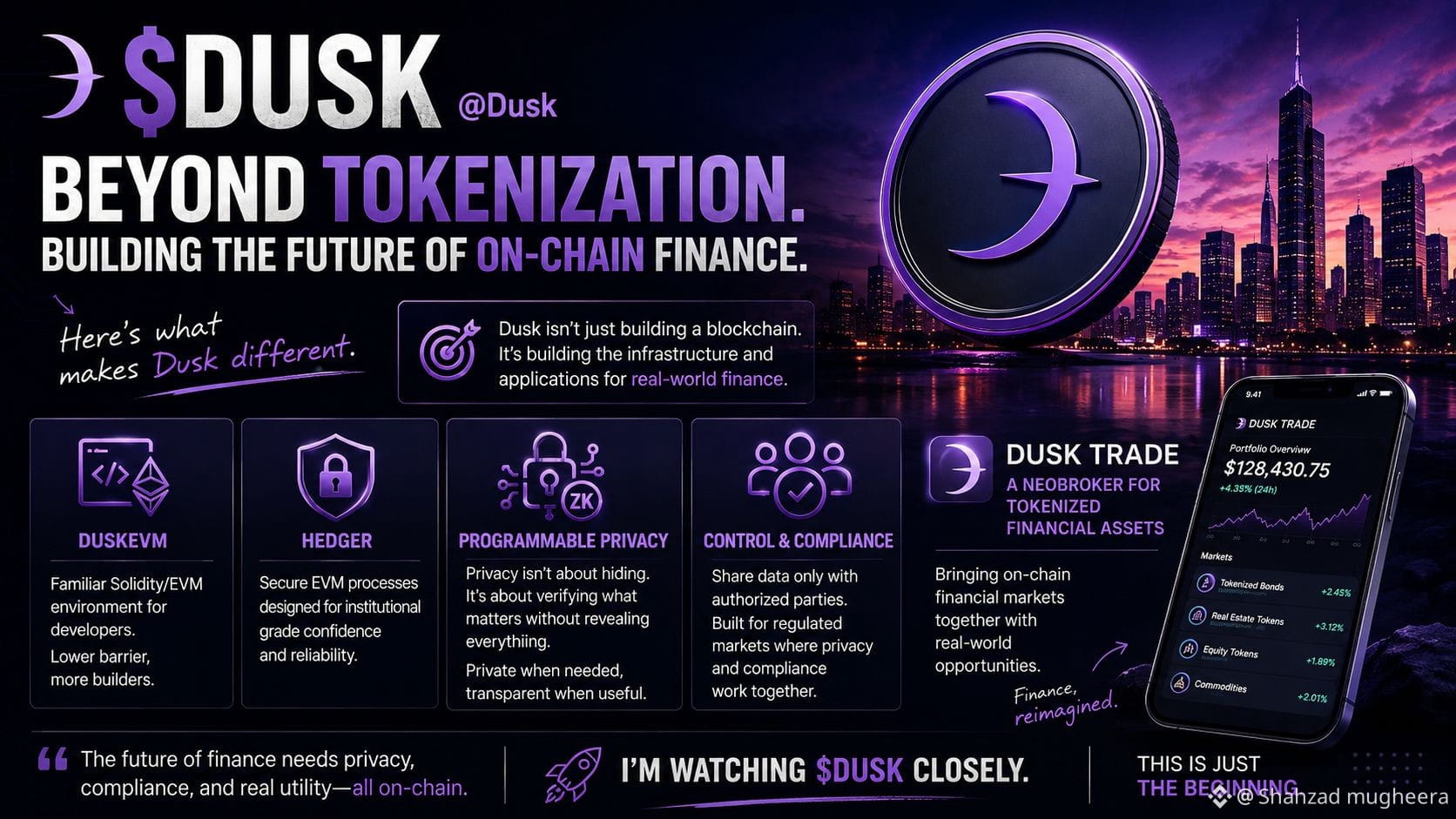
What caught my attention is the privacy angle. Dusk isn’t treating privacy as just hiding information. With zero-knowledge proofs and cryptographic commitments, the idea is to prove what needs to be proven without exposing everything.
That’s a big deal for finance.
I also like the practical side. DuskEVM gives developers a familiar Solidity/EVM route, while Hedger is designed to support secure EVM processes. So it’s not just tech for the sake of tech it’s trying to make the infrastructure usable.
And then there’s Dusk Trade.
That’s where the bigger picture starts making sense to me: tokenized financial assets actually need somewhere to operate, not just a blockchain to sit on.
My takeaway? $DUSK feels less like another tokenization chain and more like a bet on what regulated, privacy aware on-chain finance could look like.
That’s the part I’m watching closely.
#dusk $DUSK @Dusk
But after digging deeper, that take feels way too simple.
What caught my attention is the privacy angle. Dusk isn’t treating privacy as just hiding information. With zero-knowledge proofs and cryptographic commitments, the idea is to prove what needs to be proven without exposing everything.
That’s a big deal for finance.
I also like the practical side. DuskEVM gives developers a familiar Solidity/EVM route, while Hedger is designed to support secure EVM processes. So it’s not just tech for the sake of tech it’s trying to make the infrastructure usable.
And then there’s Dusk Trade.
That’s where the bigger picture starts making sense to me: tokenized financial assets actually need somewhere to operate, not just a blockchain to sit on.
My takeaway? $DUSK feels less like another tokenization chain and more like a bet on what regulated, privacy aware on-chain finance could look like.
That’s the part I’m watching closely.
#dusk $DUSK @Dusk