
A few days ago, I found myself thinking about a part of blockchain performance that rarely gets discussed: what happens when the network can no longer assume that everything is working normally?
Most projects are easy to admire when validators are online, messages are moving, and blocks are being produced exactly as expected. The harder question is what happens when a large part of the network suddenly disappears.
I used to think this was simply a matter of waiting for the system to recover. But after looking more closely at Dusk, I realized the more interesting part is how the protocol is designed to respond when normal operation starts breaking down.
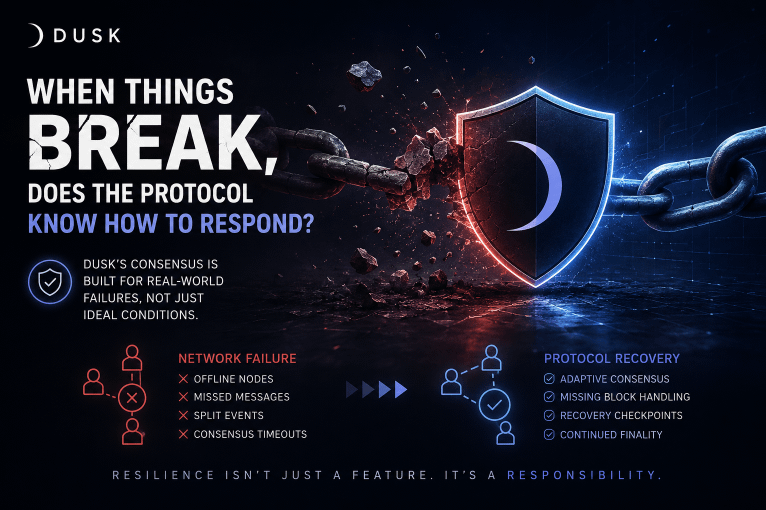
Dusk’s consensus design accounts for degraded participation. If a significant number of Provisioners become offline or isolated, the protocol doesn’t simply assume that the expected validator set will continue operating normally. When repeated consensus iterations fail to reach the required outcome, the protocol has mechanisms that allow it to adjust its behavior and continue handling the network’s changing conditions.
That distinction matters more than it may sound.
A blockchain can perform extremely well under ideal conditions. The real test is whether it can make sensible decisions when participation drops, communication becomes unreliable, or the expected validator set can’t be formed.
But there’s another question I think is just as important: how often do these recovery mechanisms get tested under realistic conditions?
A protocol can have a well-designed failure strategy on paper, but real confidence comes from implementation, testing, and seeing how the network behaves when something actually goes wrong.
That’s why I think blockchain resilience shouldn’t be measured only by TPS or block times. The deeper test is much simpler:
When things break, does the protocol know how to respond?
@Dusk #dusk $DUSK
$TUT $UAI
Most projects are easy to admire when validators are online, messages are moving, and blocks are being produced exactly as expected. The harder question is what happens when a large part of the network suddenly disappears.
I used to think this was simply a matter of waiting for the system to recover. But after looking more closely at Dusk, I realized the more interesting part is how the protocol is designed to respond when normal operation starts breaking down.
Dusk’s consensus design accounts for degraded participation. If a significant number of Provisioners become offline or isolated, the protocol doesn’t simply assume that the expected validator set will continue operating normally. When repeated consensus iterations fail to reach the required outcome, the protocol has mechanisms that allow it to adjust its behavior and continue handling the network’s changing conditions.
That distinction matters more than it may sound.
A blockchain can perform extremely well under ideal conditions. The real test is whether it can make sensible decisions when participation drops, communication becomes unreliable, or the expected validator set can’t be formed.
But there’s another question I think is just as important: how often do these recovery mechanisms get tested under realistic conditions?
A protocol can have a well-designed failure strategy on paper, but real confidence comes from implementation, testing, and seeing how the network behaves when something actually goes wrong.
That’s why I think blockchain resilience shouldn’t be measured only by TPS or block times. The deeper test is much simpler:
When things break, does the protocol know how to respond?
@Dusk #dusk $DUSK
$TUT $UAI