The Same Banks Building Their Own Crypto Rails Just Asked Regulators to Make Everyone Else's Rails Harder to Use 🏦🔓
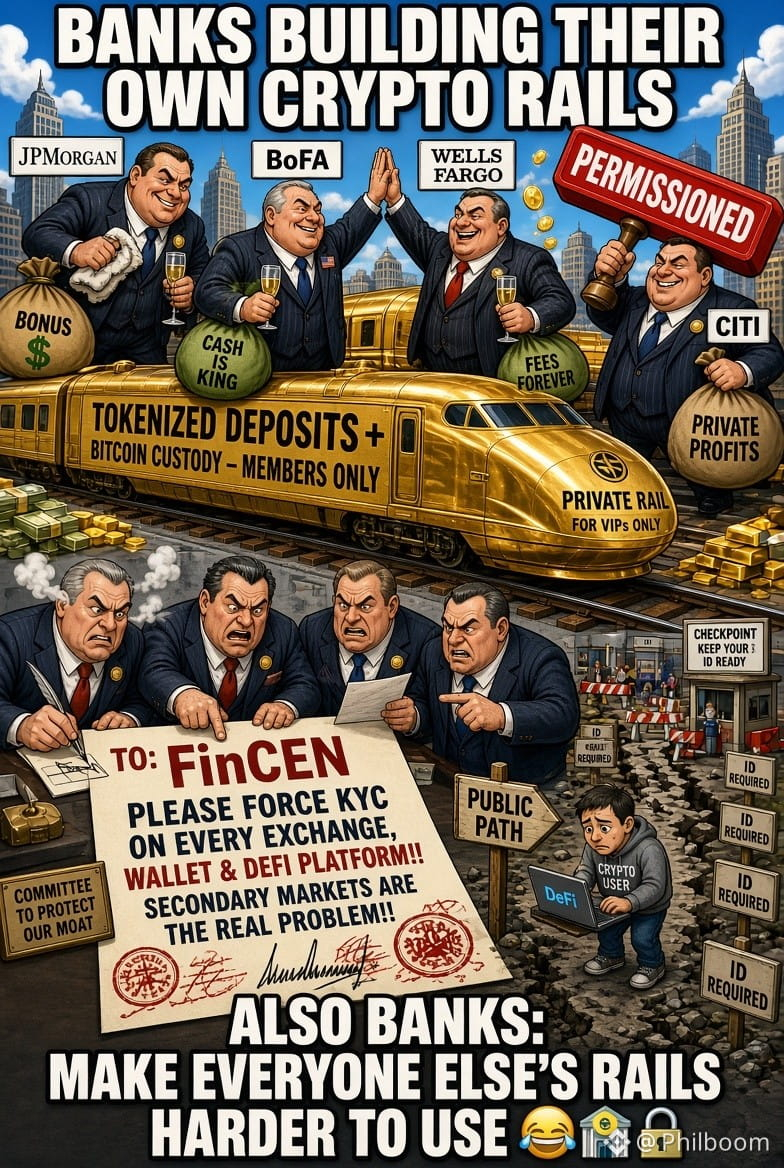
The Bank Policy Institute, representing JPMorgan, Bank of America, Wells Fargo, and Citi, the exact banks we watched build tokenized deposits and Bitcoin custody this year, filed a comment letter urging FinCEN to extend customer identification requirements beyond stablecoin issuers to secondary markets, meaning exchanges, wallets, and DeFi platforms. Their stated reasoning, most illicit activity happens there, not at the issuer level. Convenient timing, from the institutions that just spent a year building their own compliant alternative. 😂
Here is the part that should genuinely interest anyone who values decentralization 🧠
FinCEN's original proposal, implementing the GENIUS Act back in June, deliberately excluded secondary market activity. Regulators explicitly said requiring identity verification on every single stablecoin transfer would be nearly impossible to implement and potentially crippling to the industry. That was not an oversight. That was a reasoned decision. Banks are now lobbying to reverse a conclusion regulators already reached on purpose. 💎
The honest pattern worth naming 🎭
We have watched this exact dynamic play out with Korea's Travel Rule, India's surveillance system, and the EU pushing privacy coins off regulated exchanges. Every time, the argument sounds like safety. Every time, the practical effect is narrowing who gets to transact without a permission slip from an incumbent institution. 🎯
The comment period closed August 21. The fight over whether crypto stays permissionless or becomes bank shaped is not theoretical anymore. It is a filed document with a docket number. 🚀
$BTC $USDC
The Bank Policy Institute, representing JPMorgan, Bank of America, Wells Fargo, and Citi, the exact banks we watched build tokenized deposits and Bitcoin custody this year, filed a comment letter urging FinCEN to extend customer identification requirements beyond stablecoin issuers to secondary markets, meaning exchanges, wallets, and DeFi platforms. Their stated reasoning, most illicit activity happens there, not at the issuer level. Convenient timing, from the institutions that just spent a year building their own compliant alternative. 😂
Here is the part that should genuinely interest anyone who values decentralization 🧠
FinCEN's original proposal, implementing the GENIUS Act back in June, deliberately excluded secondary market activity. Regulators explicitly said requiring identity verification on every single stablecoin transfer would be nearly impossible to implement and potentially crippling to the industry. That was not an oversight. That was a reasoned decision. Banks are now lobbying to reverse a conclusion regulators already reached on purpose. 💎
The honest pattern worth naming 🎭
We have watched this exact dynamic play out with Korea's Travel Rule, India's surveillance system, and the EU pushing privacy coins off regulated exchanges. Every time, the argument sounds like safety. Every time, the practical effect is narrowing who gets to transact without a permission slip from an incumbent institution. 🎯
The comment period closed August 21. The fight over whether crypto stays permissionless or becomes bank shaped is not theoretical anymore. It is a filed document with a docket number. 🚀
$BTC $USDC