
I use to think the difficult part of privacy on EVM was proving that hidden information could still be trusted. After looking at different approaches over time, I started noticing a different problem: even when the cryptography works, someone still has to build, operate, and trust the system around it.
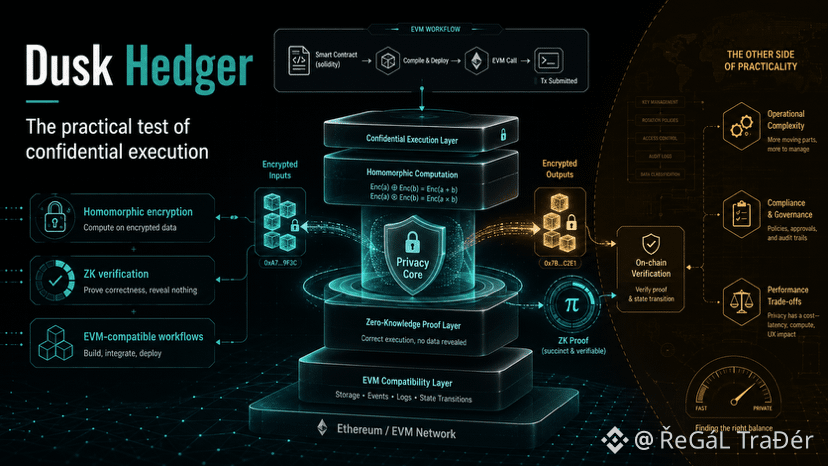
That is the part that made Hedger interesting to me. Many privacy solutions have focused on what can be hidden, but fewer spend enough time on how that privacy fits into existing developer environments. Hedger takes a different route by exploring confidential computation inside an EVM-compatible framework. By combining homomorphic encryption with zero-knowledge proofs, it aims to keep sensitive values private while still allowing verification. Precompiled contracts also make these capabilities closer to the Solidity workflows developers already know.
But the practical questions remain. encrypted computation is not free. Performance, key management & compliance processes still create friction. I’ve seen technically impressive systems before that looked convincing in controlled conditions but became more complicated when they reached real financial operations.
I am thinking Hedger is addressing a problem that is easy to underestimate. Privacy for institutions is not only about hiding information; it is about fitting confidentiality into systems that already have rules and responsibilities. I’m not fully convinced yet that the trade-offs will be easy to manage, but the attempt feels more grounded than many earlier approaches I’ve followed.
@Dusk $DUSK #dusk #dusk
That is the part that made Hedger interesting to me. Many privacy solutions have focused on what can be hidden, but fewer spend enough time on how that privacy fits into existing developer environments. Hedger takes a different route by exploring confidential computation inside an EVM-compatible framework. By combining homomorphic encryption with zero-knowledge proofs, it aims to keep sensitive values private while still allowing verification. Precompiled contracts also make these capabilities closer to the Solidity workflows developers already know.
But the practical questions remain. encrypted computation is not free. Performance, key management & compliance processes still create friction. I’ve seen technically impressive systems before that looked convincing in controlled conditions but became more complicated when they reached real financial operations.
I am thinking Hedger is addressing a problem that is easy to underestimate. Privacy for institutions is not only about hiding information; it is about fitting confidentiality into systems that already have rules and responsibilities. I’m not fully convinced yet that the trade-offs will be easy to manage, but the attempt feels more grounded than many earlier approaches I’ve followed.
@Dusk $DUSK #dusk #dusk