Something I kept circling back to while working through the DuskEVM testnet activity this past week — specifically around the contract interactions that went live after the August 16 bridge situation settled — is how differently Dusk Network ($DUSK ) treats identity versus authorization. #dusk @Dusk
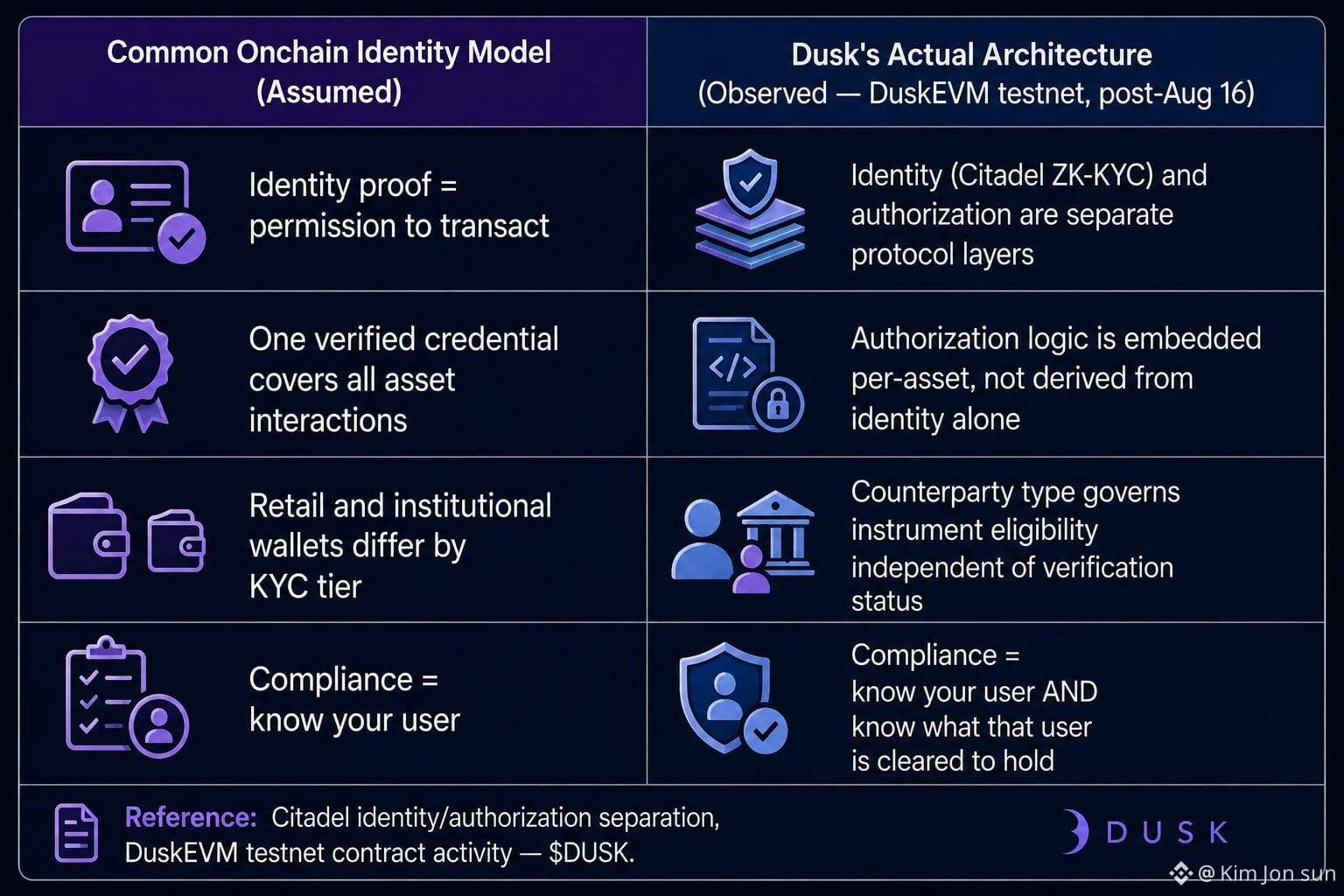
Most onchain identity projects conflate the two. You prove who you are, and that proof becomes your permission. Done. But in Dusk's architecture, identity and authorization are separate layers. Citadel handles the identity attestation through ZK-KYC — you prove attributes without exposing them. But what you're actually authorized to do with a given asset is a different question, governed separately. The regulated asset itself carries the authorization logic, not the identity credential.
Hmm. That split matters more than it sounds. In TradFi, knowing who you are doesn't automatically clear you for every instrument. A verified institutional wallet and a verified retail wallet aren't fungible counterparties for a bond issuance. Dusk seems to be modeling that distinction at protocol level rather than pushing it up to the application layer.
I'll be honest, I almost glossed over it. Spent most of the session focused on the ZK proof structure before the authorization separation clicked.
Still not clear how granular that authorization logic can actually get before it becomes too expensive or too brittle to maintain across asset types though.
Most onchain identity projects conflate the two. You prove who you are, and that proof becomes your permission. Done. But in Dusk's architecture, identity and authorization are separate layers. Citadel handles the identity attestation through ZK-KYC — you prove attributes without exposing them. But what you're actually authorized to do with a given asset is a different question, governed separately. The regulated asset itself carries the authorization logic, not the identity credential.
Hmm. That split matters more than it sounds. In TradFi, knowing who you are doesn't automatically clear you for every instrument. A verified institutional wallet and a verified retail wallet aren't fungible counterparties for a bond issuance. Dusk seems to be modeling that distinction at protocol level rather than pushing it up to the application layer.
I'll be honest, I almost glossed over it. Spent most of the session focused on the ZK proof structure before the authorization separation clicked.
Still not clear how granular that authorization logic can actually get before it becomes too expensive or too brittle to maintain across asset types though.