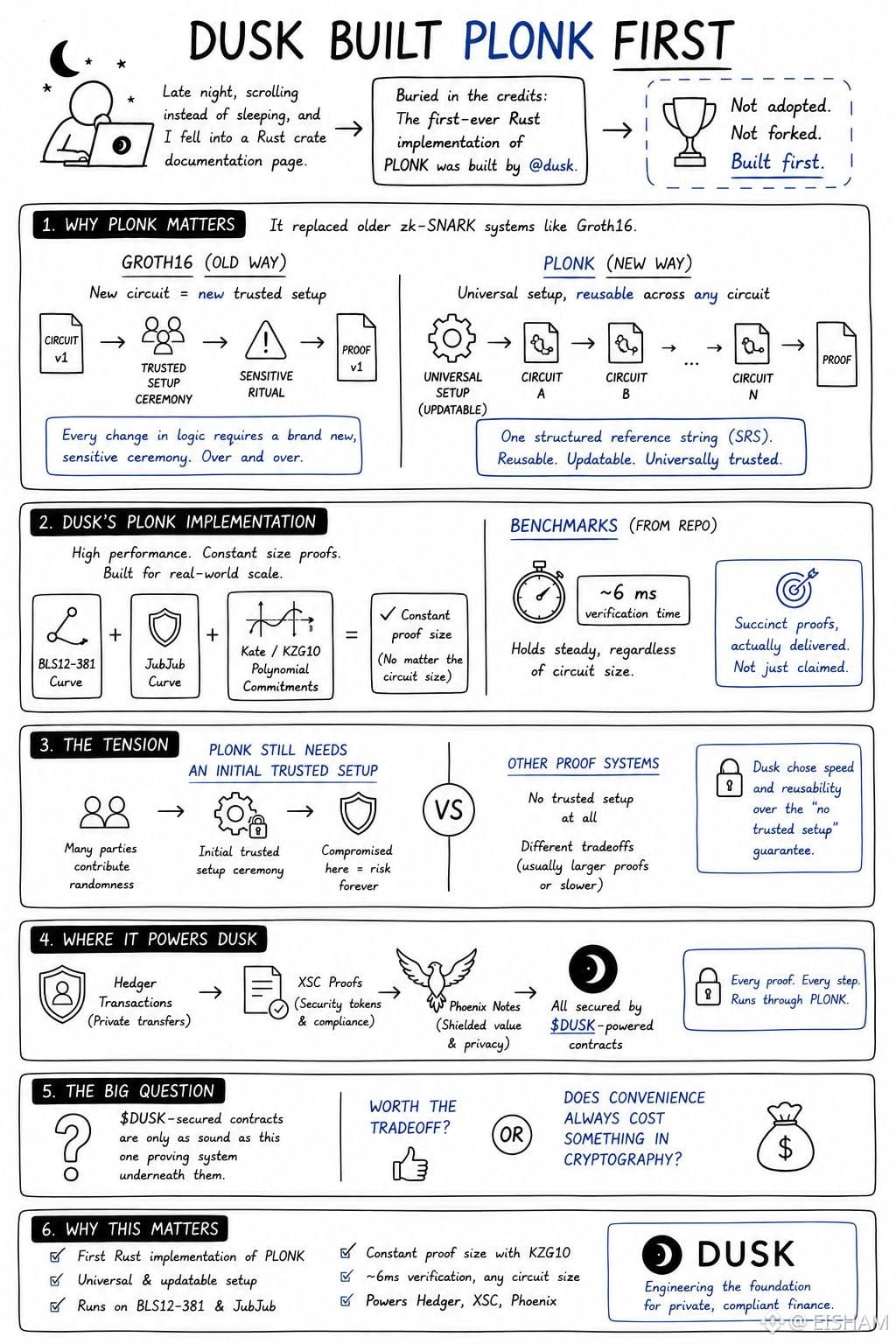
Late night, scrolling instead of sleeping, and I fell into a Rust crate documentation page of all things. buried in the credits:
the first-ever Rust implementation of PLONK was built by @Dusk . Not adopted, not forked. Built first.
PLONK matters because of what it replaced. Older zk-SNARK systems like Groth16 need a brand new trusted setup ceremony for every single circuit — a fresh, sensitive ritual each time the logic changes. PLONK's setup is universal:
one structured reference string, reusable across arbitrary circuits, and updatable, meaning anyone can keep adding randomness to it over time to strengthen trust in it further.
Dusk's implementation runs it over the BLS12-381 and JubJub curves, using Kate/KZG10 polynomial commitments to keep proof sizes constant no matter how complex the circuit gets. Benchmarks on the repo show verification holding around 6 milliseconds regardless of circuit size — the whole point of "succinct" actually delivered, not just claimed.
here's the tension worth sitting with: PLONK still needs that initial trusted setup, universal or not. If the ceremony's randomness were ever fully compromised, every circuit built on it inherits that risk, forever. Dusk chose speed and reusability over the "no trusted setup at all" guarantee some other proof systems offer.
every Hedger transaction, every XSC proof, every shielded Phoenix note ultimately runs through this. $DUSK -secured contracts are only as sound as this one proving system underneath them. Worth the tradeoff, or does convenience always eventually cost something in cryptography?#dusk $DUSK @Dusk
the first-ever Rust implementation of PLONK was built by @Dusk . Not adopted, not forked. Built first.
PLONK matters because of what it replaced. Older zk-SNARK systems like Groth16 need a brand new trusted setup ceremony for every single circuit — a fresh, sensitive ritual each time the logic changes. PLONK's setup is universal:
one structured reference string, reusable across arbitrary circuits, and updatable, meaning anyone can keep adding randomness to it over time to strengthen trust in it further.
Dusk's implementation runs it over the BLS12-381 and JubJub curves, using Kate/KZG10 polynomial commitments to keep proof sizes constant no matter how complex the circuit gets. Benchmarks on the repo show verification holding around 6 milliseconds regardless of circuit size — the whole point of "succinct" actually delivered, not just claimed.
here's the tension worth sitting with: PLONK still needs that initial trusted setup, universal or not. If the ceremony's randomness were ever fully compromised, every circuit built on it inherits that risk, forever. Dusk chose speed and reusability over the "no trusted setup at all" guarantee some other proof systems offer.
every Hedger transaction, every XSC proof, every shielded Phoenix note ultimately runs through this. $DUSK -secured contracts are only as sound as this one proving system underneath them. Worth the tradeoff, or does convenience always eventually cost something in cryptography?#dusk $DUSK @Dusk