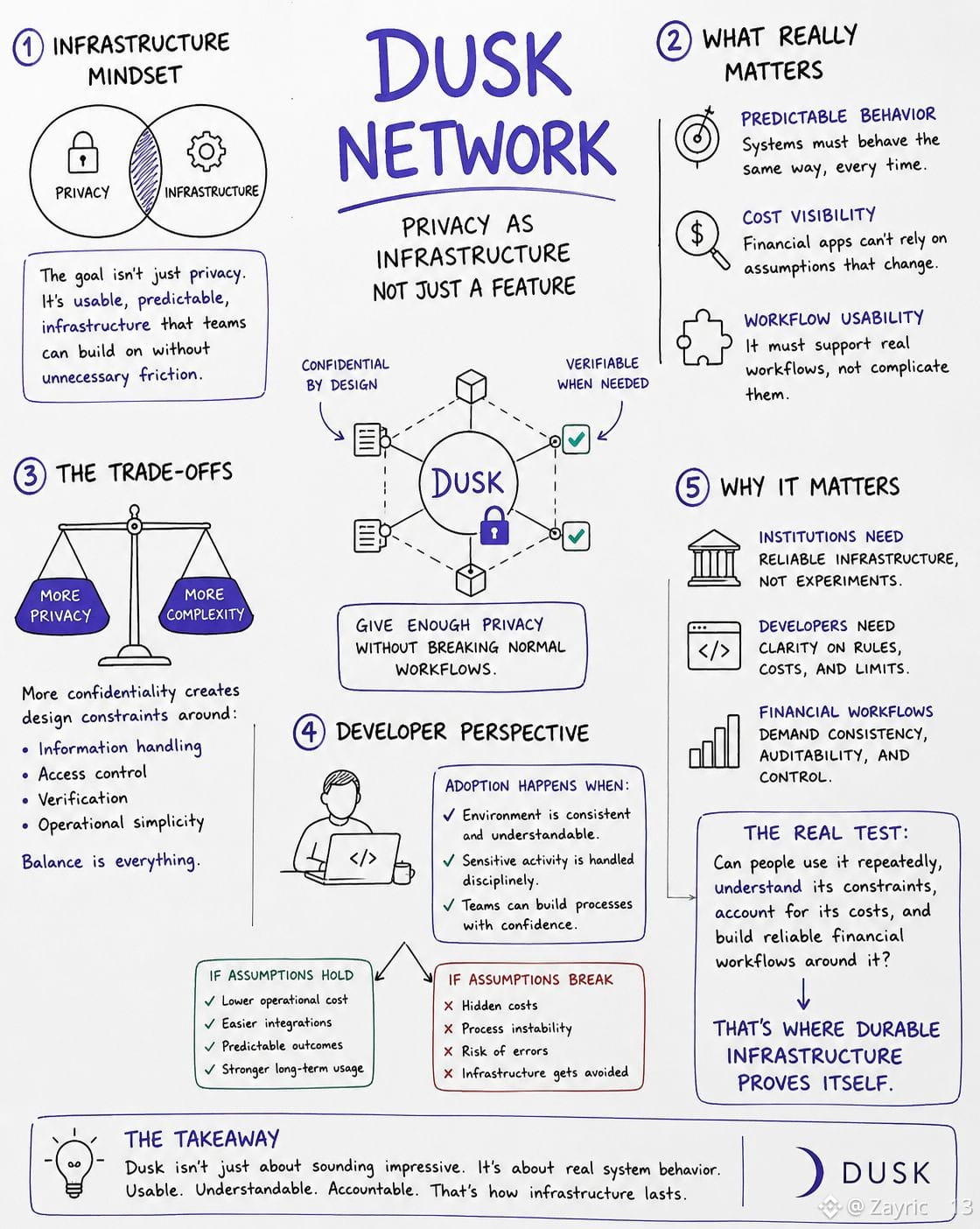

What makes Dusk more interesting to me is how it approaches privacy as an infrastructure problem, not simply as a feature to advertise. In real usage, the harder question is whether developers and institutions can work with the system without#dusk adding unnecessary operational friction. Predictable behavior matters here. So does cost visibility, because financial applications cannot rely on assumptions that change every time the system is used under different conditions.#dusk
I also think the trade-offs matter more than they first appear. Confidentiality can make certain activities more practical, but it also creates design constraints around how information is handled, accessed, and verified. The system has to give users enough privacy without making normal workflows difficult to manage. That balance is where infrastructure either becomes useful or quietly gets avoided.
For developers, small details can shape adoption more than big architectural claims. If the environment is consistent, understandable, and disciplined in how it handles sensitive activity, teams can build processes around it with greater confidence. If those assumptions are unreliable, even technically strong infrastructure becomes expensive to operate.@Dusk
That is why I look at Dusk through the lens of actual system behavior. The interesting part is not whether the technology sounds impressive. It is whether people can use it repeatedly, understand its constraints, account for its costs, and build reliable financial workflows around those realities. That is usually where durable infrastructure proves itself.
$DUSK $TUT
I also think the trade-offs matter more than they first appear. Confidentiality can make certain activities more practical, but it also creates design constraints around how information is handled, accessed, and verified. The system has to give users enough privacy without making normal workflows difficult to manage. That balance is where infrastructure either becomes useful or quietly gets avoided.
For developers, small details can shape adoption more than big architectural claims. If the environment is consistent, understandable, and disciplined in how it handles sensitive activity, teams can build processes around it with greater confidence. If those assumptions are unreliable, even technically strong infrastructure becomes expensive to operate.@Dusk
That is why I look at Dusk through the lens of actual system behavior. The interesting part is not whether the technology sounds impressive. It is whether people can use it repeatedly, understand its constraints, account for its costs, and build reliable financial workflows around those realities. That is usually where durable infrastructure proves itself.
$DUSK $TUT