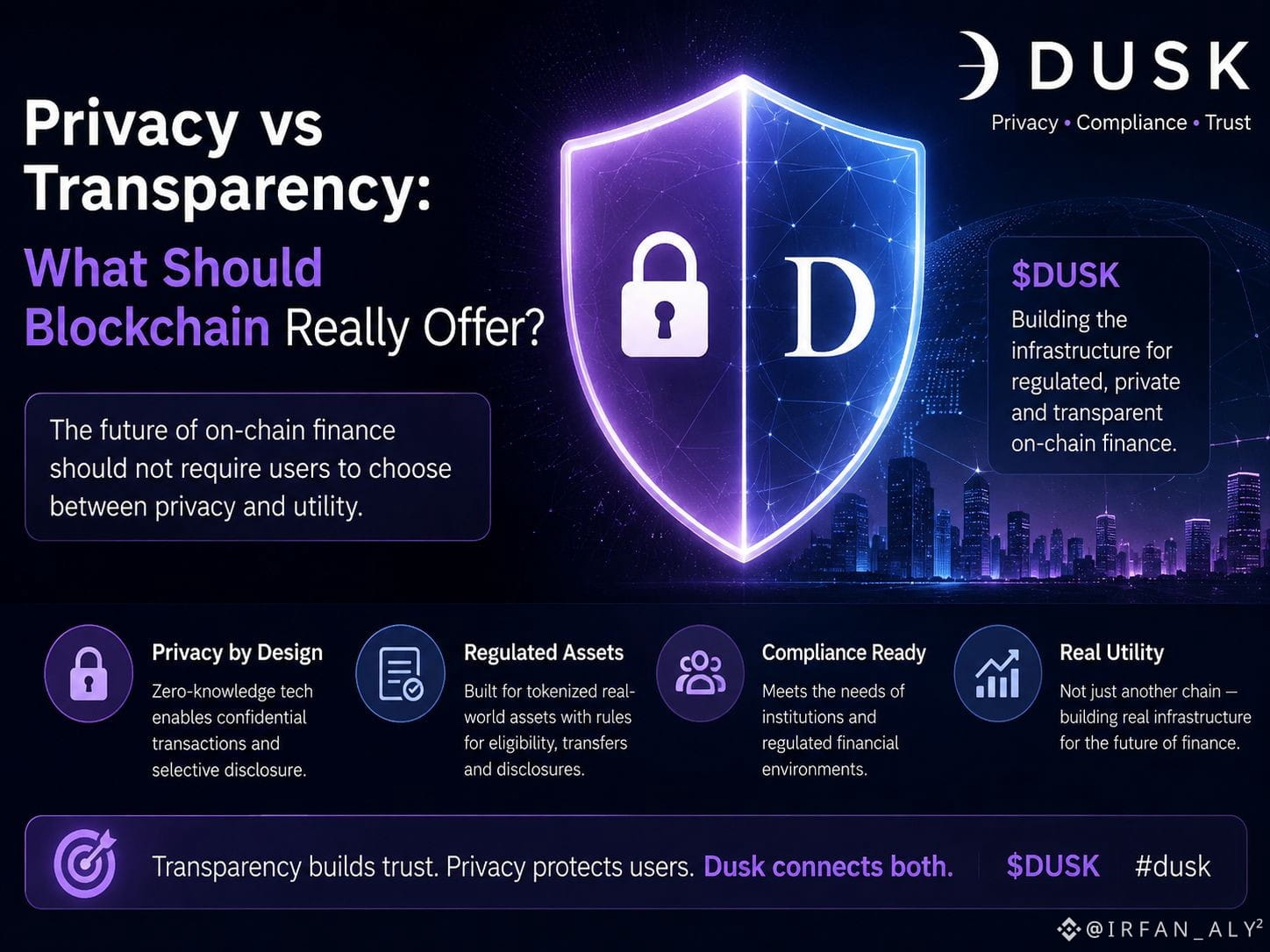
#dusk $DUSK @Dusk Privacy vs Transparency: What Should Blockchain Really Offer?
One thing I keep thinking about in blockchain is the balance between transparency and privacy. Public ledgers are powerful because anyone can verify activity, but financial users and institutions may not want every balance, transfer, or sensitive detail exposed to everyone.
This is where @Dusk takes an interesting approach.
Instead of treating privacy and compliance as opposites, Dusk is building infrastructure where they can work together. Its zero-knowledge technology can support confidential transactions while allowing information to be disclosed selectively when it is actually required. That feels much closer to how real financial systems need to operate.
Another part I find interesting is the focus on regulated digital assets. Tokenization is not only about putting an asset on a blockchain; the network also needs rules around eligibility, transfers, disclosure and settlement. Dusk is designed around these types of regulated workflows rather than treating them as an afterthought.
For me, the bigger idea is simple: the future of on-chain finance should not require users to choose between privacy and utility.
If blockchain wants serious adoption in financial markets, it needs infrastructure that protects sensitive information while still providing the transparency and controls required by regulated environments.
That is the direction I’m watching with Dusk. It’s not just about another blockchain; it’s about how privacy-preserving technology can fit into real financial infrastructure.
$DUSK #dusk @Dusk
One thing I keep thinking about in blockchain is the balance between transparency and privacy. Public ledgers are powerful because anyone can verify activity, but financial users and institutions may not want every balance, transfer, or sensitive detail exposed to everyone.
This is where @Dusk takes an interesting approach.
Instead of treating privacy and compliance as opposites, Dusk is building infrastructure where they can work together. Its zero-knowledge technology can support confidential transactions while allowing information to be disclosed selectively when it is actually required. That feels much closer to how real financial systems need to operate.
Another part I find interesting is the focus on regulated digital assets. Tokenization is not only about putting an asset on a blockchain; the network also needs rules around eligibility, transfers, disclosure and settlement. Dusk is designed around these types of regulated workflows rather than treating them as an afterthought.
For me, the bigger idea is simple: the future of on-chain finance should not require users to choose between privacy and utility.
If blockchain wants serious adoption in financial markets, it needs infrastructure that protects sensitive information while still providing the transparency and controls required by regulated environments.
That is the direction I’m watching with Dusk. It’s not just about another blockchain; it’s about how privacy-preserving technology can fit into real financial infrastructure.
$DUSK #dusk @Dusk