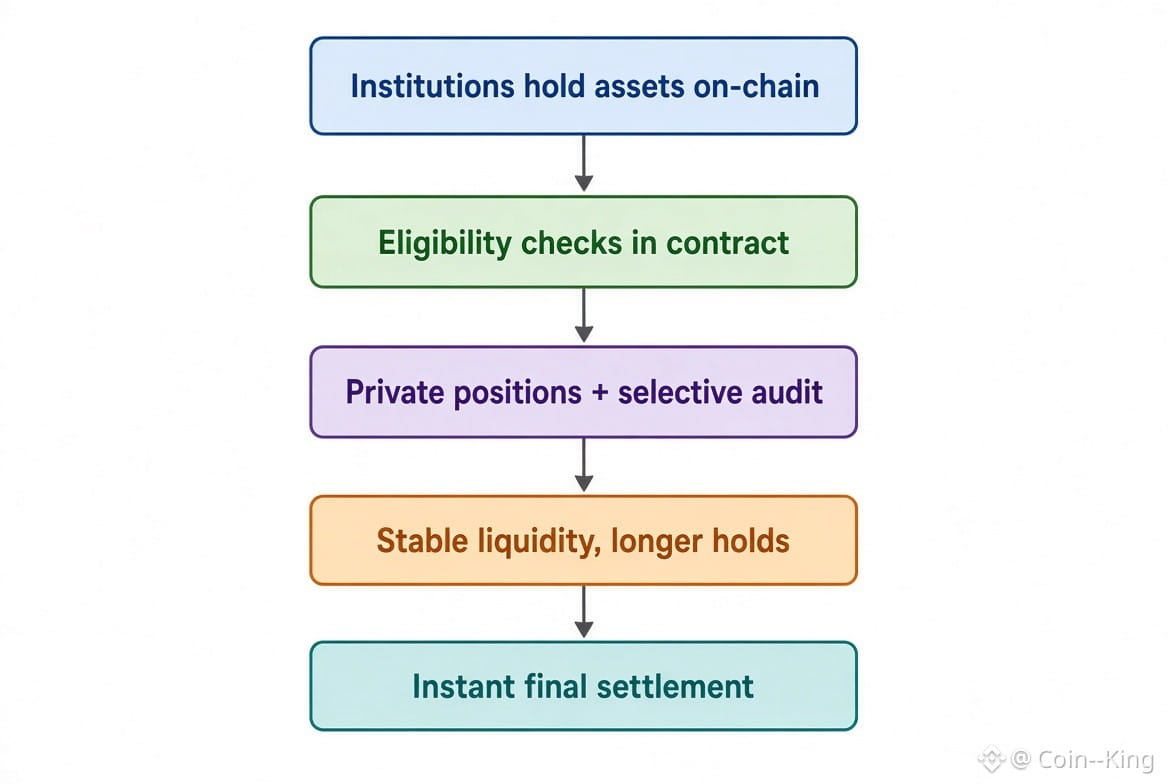
I've been watching Dusk more closely than most chains because the regulated-asset piece isn't just wrapping something that still lives off-chain. Once institutions hold the actual securities on Dusk, the rules sit in the contract instead of a separate registrar.
Transfers get checked for eligibility first, the way a transfer agent used to do it. Positions can stay private with Phoenix, but the right party can still see what they need for an audit. Closer to a real book than everything sitting in the open.
Liquidity changes too. You lose wallets that shouldn't hold the asset, so positions tend to stay put longer. Settlement is built to be final in one go, which cuts the usual waiting-around risk.
Volume stays thin until venues like NPEX actually move size. Retail is gated on purpose, which keeps the product clean but means activity builds slower. Trust now sits on the identity layer and whether the protocol holds up under real reviews, not just the issuer's promise.
Does that turn Dusk into useful settlement infrastructure or just another closed venue with better privacy? How do you see liquidity forming once institutions are actually holding the assets there?
#dusk $DUSK @Dusk
Transfers get checked for eligibility first, the way a transfer agent used to do it. Positions can stay private with Phoenix, but the right party can still see what they need for an audit. Closer to a real book than everything sitting in the open.
Liquidity changes too. You lose wallets that shouldn't hold the asset, so positions tend to stay put longer. Settlement is built to be final in one go, which cuts the usual waiting-around risk.
Volume stays thin until venues like NPEX actually move size. Retail is gated on purpose, which keeps the product clean but means activity builds slower. Trust now sits on the identity layer and whether the protocol holds up under real reviews, not just the issuer's promise.
Does that turn Dusk into useful settlement infrastructure or just another closed venue with better privacy? How do you see liquidity forming once institutions are actually holding the assets there?
#dusk $DUSK @Dusk