@Dusk
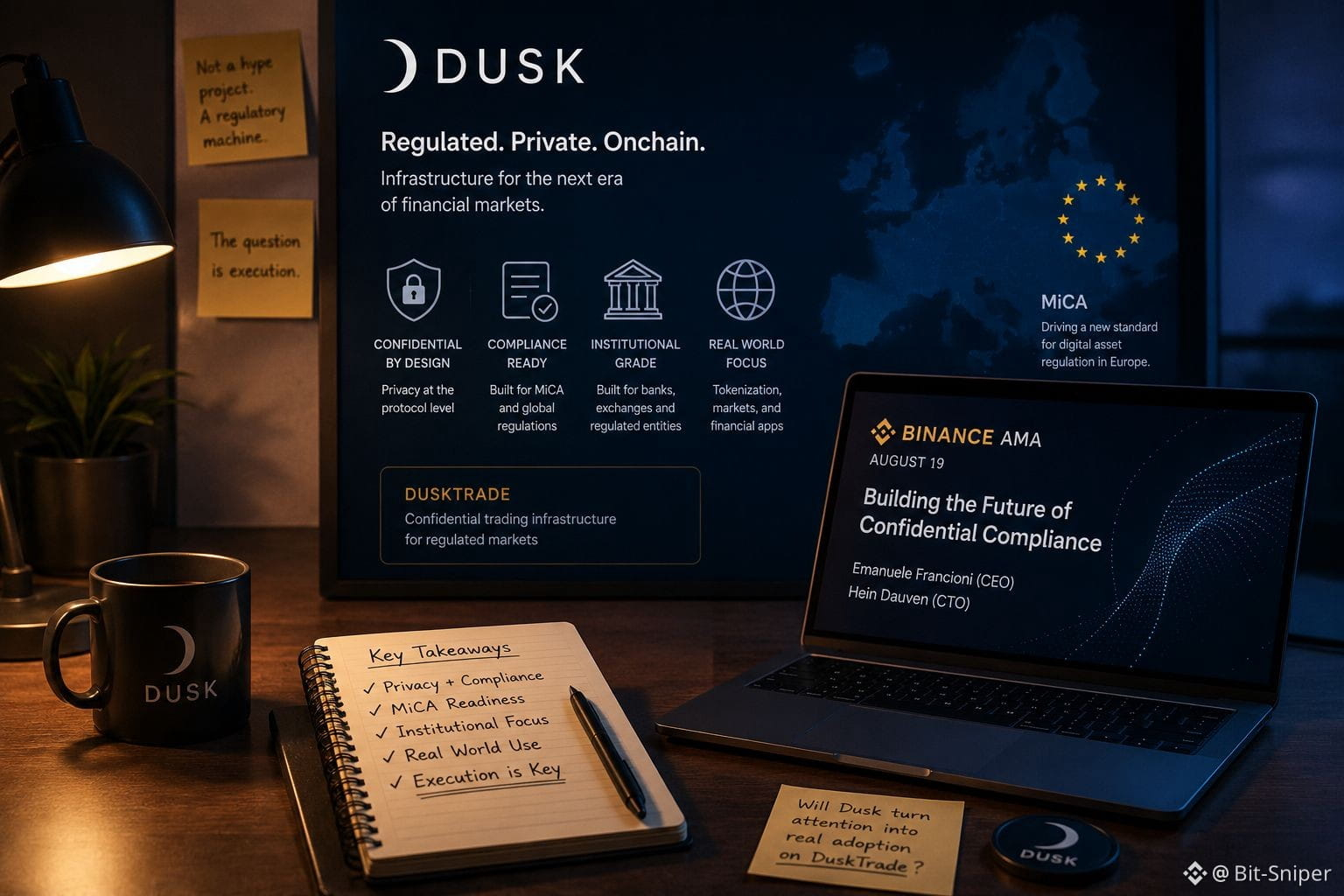
I found myself replaying parts of the Binance AMA in my head after I had already finished listening to it. The more I thought about what Emanuele Francioni and Hein Dauven were actually discussing, the less Dusk looked like a project chasing the usual crypto attention cycle.
What stood out was how consistently the conversation came back to privacy, compliance and financial infrastructure. That fits with the direction Dusk has been taking for years. The network is built around confidential transactions and selective disclosure, with the idea that regulated businesses should be able to keep sensitive information private without stepping outside the rules they have to follow.
That is a much more specific goal than simply building another fast L1.
I also think the MiCA argument needs a little care. I would not say European regulation automatically makes transparent blockchains unusable for institutions. That is a much bigger claim than the evidence supports. What regulation does seem to do is make the privacy problem harder to ignore. A bank, exchange or securities platform cannot treat sensitive customer and transaction data in the same way as a completely open public ledger.
That is where Dusk has a reasonable case to make.
The technology side is probably the part I trust most about the project because the team has spent so much time on it. Dusk has continued adding network upgrades, privacy tooling and infrastructure, while its stated focus remains regulated onchain finance. The work feels deliberate rather than rushed.
But there is another side to this.
A technically strong network still needs actual economic activity around it. And that is where I think Dusk has a harder road ahead. Binance exposure, exchange access and more visibility can bring people closer to the project, but none of that guarantees meaningful usage. The real test is whether institutions and market participants start using Dusk because it makes something easier, safer or more practical than their existing setup.
#dusk $DUSK
I found myself replaying parts of the Binance AMA in my head after I had already finished listening to it. The more I thought about what Emanuele Francioni and Hein Dauven were actually discussing, the less Dusk looked like a project chasing the usual crypto attention cycle.
What stood out was how consistently the conversation came back to privacy, compliance and financial infrastructure. That fits with the direction Dusk has been taking for years. The network is built around confidential transactions and selective disclosure, with the idea that regulated businesses should be able to keep sensitive information private without stepping outside the rules they have to follow.
That is a much more specific goal than simply building another fast L1.
I also think the MiCA argument needs a little care. I would not say European regulation automatically makes transparent blockchains unusable for institutions. That is a much bigger claim than the evidence supports. What regulation does seem to do is make the privacy problem harder to ignore. A bank, exchange or securities platform cannot treat sensitive customer and transaction data in the same way as a completely open public ledger.
That is where Dusk has a reasonable case to make.
The technology side is probably the part I trust most about the project because the team has spent so much time on it. Dusk has continued adding network upgrades, privacy tooling and infrastructure, while its stated focus remains regulated onchain finance. The work feels deliberate rather than rushed.
But there is another side to this.
A technically strong network still needs actual economic activity around it. And that is where I think Dusk has a harder road ahead. Binance exposure, exchange access and more visibility can bring people closer to the project, but none of that guarantees meaningful usage. The real test is whether institutions and market participants start using Dusk because it makes something easier, safer or more practical than their existing setup.
#dusk $DUSK