A blockchain can make a share transferable in seconds.
That does not mean it can make the transfer legal.
That distinction changed how I look at the RWA narrative.
I used to think the hard part was putting a real asset on chain. Now I think the harder problem starts after the token exists.
Who can own it? Which transfers should fail? How do dividends and voting work?
And how can ownership data stay private while authorized parties still get what they need?
That is where Dusk’s architecture becomes interesting.
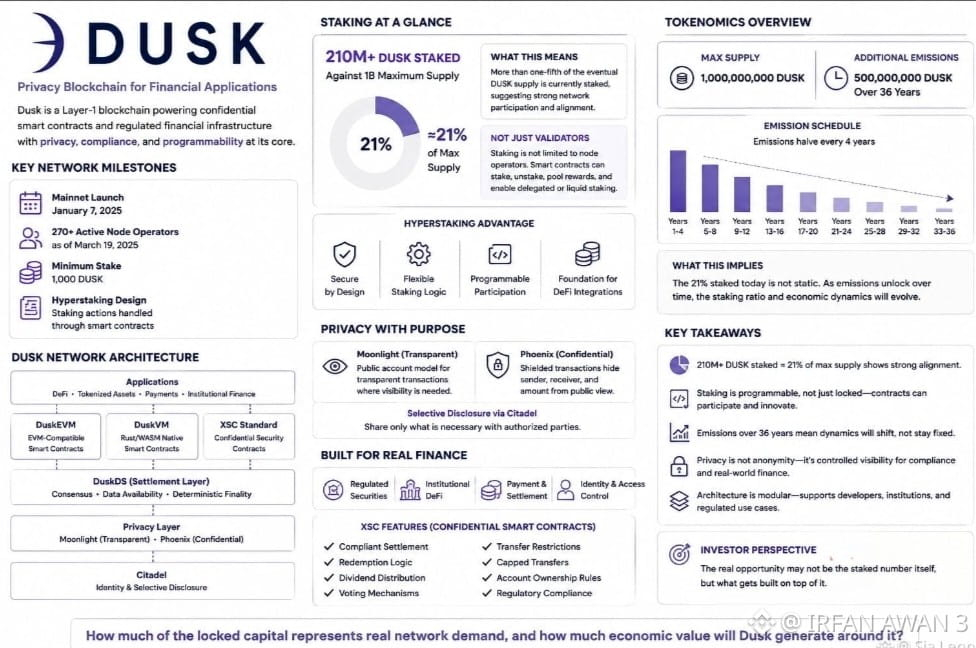
The Confidential Security Contract Standard (XSC) is designed for confidential smart contracts that can incorporate privacy and compliance requirements with Dusk’s regulated asset architecture supporting controlled transfers and corporate actions.
The key insight is simple:
A regulated security needs its rules to travel with the asset not sit beside it as an afterthought.
Privacy is equally important.
Phoenix uses shielded, note based transactions and zero knowledge proofs to verify transaction validity without exposing sensitive transaction details while viewing keys enable selective disclosure when required.
The architecture then separates the major functions
XSC → security logic
Phoenix → transaction privacy
DuskEVM → EVM-compatible execution
DuskDS → consensus finality and data availability
Hedger → regulated-asset architecture on DuskEVM
That changes the RWA question.
Not
“Can we put a security on chain?”
But:
“Can the network enforce the conditions under which that security moves while keeping sensitive ownership information private?”
Because tokenization is only the starting point.
Tokenization puts the asset onchain. Infrastructure determines whether it can actually function on chain.
If Dusk can make more of those rules programmable, verifiable and confidential, the bigger innovation is not the token.
It’s the financial infrastructure underneath it.
@Dusk #Dusk $DUSK
That does not mean it can make the transfer legal.
That distinction changed how I look at the RWA narrative.
I used to think the hard part was putting a real asset on chain. Now I think the harder problem starts after the token exists.
Who can own it? Which transfers should fail? How do dividends and voting work?
And how can ownership data stay private while authorized parties still get what they need?
That is where Dusk’s architecture becomes interesting.
The Confidential Security Contract Standard (XSC) is designed for confidential smart contracts that can incorporate privacy and compliance requirements with Dusk’s regulated asset architecture supporting controlled transfers and corporate actions.
The key insight is simple:
A regulated security needs its rules to travel with the asset not sit beside it as an afterthought.
Privacy is equally important.
Phoenix uses shielded, note based transactions and zero knowledge proofs to verify transaction validity without exposing sensitive transaction details while viewing keys enable selective disclosure when required.
The architecture then separates the major functions
XSC → security logic
Phoenix → transaction privacy
DuskEVM → EVM-compatible execution
DuskDS → consensus finality and data availability
Hedger → regulated-asset architecture on DuskEVM
That changes the RWA question.
Not
“Can we put a security on chain?”
But:
“Can the network enforce the conditions under which that security moves while keeping sensitive ownership information private?”
Because tokenization is only the starting point.
Tokenization puts the asset onchain. Infrastructure determines whether it can actually function on chain.
If Dusk can make more of those rules programmable, verifiable and confidential, the bigger innovation is not the token.
It’s the financial infrastructure underneath it.
@Dusk #Dusk $DUSK