I went back through Dusk’s current product pages and caught myself making one broad assumption: because mainnet is live, I treated the whole financial stack as if it had reached the same stage. The status labels changed that view.
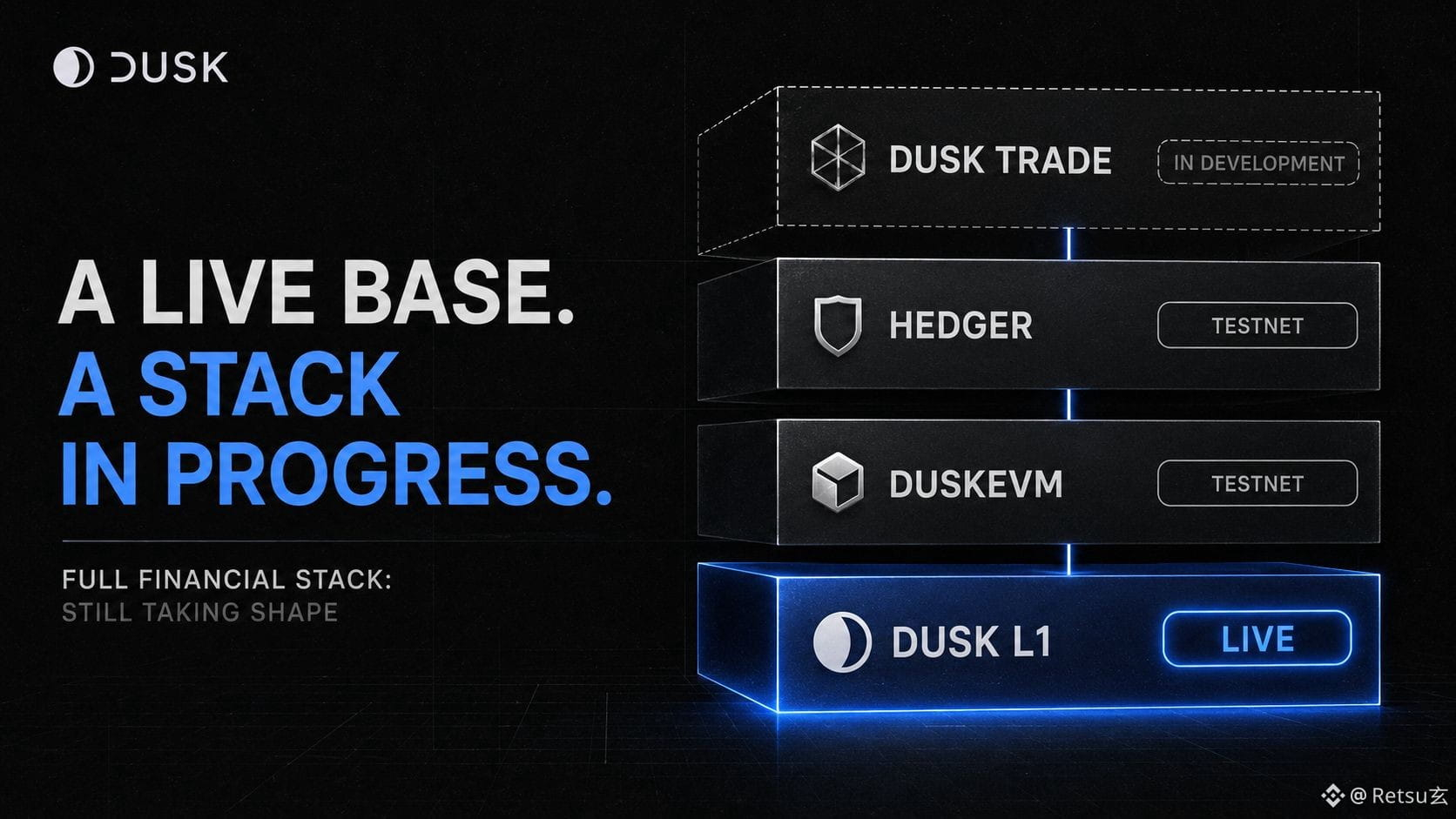
Dusk L1 is live, providing consensus, settlement, data availability, public and shielded transactions, and DuskVM execution. DuskEVM remains on testnet, where Solidity apps use familiar EVM tooling and DUSK for gas while settling through DuskDS. The hedger is also on testnet, adding confidential EVM flows. Dusk Trade is still being built as the product layer for onboarding, controlled access, trading, payment coordination, and settlement.
That made me look at it differently.
My interpretation: Dusk has a live base, but its broader financial thesis depends on several moving layers becoming production-ready together. A secure L1 does not automatically prove that the EVM layer, privacy engine, bridge, and user app will behave as one reliable market workflow.
My uncertainty is integration risk. What release and audit conditions will move DuskEVM and Hedger from testnet to mainnet? If Dusk Trade relies on those layers, how will upgrades or failures be coordinated without interrupting eligibility, trading, or settlement?
I want to watch this in practice.
#dusk $DUSK @Dusk
Dusk L1 is live, providing consensus, settlement, data availability, public and shielded transactions, and DuskVM execution. DuskEVM remains on testnet, where Solidity apps use familiar EVM tooling and DUSK for gas while settling through DuskDS. The hedger is also on testnet, adding confidential EVM flows. Dusk Trade is still being built as the product layer for onboarding, controlled access, trading, payment coordination, and settlement.
That made me look at it differently.
My interpretation: Dusk has a live base, but its broader financial thesis depends on several moving layers becoming production-ready together. A secure L1 does not automatically prove that the EVM layer, privacy engine, bridge, and user app will behave as one reliable market workflow.
My uncertainty is integration risk. What release and audit conditions will move DuskEVM and Hedger from testnet to mainnet? If Dusk Trade relies on those layers, how will upgrades or failures be coordinated without interrupting eligibility, trading, or settlement?
I want to watch this in practice.
#dusk $DUSK @Dusk