Regulation in crypto usually gets treated as an obstacle to design around. Dusk Network treats it as a spec to build to, and that's a meaningfully different starting point.
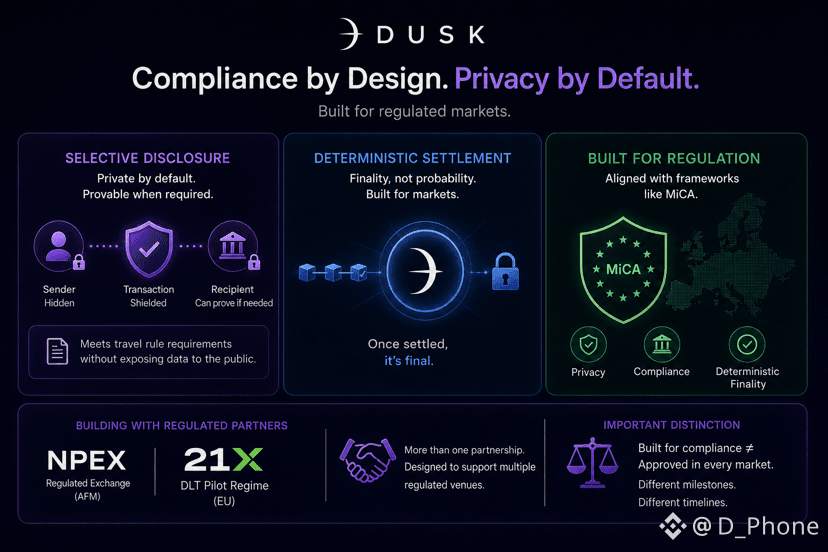
Selective disclosure is the mechanism that makes this possible in practice, not just in messaging. A shielded transfer on Dusk hides the sender and amount from public view by default, but the recipient can cryptographically prove who paid them when asked, satisfying rules like the EU's travel regulations without exposing the transaction to everyone else watching the chain. Add deterministic settlement, transactions that reach final, certain completion rather than a slowly improving probability, and the pieces start to resemble something built specifically for markets operating under frameworks like MiCA, rather than a general purpose chain hoping compliance works out later.
That ordering matters more than it gets credit for. Retrofitting compliance onto a transparent-by-default chain, or onto a fully private one, tends to produce awkward compromises. Designing selective disclosure into the base protocol from the start is a harder engineering problem upfront, in exchange for fewer painful compromises down the line.
NPEX isn't the only regulated venue in this picture either. Dusk has also connected with 21X, a digital asset exchange operating under the EU's DLT Pilot Regime, which suggests the compliance-first design isn't a one-partnership story but something the architecture is meant to support across multiple regulated venues and, eventually, multiple frameworks beyond MiCA alone.
None of this means regulatory approval is automatic or universal. MiCA covers the EU. Other jurisdictions have their own frameworks, their own regulators, their own timelines, and architecture readiness on Dusk's side doesn't shortcut any of that. Being built for compliance and being formally cleared for it in every market that matters are two different milestones, on two different schedules.
@Dusk #dusk $DUSK $BTW $TRUMP
Selective disclosure is the mechanism that makes this possible in practice, not just in messaging. A shielded transfer on Dusk hides the sender and amount from public view by default, but the recipient can cryptographically prove who paid them when asked, satisfying rules like the EU's travel regulations without exposing the transaction to everyone else watching the chain. Add deterministic settlement, transactions that reach final, certain completion rather than a slowly improving probability, and the pieces start to resemble something built specifically for markets operating under frameworks like MiCA, rather than a general purpose chain hoping compliance works out later.
That ordering matters more than it gets credit for. Retrofitting compliance onto a transparent-by-default chain, or onto a fully private one, tends to produce awkward compromises. Designing selective disclosure into the base protocol from the start is a harder engineering problem upfront, in exchange for fewer painful compromises down the line.
NPEX isn't the only regulated venue in this picture either. Dusk has also connected with 21X, a digital asset exchange operating under the EU's DLT Pilot Regime, which suggests the compliance-first design isn't a one-partnership story but something the architecture is meant to support across multiple regulated venues and, eventually, multiple frameworks beyond MiCA alone.
None of this means regulatory approval is automatic or universal. MiCA covers the EU. Other jurisdictions have their own frameworks, their own regulators, their own timelines, and architecture readiness on Dusk's side doesn't shortcut any of that. Being built for compliance and being formally cleared for it in every market that matters are two different milestones, on two different schedules.
@Dusk #dusk $DUSK $BTW $TRUMP