#dusk $DUSK @Dusk
Someone replied to my last Dusk post asking why I never explained the block reward split.
A FAIR CALLOUT👍.
So I went to whitepaper yesterday again, to answer it properly, and got stuck on a different section instead: how a block that just got voted on actually reaches everyone else fast enough to matter.
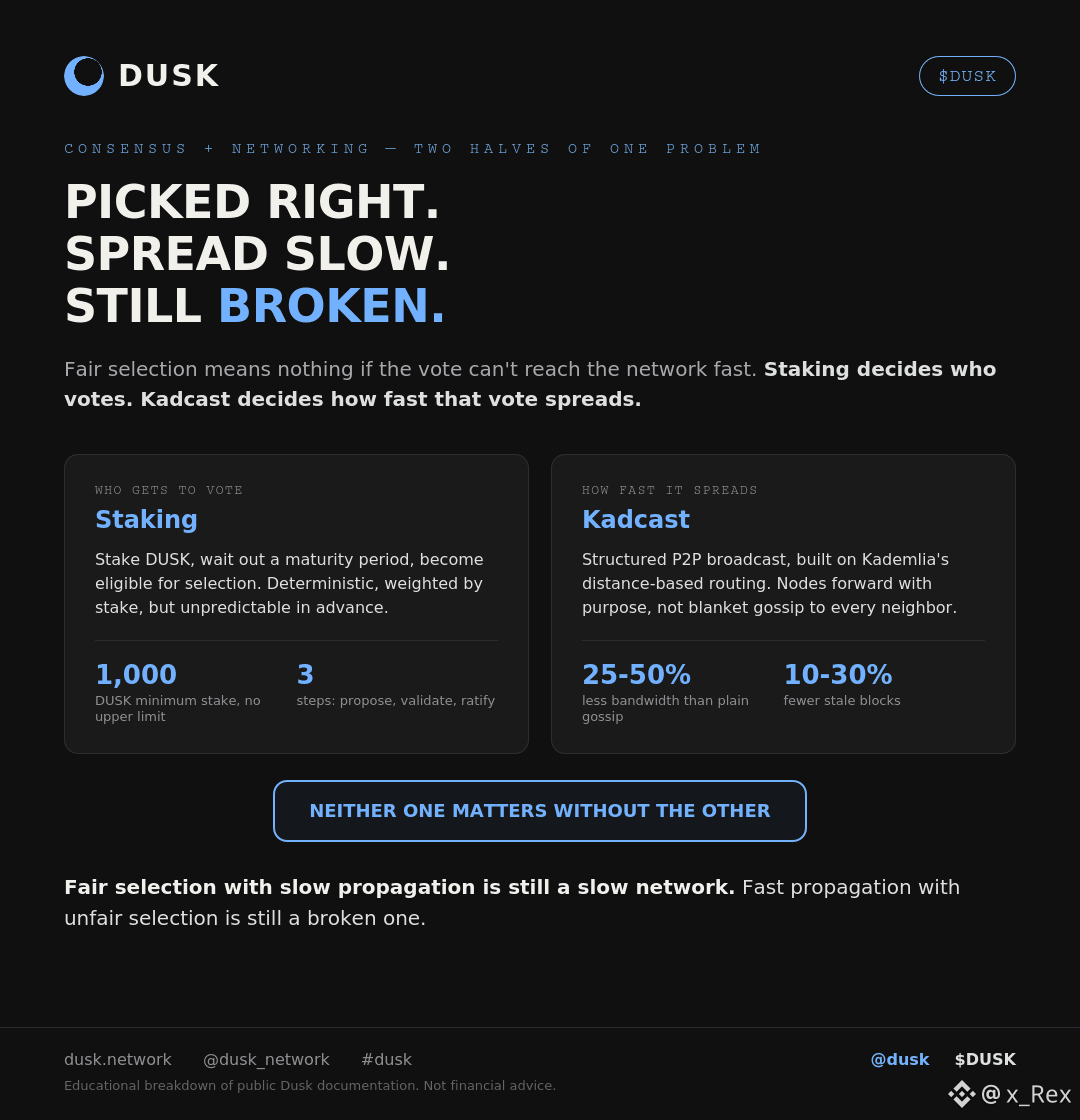
Staking decides who gets picked to vote.But picking the right validator solves nothing if their vote takes forever to reach the network.
That's what Kadcast is for.
Most blockchain networks broadcast the blunt way.
Gossip, where a node forwards to neighbors who forward to more neighbors, with a lot of duplicate transmission.
Kadcast is more structured.
It's built on Kademlia, the distributed hash table design used in peer-to-peer file systems, and routes messages based on how far nodes are from each other, not just who's nearby.
The number that surprised me: this gets roughly 25 to 50 percent less bandwidth usage than plain gossip, since nodes aren't blasting the same message at everyone in range.
There's a knock-on effect too, about a 10 to 30 percent drop in stale blocks, blocks that got produced but didn't make the final chain in time.
Less wasted propagation means fewer blocks that show up too late to count.
Once I connected the two, staking and Kadcast stopped looking like separate topics.
One decides who gets to vote.
The other decides how fast that vote spreads to everyone who needs it.
Fair selection with slow propagation is still a slow network.
Fast propagation with unfair selection is still a broken one.
Nobody writes threads about the P2P layer. Privacy gets threads. Compliance gets threads. But this is the piece deciding whether a fast consensus mechanism is fast in practice or just fast on paper.
Genuinely curious though Does Kadcast's advantage grow with network size, or shrink once validators are already few and well-connected?
Also.
Is bandwidth efficiency an actual edge for a financial-settlement chain, or is fast message propagation a solved problem industry-wide already?
Someone replied to my last Dusk post asking why I never explained the block reward split.
A FAIR CALLOUT👍.
So I went to whitepaper yesterday again, to answer it properly, and got stuck on a different section instead: how a block that just got voted on actually reaches everyone else fast enough to matter.
Staking decides who gets picked to vote.But picking the right validator solves nothing if their vote takes forever to reach the network.
That's what Kadcast is for.
Most blockchain networks broadcast the blunt way.
Gossip, where a node forwards to neighbors who forward to more neighbors, with a lot of duplicate transmission.
Kadcast is more structured.
It's built on Kademlia, the distributed hash table design used in peer-to-peer file systems, and routes messages based on how far nodes are from each other, not just who's nearby.
The number that surprised me: this gets roughly 25 to 50 percent less bandwidth usage than plain gossip, since nodes aren't blasting the same message at everyone in range.
There's a knock-on effect too, about a 10 to 30 percent drop in stale blocks, blocks that got produced but didn't make the final chain in time.
Less wasted propagation means fewer blocks that show up too late to count.
Once I connected the two, staking and Kadcast stopped looking like separate topics.
One decides who gets to vote.
The other decides how fast that vote spreads to everyone who needs it.
Fair selection with slow propagation is still a slow network.
Fast propagation with unfair selection is still a broken one.
Nobody writes threads about the P2P layer. Privacy gets threads. Compliance gets threads. But this is the piece deciding whether a fast consensus mechanism is fast in practice or just fast on paper.
Genuinely curious though Does Kadcast's advantage grow with network size, or shrink once validators are already few and well-connected?
Also.
Is bandwidth efficiency an actual edge for a financial-settlement chain, or is fast message propagation a solved problem industry-wide already?