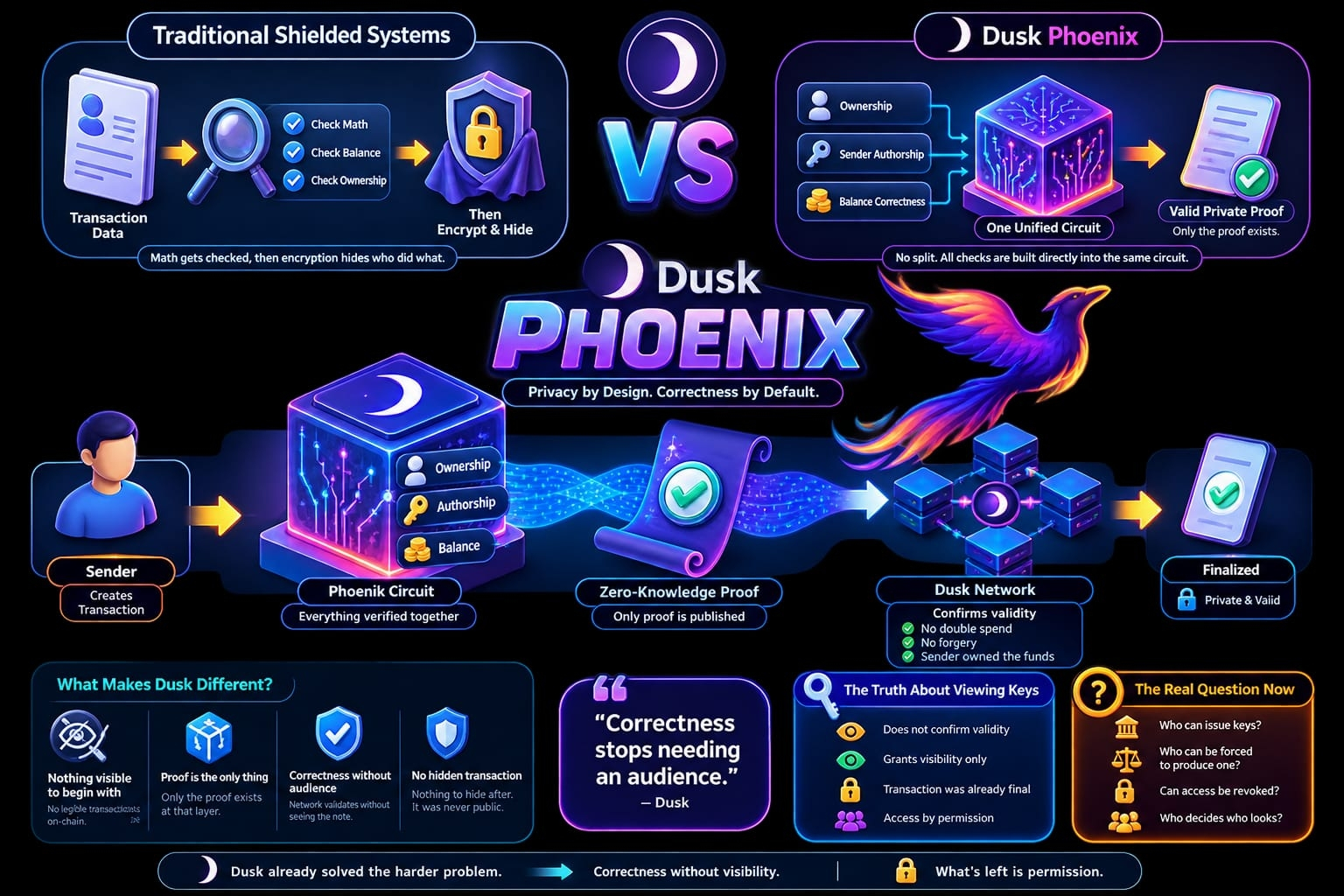

#dusk $DUSK @Dusk I used to think Dusk's Phoenix worked like most shielded systems, math gets checked, then encryption hides who did what. Looking closer at how it actually verifies a transaction, that split doesn't exist. Ownership, sender authorship, balance correctness, none of it gets checked separately and then wrapped in privacy afterward. It's built directly into the same circuit that proves the transaction is valid in the first place.
That's the part that took me a while to actually sit with. There's no visible transaction sitting somewhere on @Dusk that later gets curtained off. The proof is the only thing that ever exists at that layer. Nothing was legible to begin with, so there was nothing to hide. Normally you trust a transaction because you can trace it yourself, inputs, outputs, all sitting in the open. Dusk flips that. The network confirms nothing was double spent, nothing was forged, and the sender actually owned what they moved, all without anyone ever seeing the note. Correctness on Dusk stops needing an audience.
Which changes what a viewing key on @Dusk is actually doing. It's tempting to think of it as unlocking some hidden truth, like the key finally reveals what really happened underneath. But the transaction was already correct before anyone held a key. It was already final the moment consensus accepted it. The key doesn't confirm validity, it grants visibility into something whose validity was never in question to begin with.
So when a regulator or exchange checks a Dusk transaction with a viewing key, they're not verifying anything the network hadn't already settled on its own. They're being let into a room that was locked for everyone else, and the lock was never about correctness. It was about permission.
Which means the interesting fight on $DUSK was never really cryptographic. It's about who gets to issue keys, who can be compelled to produce one, and whether access can be pulled back once it's handed out. $DUSK already solved the harder problem, correctness without visibility.
#dusk
That's the part that took me a while to actually sit with. There's no visible transaction sitting somewhere on @Dusk that later gets curtained off. The proof is the only thing that ever exists at that layer. Nothing was legible to begin with, so there was nothing to hide. Normally you trust a transaction because you can trace it yourself, inputs, outputs, all sitting in the open. Dusk flips that. The network confirms nothing was double spent, nothing was forged, and the sender actually owned what they moved, all without anyone ever seeing the note. Correctness on Dusk stops needing an audience.
Which changes what a viewing key on @Dusk is actually doing. It's tempting to think of it as unlocking some hidden truth, like the key finally reveals what really happened underneath. But the transaction was already correct before anyone held a key. It was already final the moment consensus accepted it. The key doesn't confirm validity, it grants visibility into something whose validity was never in question to begin with.
So when a regulator or exchange checks a Dusk transaction with a viewing key, they're not verifying anything the network hadn't already settled on its own. They're being let into a room that was locked for everyone else, and the lock was never about correctness. It was about permission.
Which means the interesting fight on $DUSK was never really cryptographic. It's about who gets to issue keys, who can be compelled to produce one, and whether access can be pulled back once it's handed out. $DUSK already solved the harder problem, correctness without visibility.
#dusk