I used to think blockchain privacy was almost an all or nothing thing.But the deeper I looked into Dusk the more I realized privacy isn’t that simple. It made me even more curious could there actually be a practical middle ground between privacy and transparency? @Dusk #dusk $DUSK
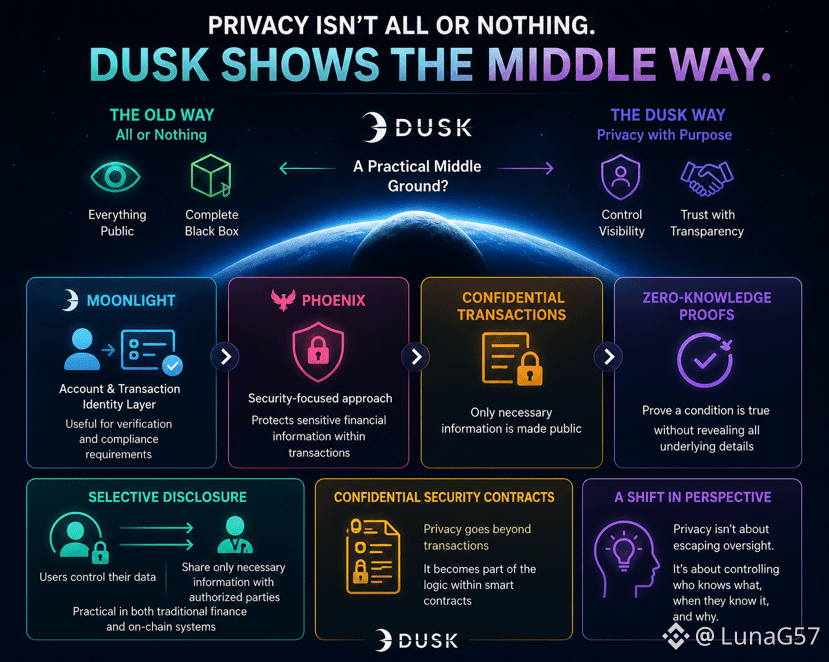
Moonlight stood out to me as an account and transaction identity layer especially in situations where verification and compliance are still important. Meanwhile Phoenix takes a more security focused approach helping protect sensitive financial information within transactions.
What I found most interesting is that Dusk isn’t simply about hiding transactions. Confidential transactions can make only the necessary information public. Zero knowledge proofs take this idea even furtheryou can prove that a condition is true without revealing all the underlying details.
That’s where selective disclosure started to make a lot of sense to me. Even in traditional finance, not everyone has access to every detail of a transaction. Similarly, on-chain systems may need to let users maintain control over their data while sharing only the information required with authorized parties.
Confidential Security Contracts take this idea even further privacy doesn’t have to be limited to transactions; it can become part of the logic within smart contracts themselves.
Looking at Dusk this way completely changed my perspective. Privacy isn’t about escaping oversight. It’s about controlling who gets to know what when they know it and why. @Dusk #dusk $DUSK
Moonlight stood out to me as an account and transaction identity layer especially in situations where verification and compliance are still important. Meanwhile Phoenix takes a more security focused approach helping protect sensitive financial information within transactions.
What I found most interesting is that Dusk isn’t simply about hiding transactions. Confidential transactions can make only the necessary information public. Zero knowledge proofs take this idea even furtheryou can prove that a condition is true without revealing all the underlying details.
That’s where selective disclosure started to make a lot of sense to me. Even in traditional finance, not everyone has access to every detail of a transaction. Similarly, on-chain systems may need to let users maintain control over their data while sharing only the information required with authorized parties.
Confidential Security Contracts take this idea even further privacy doesn’t have to be limited to transactions; it can become part of the logic within smart contracts themselves.
Looking at Dusk this way completely changed my perspective. Privacy isn’t about escaping oversight. It’s about controlling who gets to know what when they know it and why. @Dusk #dusk $DUSK