#dusk $DUSK @Dusk
Selective Disclosure Won't Save Dusk If Nobody Uses the Audit Key**
I keep coming back to one question with Dusk Network: privacy tech for regulated finance sounds elegant on a whiteboard, but who actually holds the key that unlocks the disclosure, and what stops that key from becoming the weakest link in the whole system?
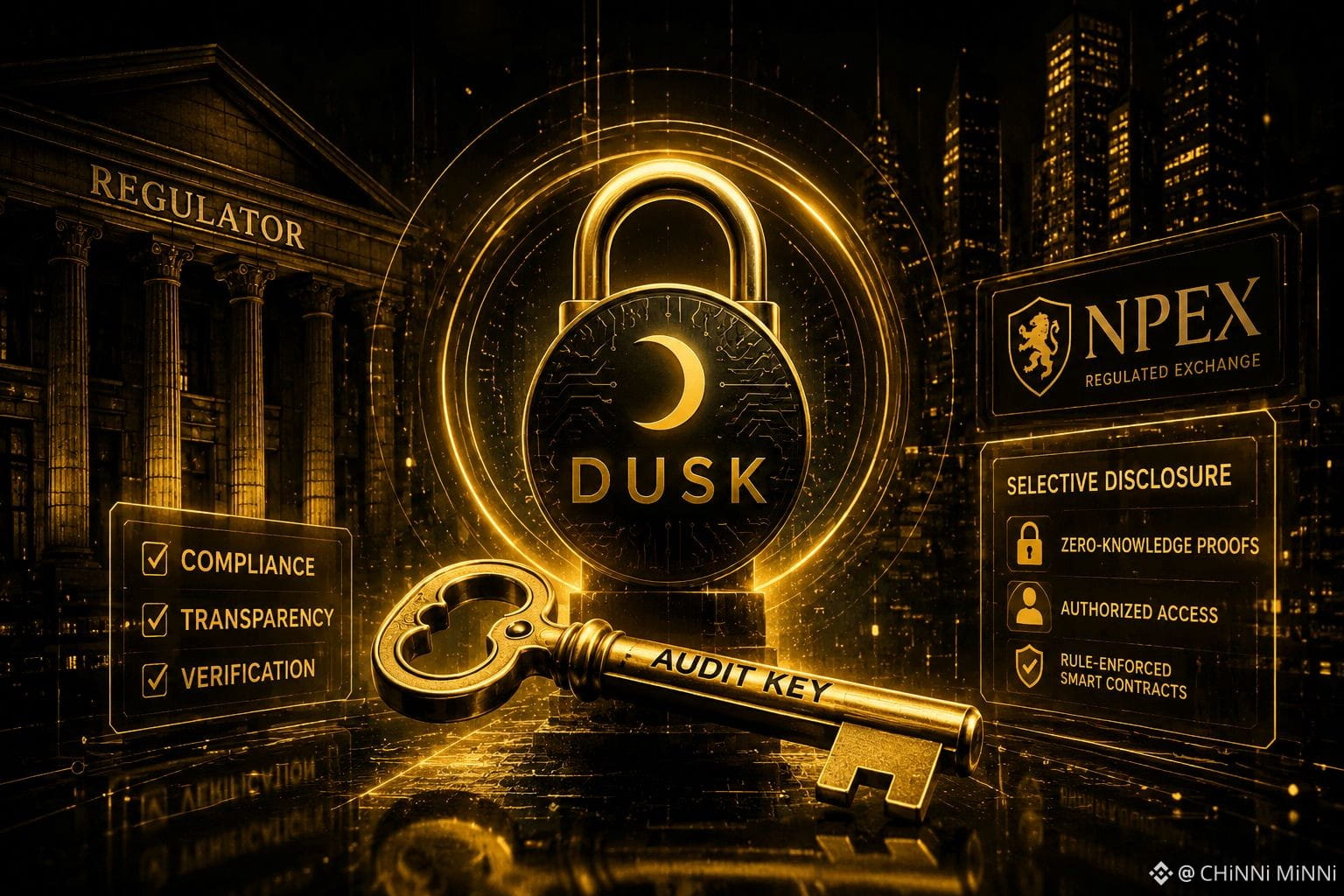
Dusk's answer is selective disclosure — zero-knowledge proofs let a transaction stay encrypted from the public while still letting an authorized party verify compliance through cryptographic attestations rather than raw data exposure Paired with deterministic settlement and rule-enforced smart contracts, the idea is that regulators can confirm eligibility or transfer restrictions without ever touching the underlying transaction data That's a genuinely different posture from most privacy chains, which treat regulators as adversaries to route around rather than parties to accommodate.
The structural bet here isn't really cryptographic — it's institutional. Dusk's growing tie-up with NPEX, a regulated Dutch exchange, matters more than the ZK math itself, because it integrates regulated-market experience with tokenization infrastructure for issuance, trading, and settlement That's where the real test sits: does a national regulator ever actually invoke the disclosure mechanism in a dispute, or does it stay theoretical while the marketing narrative does the heavy lifting?
My concern is concentration risk in who controls audit access, and whether "compliant privacy" becomes a selling point that's rarely operationally exercised until a regulator forces the question during a real enforcement case.
Selective Disclosure Won't Save Dusk If Nobody Uses the Audit Key**
I keep coming back to one question with Dusk Network: privacy tech for regulated finance sounds elegant on a whiteboard, but who actually holds the key that unlocks the disclosure, and what stops that key from becoming the weakest link in the whole system?
Dusk's answer is selective disclosure — zero-knowledge proofs let a transaction stay encrypted from the public while still letting an authorized party verify compliance through cryptographic attestations rather than raw data exposure Paired with deterministic settlement and rule-enforced smart contracts, the idea is that regulators can confirm eligibility or transfer restrictions without ever touching the underlying transaction data That's a genuinely different posture from most privacy chains, which treat regulators as adversaries to route around rather than parties to accommodate.
The structural bet here isn't really cryptographic — it's institutional. Dusk's growing tie-up with NPEX, a regulated Dutch exchange, matters more than the ZK math itself, because it integrates regulated-market experience with tokenization infrastructure for issuance, trading, and settlement That's where the real test sits: does a national regulator ever actually invoke the disclosure mechanism in a dispute, or does it stay theoretical while the marketing narrative does the heavy lifting?
My concern is concentration risk in who controls audit access, and whether "compliant privacy" becomes a selling point that's rarely operationally exercised until a regulator forces the question during a real enforcement case.