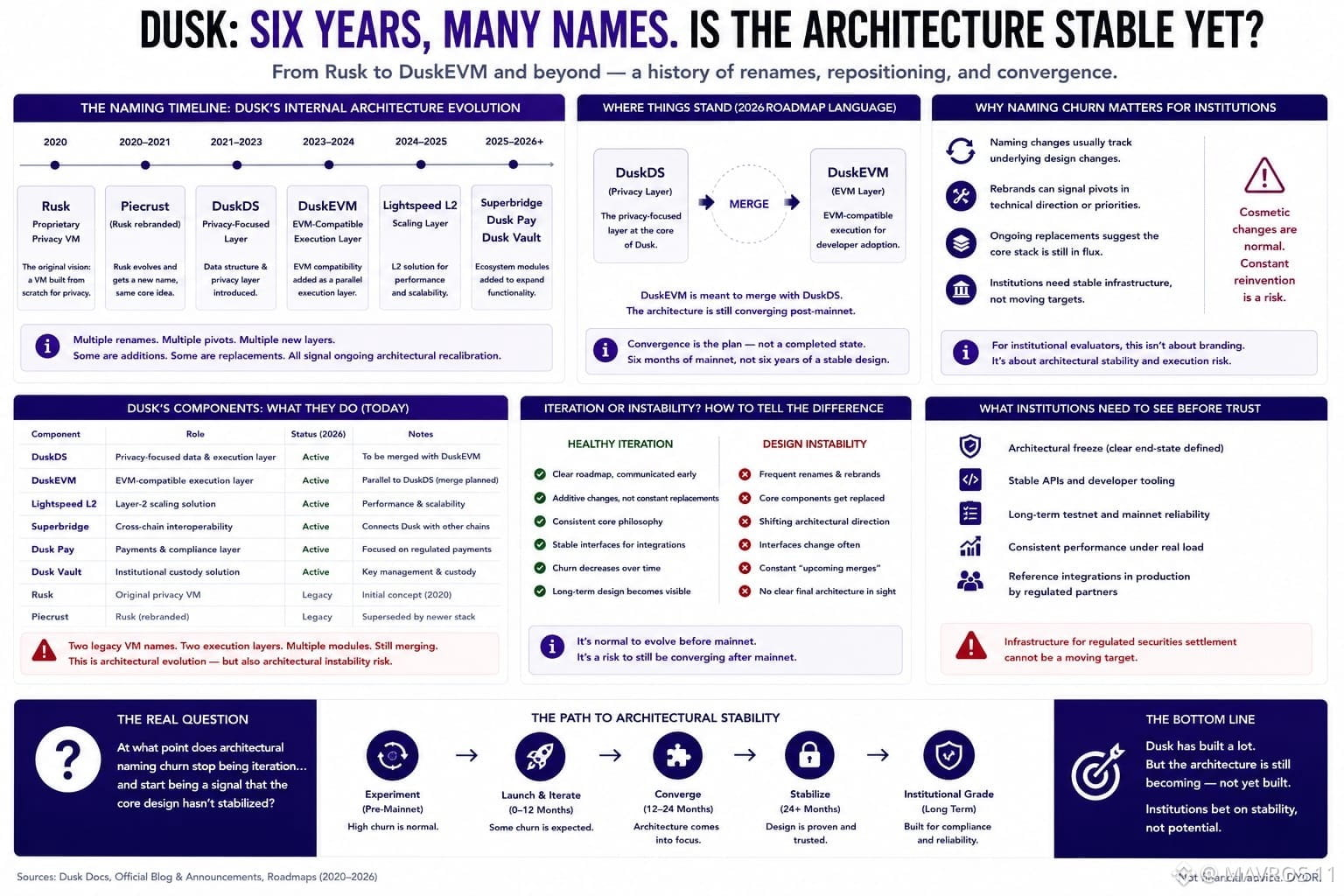
Went back through years of @Dusk 's own materials and started listing every internal component name: Rusk, Piecrust, DuskDS, DuskEVM, Lightspeed L2, Superbridge, Dusk Pay, Dusk Vault. That's a lot of naming turnover for a single chain's core architecture over roughly six years of development.
hmmm .Some of this is normal — projects rename things, rebrand VMs, add new modules as scope expands. But the pattern here is worth flagging: several of these aren't additions, they're replacements or repositioning of earlier components. The privacy-focused VM went through at least one rename before DuskEVM appeared as a parallel, EVM-compatible execution layer. "DuskDS" shows up in 2026 roadmap language as the privacy-focused layer that DuskEVM is meant to merge with — meaning even now, post-mainnet, the architecture is described as still converging rather than settled.
For institutional evaluators doing technical due diligence, naming churn isn't cosmetic. It usually tracks underlying design churn — components getting rescoped, rebuilt, or reconceived mid-flight. That's normal in pre-mainnet R&D. It's a different signal six months after mainnet launch, when the "core infrastructure" is supposed to be the stable part institutions build custody and compliance tooling against.
None of this means the current architecture is wrong. It means the six-year history shows a project still actively converging on its own design, even post-launch.
At what point does architectural naming churn stop being iteration and start being a signal that the core design hasn't actually stabilized?$DUSK #dusk
hmmm .Some of this is normal — projects rename things, rebrand VMs, add new modules as scope expands. But the pattern here is worth flagging: several of these aren't additions, they're replacements or repositioning of earlier components. The privacy-focused VM went through at least one rename before DuskEVM appeared as a parallel, EVM-compatible execution layer. "DuskDS" shows up in 2026 roadmap language as the privacy-focused layer that DuskEVM is meant to merge with — meaning even now, post-mainnet, the architecture is described as still converging rather than settled.
For institutional evaluators doing technical due diligence, naming churn isn't cosmetic. It usually tracks underlying design churn — components getting rescoped, rebuilt, or reconceived mid-flight. That's normal in pre-mainnet R&D. It's a different signal six months after mainnet launch, when the "core infrastructure" is supposed to be the stable part institutions build custody and compliance tooling against.
None of this means the current architecture is wrong. It means the six-year history shows a project still actively converging on its own design, even post-launch.
At what point does architectural naming churn stop being iteration and start being a signal that the core design hasn't actually stabilized?$DUSK #dusk