
Look ,I’ve been looking into Dusk Network, and the more I read, the less I think its story is simply about “privacy.”
The harder question is whether privacy can actually work as financial infrastructure.
Traditional finance can’t just hide everything. Institutions need confidentiality around positions, identities, and transactions, but they also need to prove ownership, satisfy compliance, and reveal information when the right party is authorised to see it.
That’s what makes Dusk interesting to me.
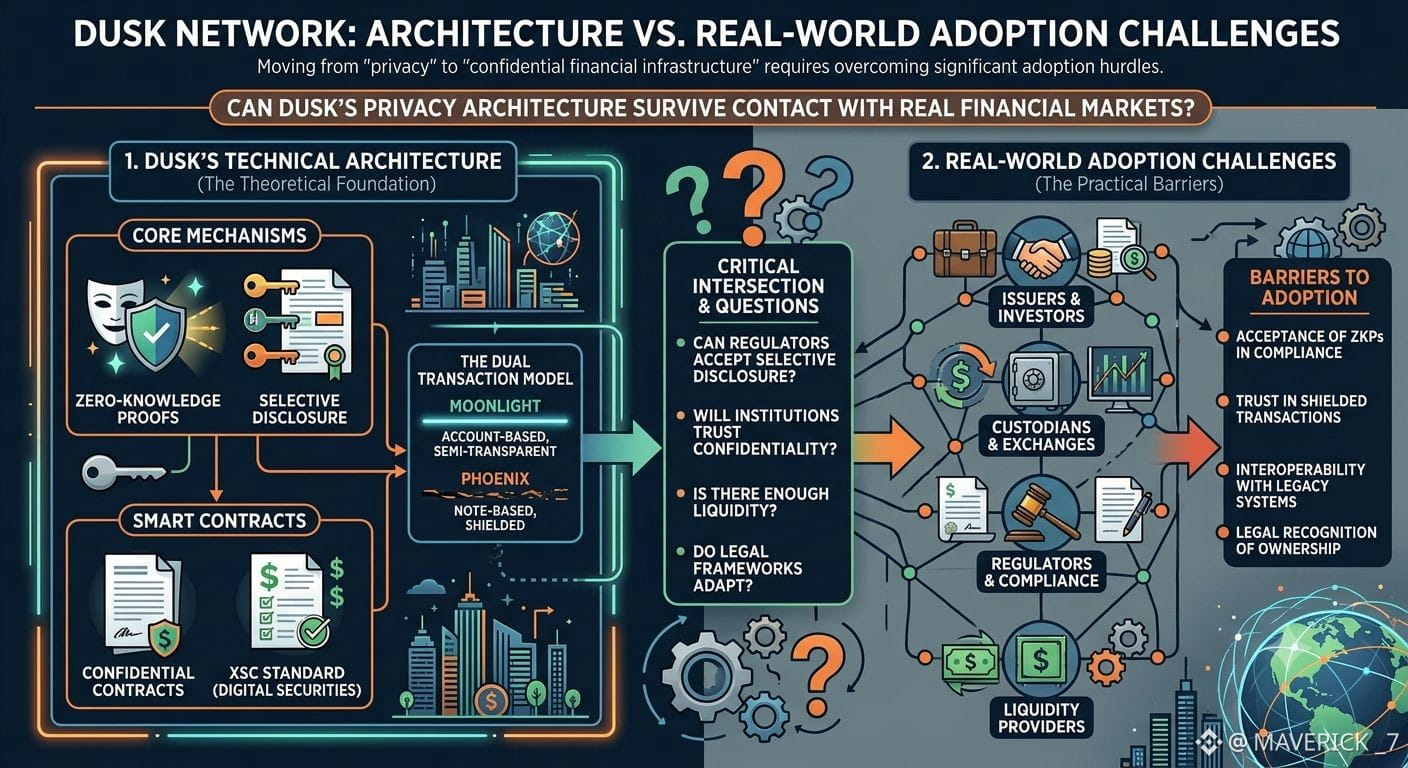
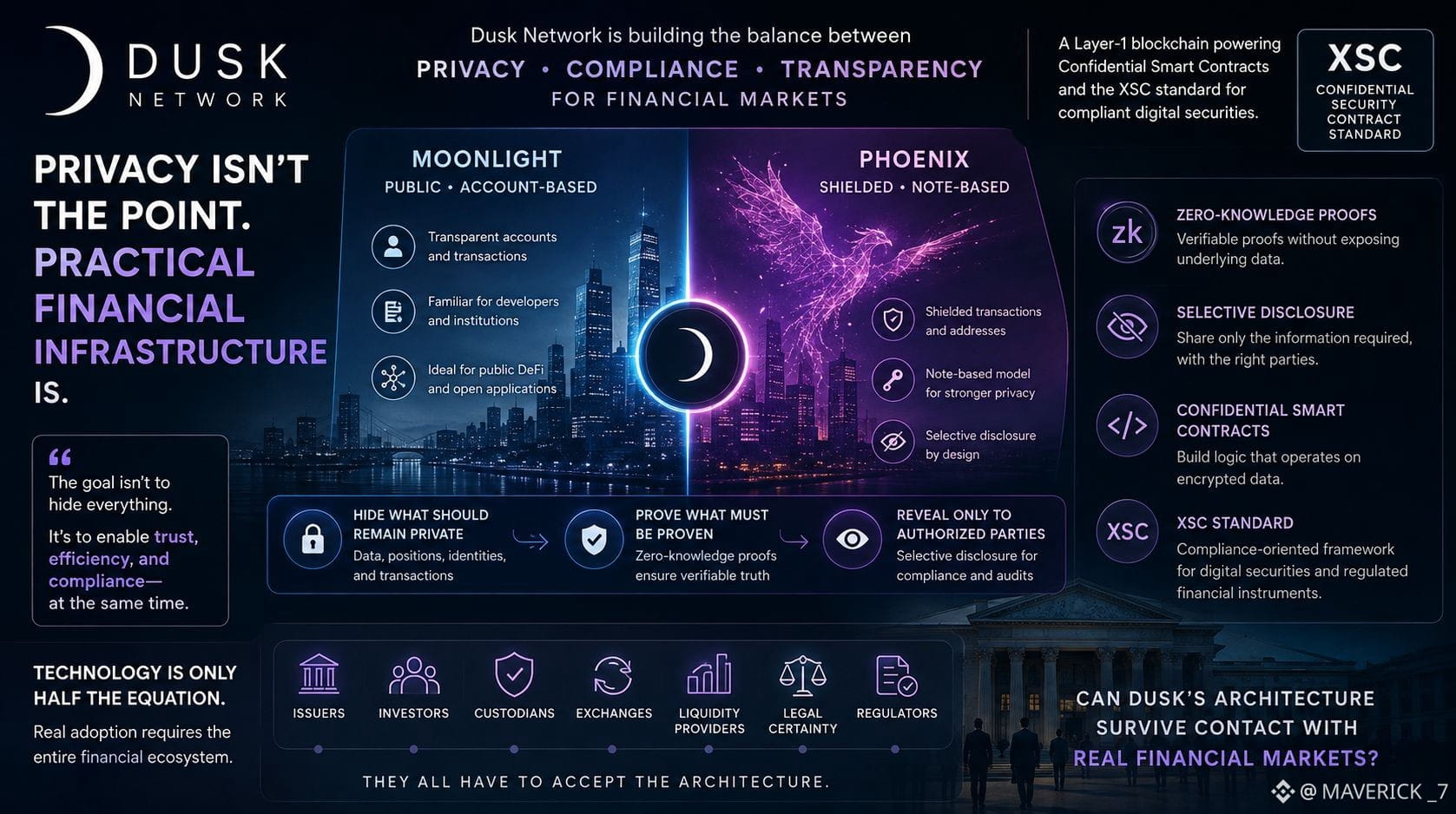
Moonlight takes a more familiar public, account-based approach, while Phoenix moves toward shielded, note-based transactions. Around that, zero-knowledge proofs and selective disclosure create a more nuanced model: keep sensitive information private, while proving only what actually needs to be proven.
Dusk’s confidential smart contracts and XSC standard also push the idea toward digital securities and compliance, rather than treating privacy as the final objective.
Still, I’m not convinced architecture alone is enough.
Real adoption depends on issuers, investors, custodians, exchanges, liquidity, regulators, and legal frameworks accepting how the system works.
That’s the part I’ll be watching.
Can Dusk’s architecture survive contact with real financial markets?
@Dusk
#dusk
$DUSK
The harder question is whether privacy can actually work as financial infrastructure.
Traditional finance can’t just hide everything. Institutions need confidentiality around positions, identities, and transactions, but they also need to prove ownership, satisfy compliance, and reveal information when the right party is authorised to see it.
That’s what makes Dusk interesting to me.
Moonlight takes a more familiar public, account-based approach, while Phoenix moves toward shielded, note-based transactions. Around that, zero-knowledge proofs and selective disclosure create a more nuanced model: keep sensitive information private, while proving only what actually needs to be proven.
Dusk’s confidential smart contracts and XSC standard also push the idea toward digital securities and compliance, rather than treating privacy as the final objective.
Still, I’m not convinced architecture alone is enough.
Real adoption depends on issuers, investors, custodians, exchanges, liquidity, regulators, and legal frameworks accepting how the system works.
That’s the part I’ll be watching.
Can Dusk’s architecture survive contact with real financial markets?
@Dusk
#dusk
$DUSK