I’ve been poking around Binance Square looking for projects that feel built for something more lasting than the usual cycle of narratives. @Dusk keeps catching my attention for a quiet reason: it treats privacy and regulation as two sides of the same problem rather than opposing forces.
Most public chains still force a blunt trade-off. Either everything sits in the open, which institutions simply will not accept for sensitive positions, or the system leans so hard into anonymity that compliance becomes nearly impossible.
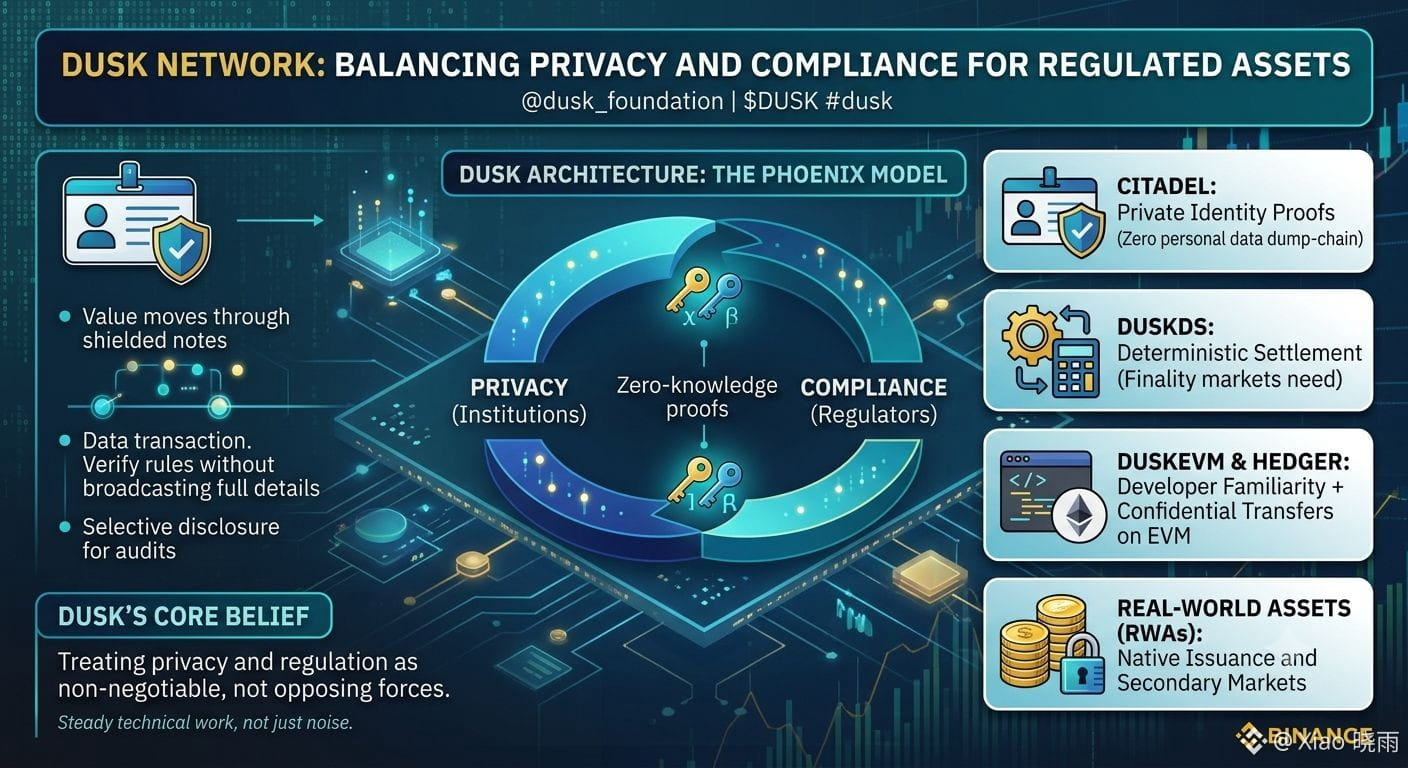
Dusk’s Phoenix model tries a different route. Value moves through shielded notes backed by zero-knowledge proofs. The network can verify that the rules were followed without broadcasting amounts or full participant details. When an auditor or regulator needs to check something, selective disclosure is available. That design choice feels more practical than pure ideology.
The architecture supports the same idea. DuskDS handles settlement with the kind of deterministic finality markets actually need. DuskEVM lets developers work with tools they already know. Hedger adds confidential transfers on the EVM side, and Citadel offers identity proofs that do not dump personal data on-chain.
Together they form infrastructure aimed at native issuance and secondary markets for regulated assets rather than just wrapping existing ones.
Of course the institutional path is slower and messier than pure DeFi experimentation. Partnerships and regulatory alignment take time, and not every privacy system survives real scrutiny. Still, the direction makes sense given how quickly real-world asset conversations have moved from theory into actual pilots across Europe. Watching the steady technical work rather than constant marketing noise has left me more interested in what @Dusk might support over a longer horizon.
#dusk $DUSK $PEPE $ZEC
Most public chains still force a blunt trade-off. Either everything sits in the open, which institutions simply will not accept for sensitive positions, or the system leans so hard into anonymity that compliance becomes nearly impossible.
Dusk’s Phoenix model tries a different route. Value moves through shielded notes backed by zero-knowledge proofs. The network can verify that the rules were followed without broadcasting amounts or full participant details. When an auditor or regulator needs to check something, selective disclosure is available. That design choice feels more practical than pure ideology.
The architecture supports the same idea. DuskDS handles settlement with the kind of deterministic finality markets actually need. DuskEVM lets developers work with tools they already know. Hedger adds confidential transfers on the EVM side, and Citadel offers identity proofs that do not dump personal data on-chain.
Together they form infrastructure aimed at native issuance and secondary markets for regulated assets rather than just wrapping existing ones.
Of course the institutional path is slower and messier than pure DeFi experimentation. Partnerships and regulatory alignment take time, and not every privacy system survives real scrutiny. Still, the direction makes sense given how quickly real-world asset conversations have moved from theory into actual pilots across Europe. Watching the steady technical work rather than constant marketing noise has left me more interested in what @Dusk might support over a longer horizon.
#dusk $DUSK $PEPE $ZEC