
#dusk $DUSK @Dusk
I’ve been watching privacy chains come and go for years. Most of them promised the same thing: institutions will finally show up once the ledger stops broadcasting every balance and counterparty to the world. Then the cycles turned, the narratives got recycled, and the actual volume never really arrived.
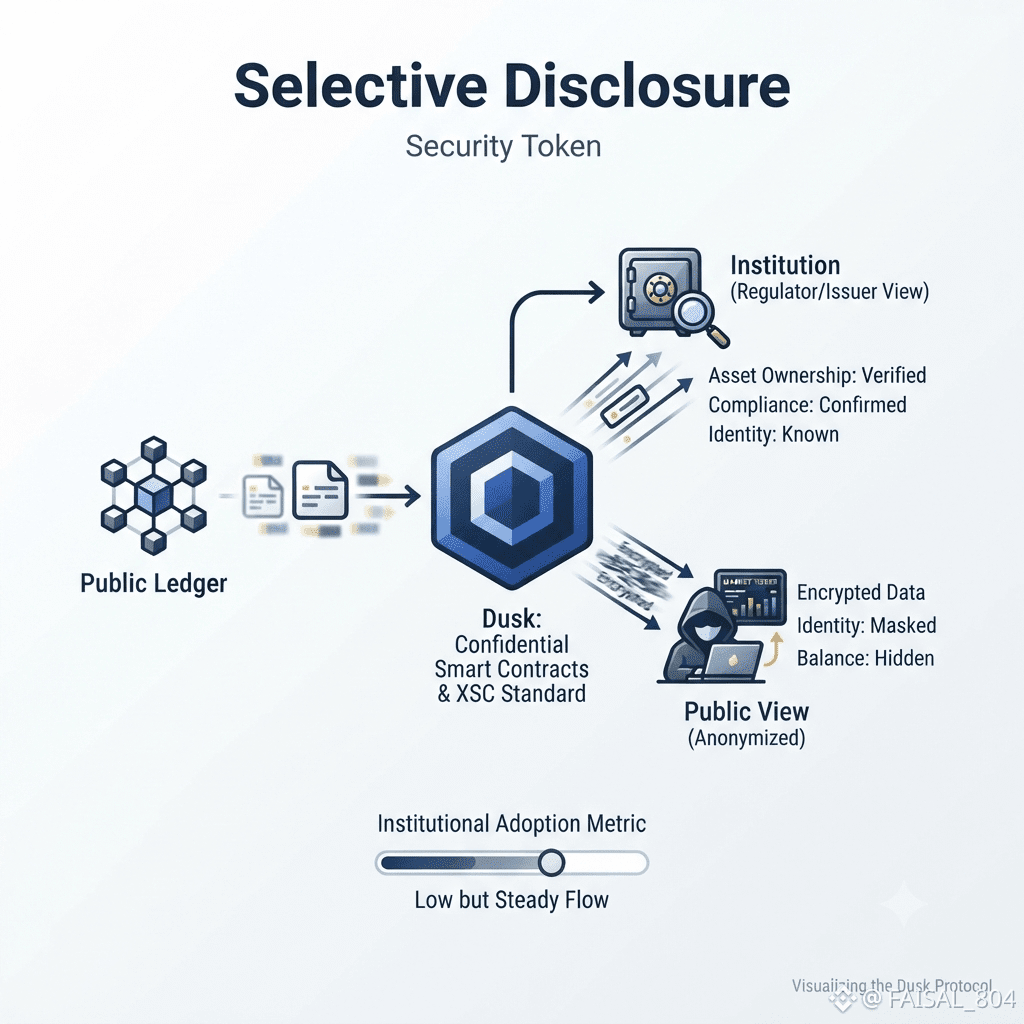
Dusk keeps showing up in that same conversation, but with a narrower focus. It’s not trying to be another general-purpose privacy layer. It’s built around confidential smart contracts and something they call the XSC standard for security tokens. The idea is that you can keep the sensitive parts private while still letting the right parties prove compliance when they need to. Selective disclosure instead of total darkness or total transparency.
I’ve seen versions of this pitch before. The technical pieces look solid on paper—zero-knowledge proofs, dual transaction models, an L1 designed for regulated assets rather than bolted-on later. The hard part has never been the cryptography. It’s the friction of getting real issuers, real venues, and real capital to move anything meaningful on-chain when the incentives, the legal comfort, and the secondary market liquidity all still live elsewhere.
Something about the persistence of the approach feels different from the usual noise. They’re still iterating on the same problem after most others moved on to the next narrative. That doesn’t mean it works. Most things that feel different still fail for ordinary reasons: slow institutional movement, thin activity, the gap between what the tech allows and what the market will actually use.
I’m not sure yet. I don’t fully trust any of these claims until the boring, quiet flow of actual securities starts showing up in measurable volume. But I keep noticing the projects that refuse to abandon the hard version of the problem. They tend to be the ones worth watching a little longer than the rest.
I’ve been watching privacy chains come and go for years. Most of them promised the same thing: institutions will finally show up once the ledger stops broadcasting every balance and counterparty to the world. Then the cycles turned, the narratives got recycled, and the actual volume never really arrived.
Dusk keeps showing up in that same conversation, but with a narrower focus. It’s not trying to be another general-purpose privacy layer. It’s built around confidential smart contracts and something they call the XSC standard for security tokens. The idea is that you can keep the sensitive parts private while still letting the right parties prove compliance when they need to. Selective disclosure instead of total darkness or total transparency.
I’ve seen versions of this pitch before. The technical pieces look solid on paper—zero-knowledge proofs, dual transaction models, an L1 designed for regulated assets rather than bolted-on later. The hard part has never been the cryptography. It’s the friction of getting real issuers, real venues, and real capital to move anything meaningful on-chain when the incentives, the legal comfort, and the secondary market liquidity all still live elsewhere.
Something about the persistence of the approach feels different from the usual noise. They’re still iterating on the same problem after most others moved on to the next narrative. That doesn’t mean it works. Most things that feel different still fail for ordinary reasons: slow institutional movement, thin activity, the gap between what the tech allows and what the market will actually use.
I’m not sure yet. I don’t fully trust any of these claims until the boring, quiet flow of actual securities starts showing up in measurable volume. But I keep noticing the projects that refuse to abandon the hard version of the problem. They tend to be the ones worth watching a little longer than the rest.