#dusk $DUSK @Dusk
🤔Why are traditional financial institutions still so hesitant to bring real assets onto public blockchains?
In my journey researching RWA tokenization over the past few years.
I’ve realized that the hard part isn’t simply putting an asset on-chain.
Institutions also need the legal framework, investor checks, transfer controls, privacy, and regulated markets around that asset.
That’s what made @Dusk stand out to me.
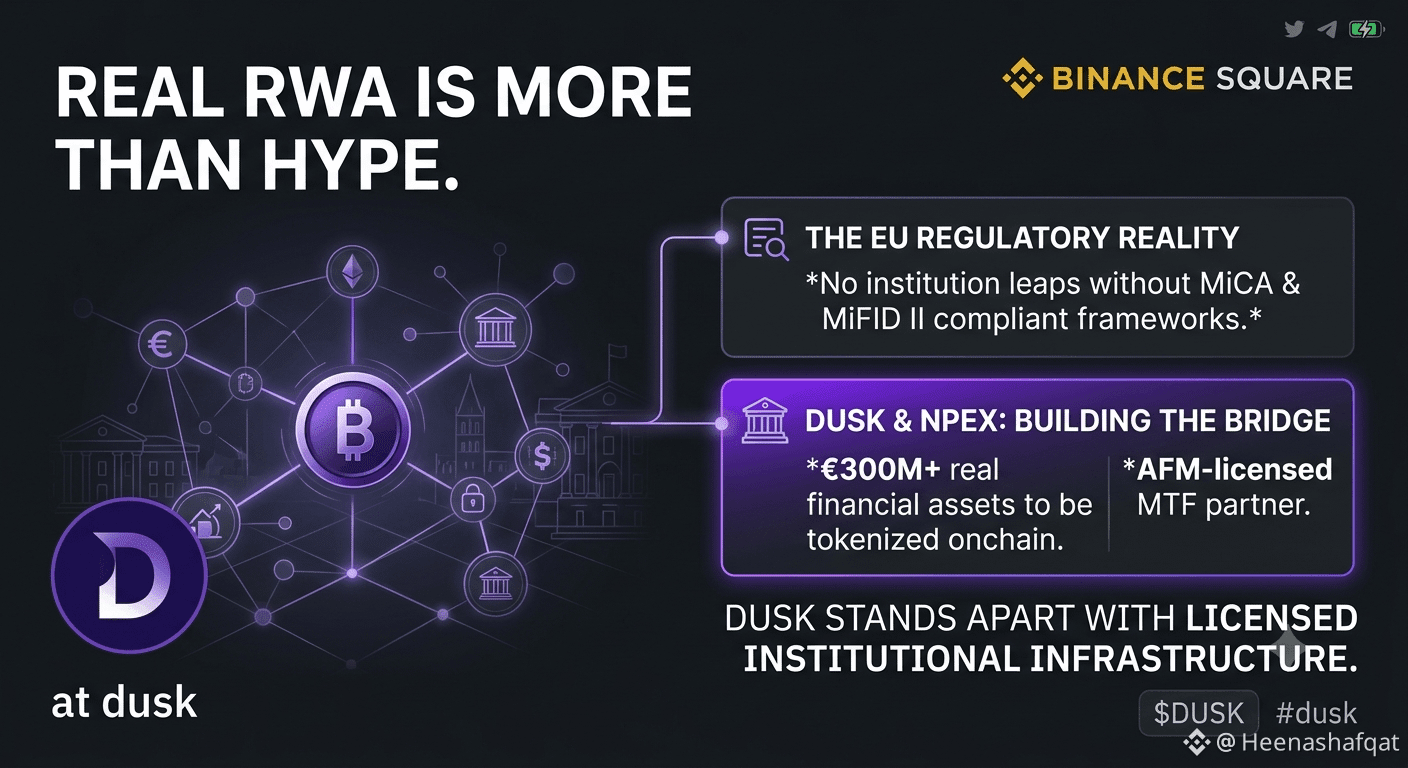
Dusk isn’t approaching #RWA s as just another tokenization narrative. Its work with NPEX, a Dutch stock exchange operating under an MTF license, is a real example of connecting blockchain infrastructure with regulated financial markets. Dusk has also highlighted NPEX’s €300M AUM being brought on-chain.
Then there’s #dusk Trade, which is being built as an investment platform for tokenized assets, covering things like onboarding, buying, selling and settlement workflows.
For me, that changes how I look at $DUSK .
Real RWA adoption isn’t just about creating tokens. It’s about making the whole process workable within the rules financial institutions already operate under.
That’s the part of Dusk I find genuinely interesting.
Do you think regulatory infrastructure is the missing piece for mass RWA adoption, or will institutions eventually move toward more permissionless models?
#dusk $DUSK
🤔Why are traditional financial institutions still so hesitant to bring real assets onto public blockchains?
In my journey researching RWA tokenization over the past few years.
I’ve realized that the hard part isn’t simply putting an asset on-chain.
Institutions also need the legal framework, investor checks, transfer controls, privacy, and regulated markets around that asset.
That’s what made @Dusk stand out to me.
Dusk isn’t approaching #RWA s as just another tokenization narrative. Its work with NPEX, a Dutch stock exchange operating under an MTF license, is a real example of connecting blockchain infrastructure with regulated financial markets. Dusk has also highlighted NPEX’s €300M AUM being brought on-chain.
Then there’s #dusk Trade, which is being built as an investment platform for tokenized assets, covering things like onboarding, buying, selling and settlement workflows.
For me, that changes how I look at $DUSK .
Real RWA adoption isn’t just about creating tokens. It’s about making the whole process workable within the rules financial institutions already operate under.
That’s the part of Dusk I find genuinely interesting.
Do you think regulatory infrastructure is the missing piece for mass RWA adoption, or will institutions eventually move toward more permissionless models?
#dusk $DUSK