#dusk $DUSK @Dusk The biggest RWA mistake is thinking a tokenized share becomes useful the moment it is minted.
Minting is easy. Making that share legally meaningful, private, tradable and settleable is the hard part.
That is what made me look deeper at Dusk. It is often placed inside the broad RWA narrative, but the project is working on the less glamorous part most posts skip: the complete market workflow.
Its latest research on SME financing makes a refreshingly honest point: fractional ownership alone does not create demand, legal certainty or liquidity.
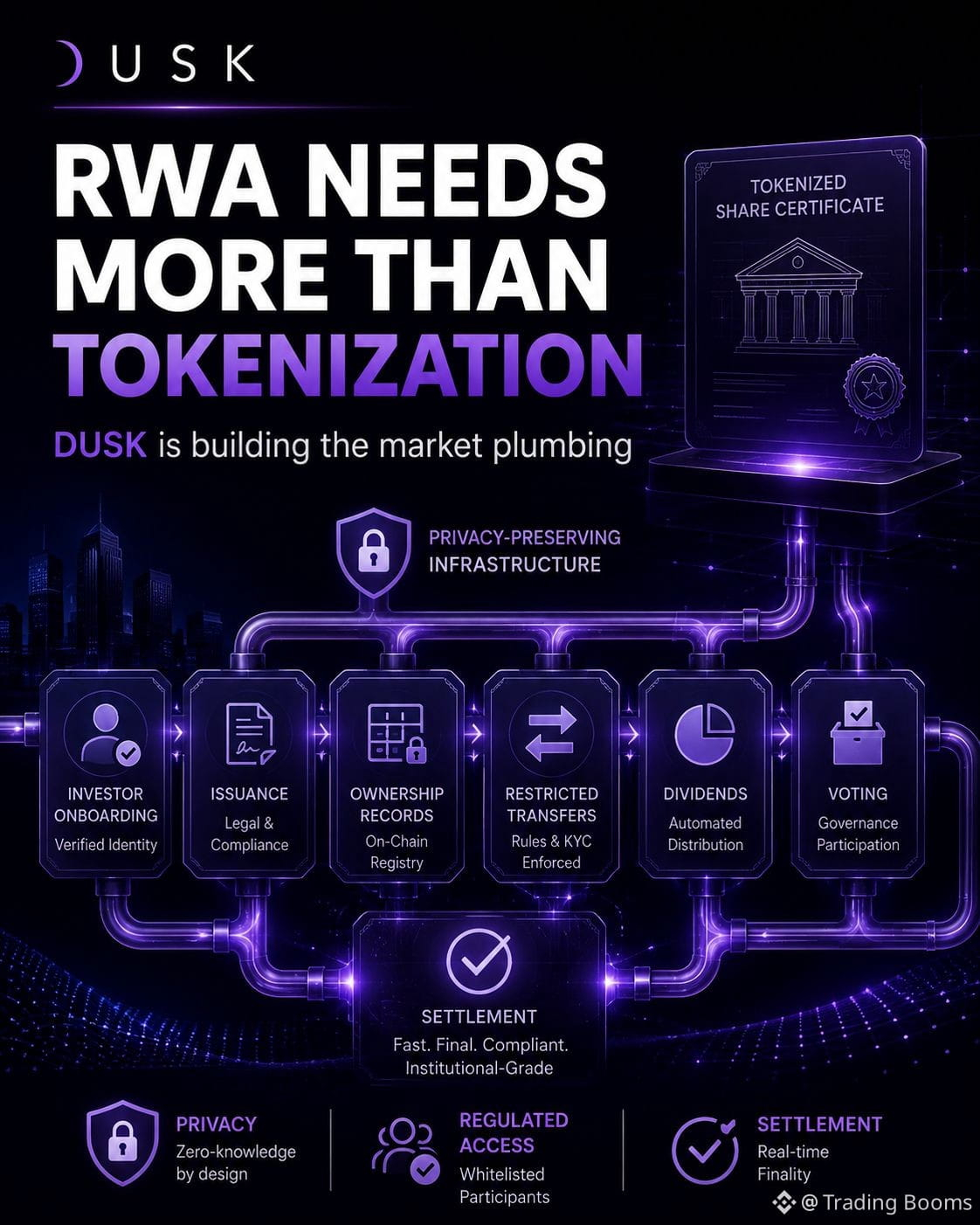
A usable system still has to connect investor checks, issuance, ownership records, transfer restrictions, dividends, voting and settlement—without exposing an investor’s complete financial history to everyone.
Dusk’s answer is a live privacy-preserving L1 with confidential transfers, selective disclosure, ZK smart contracts and deterministic finality of roughly 10 seconds. Dusk Trade is being built around investor onboarding, wallet binding, controlled transfers and payment coordination.
Then there is NPEX: a regulated Dutch market operator whose Dusk case study cites 20,000+ investors and €200M+ in confirmed issuance. That makes this far more interesting than another “tokenize everything” pitch.
My takeaway: Dusk is not trying to replace regulators, venues or legal ownership. It is building shared infrastructure so the same asset does not need to be reconciled across half a dozen disconnected systems.
If this model succeeds, the real value will not be the token wrapper.
It will be the market plumbing underneath it.
Which part matters most for real adoption: privacy, faster settlement, or access to regulated investors?
Minting is easy. Making that share legally meaningful, private, tradable and settleable is the hard part.
That is what made me look deeper at Dusk. It is often placed inside the broad RWA narrative, but the project is working on the less glamorous part most posts skip: the complete market workflow.
Its latest research on SME financing makes a refreshingly honest point: fractional ownership alone does not create demand, legal certainty or liquidity.
A usable system still has to connect investor checks, issuance, ownership records, transfer restrictions, dividends, voting and settlement—without exposing an investor’s complete financial history to everyone.
Dusk’s answer is a live privacy-preserving L1 with confidential transfers, selective disclosure, ZK smart contracts and deterministic finality of roughly 10 seconds. Dusk Trade is being built around investor onboarding, wallet binding, controlled transfers and payment coordination.
Then there is NPEX: a regulated Dutch market operator whose Dusk case study cites 20,000+ investors and €200M+ in confirmed issuance. That makes this far more interesting than another “tokenize everything” pitch.
My takeaway: Dusk is not trying to replace regulators, venues or legal ownership. It is building shared infrastructure so the same asset does not need to be reconciled across half a dozen disconnected systems.
If this model succeeds, the real value will not be the token wrapper.
It will be the market plumbing underneath it.
Which part matters most for real adoption: privacy, faster settlement, or access to regulated investors?