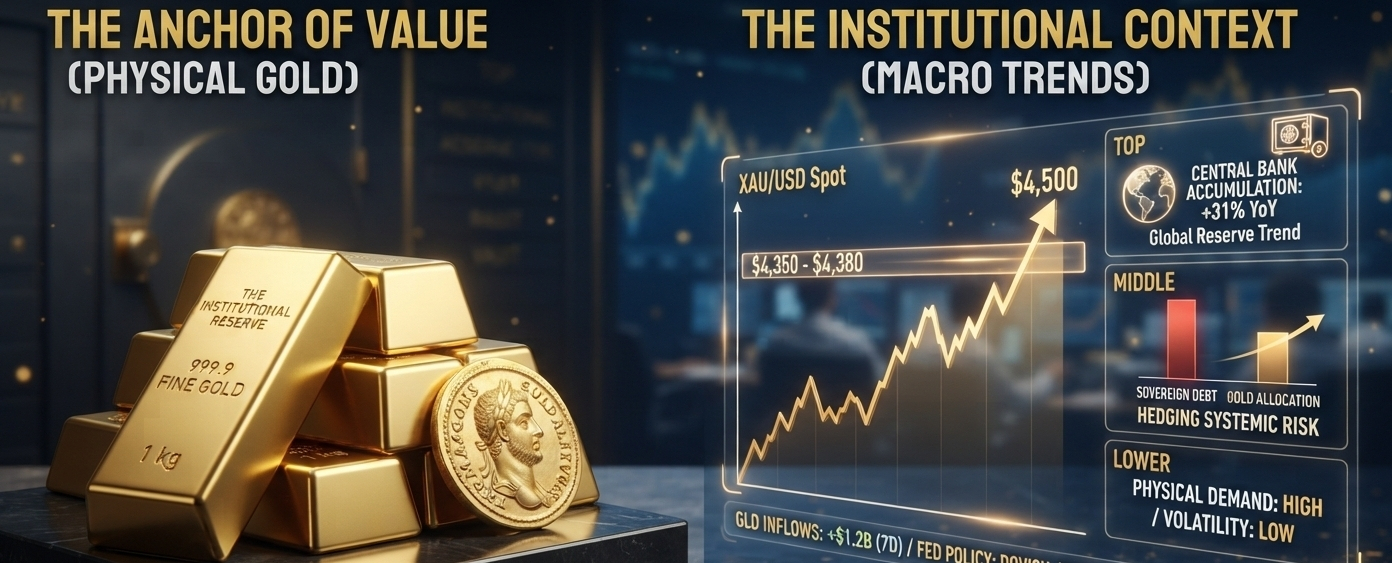

Over the last two weeks I have seen something in the gold market that hasn't been observed since the worst moments of the 2008-2011 financial crisis: the precious metal has broken historical resistances without the dollar collapsing, but with a much more dangerous signal for the system: the US Treasury itself is buying back bonds to ease debt pressure, while the Federal Reserve is hinting at more aggressive rate cuts than expected. And, as if that weren't enough, a bill is being debated in the US Senate that could redefine the country's strategic reserves, placing gold, and possibly Bitcoin, at the center of monetary strategy.
This is not a simple rebound. It is a structural shift in the global perception of sovereign risk. Let me explain why.
1. The trigger: rates, bond buybacks and legislation
The US Treasury's bond buyback is not a minor technical operation. When a government repurchases its own debt in the secondary market, it is sending a clear message: the cost of financing has become unsustainable and it prefers to inject liquidity rather than continue paying rising interest. This, combined with a Fed that can no longer keep rates high without triggering a recession, is creating a perfect cocktail for gold.
Moreover, the bill being discussed in the Senate, promoted by sectors seeking transparency and backing in hard assets, could force the Fed to disclose or even increase its gold reserves. If that moves forward, the price of the metal will not only rise due to demand: it will rise by institutional mandate.
2. Central banks: record accumulation and the end of the unquestionable dollar era
Since 2022, central banks in China, India, Turkey, Poland and several emerging countries have been buying gold at a pace not seen since the 1960s. The reason is simple: they are mitigating the disadvantages in their trade balances and reducing their exposure to the dollar in the face of the risk of sanctions, asset freezes or sharp devaluations.
Gold is the only asset that is no one's liability. It does not depend on a government's promise. That is why, when central banks buy gold, they are not speculating: they are protecting the survival of their economies. And in the last two weeks, purchases have accelerated just as the US announces bond buybacks. That is not a coincidence.
3. Gold cryptos: monetizing the metal without friction
This is where the story gets interesting. Physical gold is a safe haven, but it has a problem: it is difficult to move, divide and use as collateral in the modern financial system. Gold-backed cryptocurrencies (like $PAXG or $XAUT) and real-world asset (RWA) tokenization platforms are solving exactly that.
Advantages of monetizing gold through blockchain:
24/7 liquidity: you can buy or sell fractions of gold at any time, without waiting for the metals market to open.
Infinite divisibility: you can hold the equivalent of $5 in tokenized gold, something impossible with a physical coin.
Programmability: you can use it as collateral in DeFi protocols, earn yield or automate payments.
Transparency and custody: each token is backed by audited physical gold, eliminating the risk of counterfeiting or personal storage.
Regulatory compliance: platforms like @Dusk are building the regulated privacy layer so that these tokenized assets are accepted by traditional financial institutions. It is not just a token: it is infrastructure for the new monetary system.
The future is not choosing between physical gold or crypto. It is tokenized, liquid and programmable gold.
4. Gold forecast for the rest of 2026 and 2027
Based on the current context and assuming the Fed cuts rates at least two more times in 2026 and that bond buybacks continue, my central scenario is:
Rest of 2026: gold will break the psychological barrier of $4,000 per ounce. If the Senate bill advances, we could see an explosive move toward $4,700–$4,800 before December. Corrections will be aggressively bought by central banks and sovereign funds.
2027: if the US economy enters a recession and fiscal deficits soar, gold could seek $4,900-5,000 per ounce. That is not crazy: it would be the continuation of the trend of fiat currencies devaluing against scarce assets. Tokenized gold cryptos will see exponential growth in market capitalization, because they will combine the scarcity of the metal with the efficiency of blockchain.
My personal conclusion: we are at a historic inflection point. Central banks no longer trust paper. Laws are beginning to recognize gold as a strategic asset. And blockchain technology allows, for the first time, any person not just states, to own liquid, divisible and programmable gold.
Gold is not going to disappear. It is going to change form. And those who understand this now will not have to chase the price later.