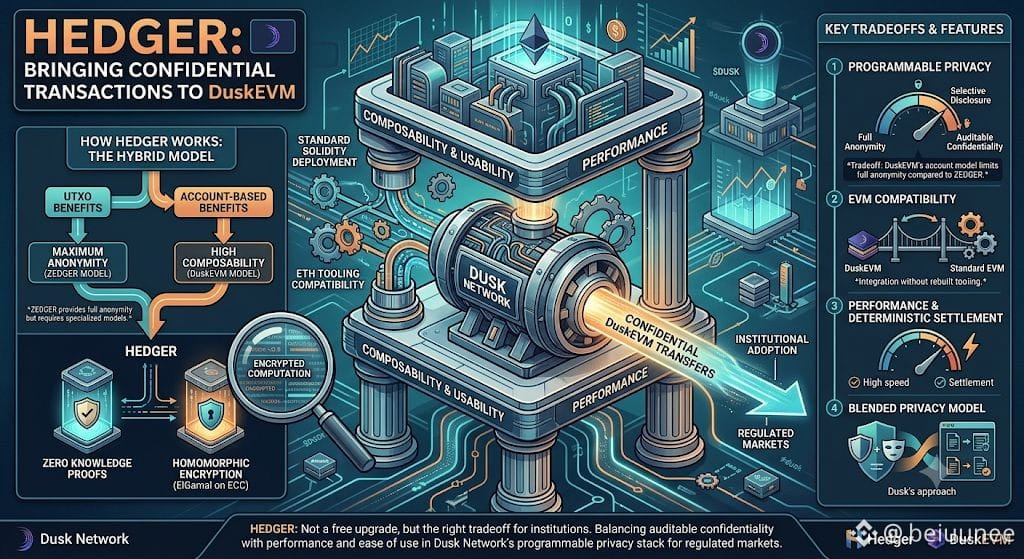
I did not expect a privacy tool named after an insurance term to be one of the more interesting technical reads of my week, but Hedger earned it. Dusk Network built Hedger specifically to bring confidential transactions to DuskEVM, its EVM compatible execution layer, and the engineering choice behind it says a lot about what tradeoffs actually mean in practice.
Most privacy systems in DeFi lean entirely on zero knowledge proofs. Hedger combines that with homomorphic encryption, specifically ElGamal built over elliptic curve cryptography, so computation can happen directly on encrypted values without ever exposing them. Pair that with a hybrid model that borrows from both the UTXO and account based worlds, and you get something built to plug into standard Ethereum tooling instead of asking every integrator to relearn a new mental model. That single design choice is why a team already running Solidity contracts elsewhere can add confidential transfers without rebuilding their existing tooling from scratch.
The honest part of the story, and the part I respect, is that Dusk does not oversell it. Hedger's own documentation admits that because DuskEVM runs on an account based model, it cannot offer the same level of full anonymity that Zedger, Dusk's earlier UTXO based privacy protocol, provides. What Hedger trades away in absolute anonymity it gets back in composability, in performance, and in being usable by any developer who already knows Solidity.
I think that is the right tradeoff for institutional adoption, but it is still a tradeoff, not a free upgrade. It fits the broader pattern across Dusk's stack, blending privacy, transparency, selective disclosure and deterministic settlement into what the team calls programmable privacy for regulated markets. Anyone comparing privacy chains should ask which kind of privacy they actually need, full anonymity or auditable confidentiality, before assuming DuskEVM and Hedger cover every case Zedger was originally built for.
#dusk $DUSK @Dusk
Most privacy systems in DeFi lean entirely on zero knowledge proofs. Hedger combines that with homomorphic encryption, specifically ElGamal built over elliptic curve cryptography, so computation can happen directly on encrypted values without ever exposing them. Pair that with a hybrid model that borrows from both the UTXO and account based worlds, and you get something built to plug into standard Ethereum tooling instead of asking every integrator to relearn a new mental model. That single design choice is why a team already running Solidity contracts elsewhere can add confidential transfers without rebuilding their existing tooling from scratch.
The honest part of the story, and the part I respect, is that Dusk does not oversell it. Hedger's own documentation admits that because DuskEVM runs on an account based model, it cannot offer the same level of full anonymity that Zedger, Dusk's earlier UTXO based privacy protocol, provides. What Hedger trades away in absolute anonymity it gets back in composability, in performance, and in being usable by any developer who already knows Solidity.
I think that is the right tradeoff for institutional adoption, but it is still a tradeoff, not a free upgrade. It fits the broader pattern across Dusk's stack, blending privacy, transparency, selective disclosure and deterministic settlement into what the team calls programmable privacy for regulated markets. Anyone comparing privacy chains should ask which kind of privacy they actually need, full anonymity or auditable confidentiality, before assuming DuskEVM and Hedger cover every case Zedger was originally built for.
#dusk $DUSK @Dusk