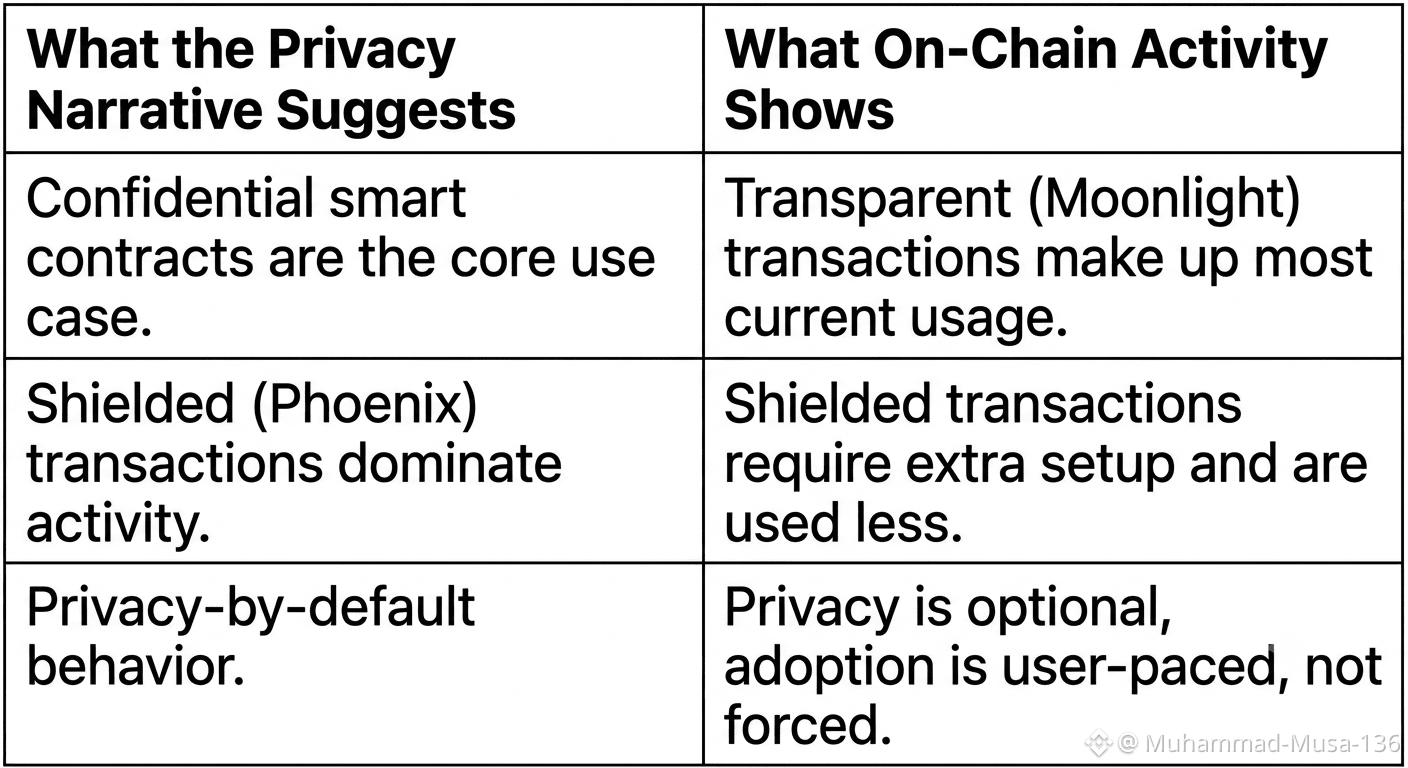
What caught my attention with Dusk wasn't the whitepaper, it was checking explorer activity and seeing how lopsided the two transaction models actually are. $DUSK runs on a dual system, Phoenix for shielded transactions and Moonlight for public ones, and the pitch is usually about confidential smart contracts being the whole point of #Dusk. But when I actually looked at what people are doing on-chain right now, most activity sits on the transparent Moonlight side, not the private one.
That's not a criticism, it's just early behavior. Shielded transactions require more setup, more understanding of proofs, and frankly more trust that you're doing it right, so people default to the simpler path even on a chain built around privacy. @Dusk_Network's own docs are upfront about this being intentional, letting adoption happen at whatever pace users are comfortable with instead of forcing privacy by default. Still, it left me wondering what the real signal is here. Is transparent-heavy usage just a bootstrapping phase, or does it say something about how much retail actually wants privacy when it's optional rather than required.#dusk $DUSK @Dusk
That's not a criticism, it's just early behavior. Shielded transactions require more setup, more understanding of proofs, and frankly more trust that you're doing it right, so people default to the simpler path even on a chain built around privacy. @Dusk_Network's own docs are upfront about this being intentional, letting adoption happen at whatever pace users are comfortable with instead of forcing privacy by default. Still, it left me wondering what the real signal is here. Is transparent-heavy usage just a bootstrapping phase, or does it say something about how much retail actually wants privacy when it's optional rather than required.#dusk $DUSK @Dusk