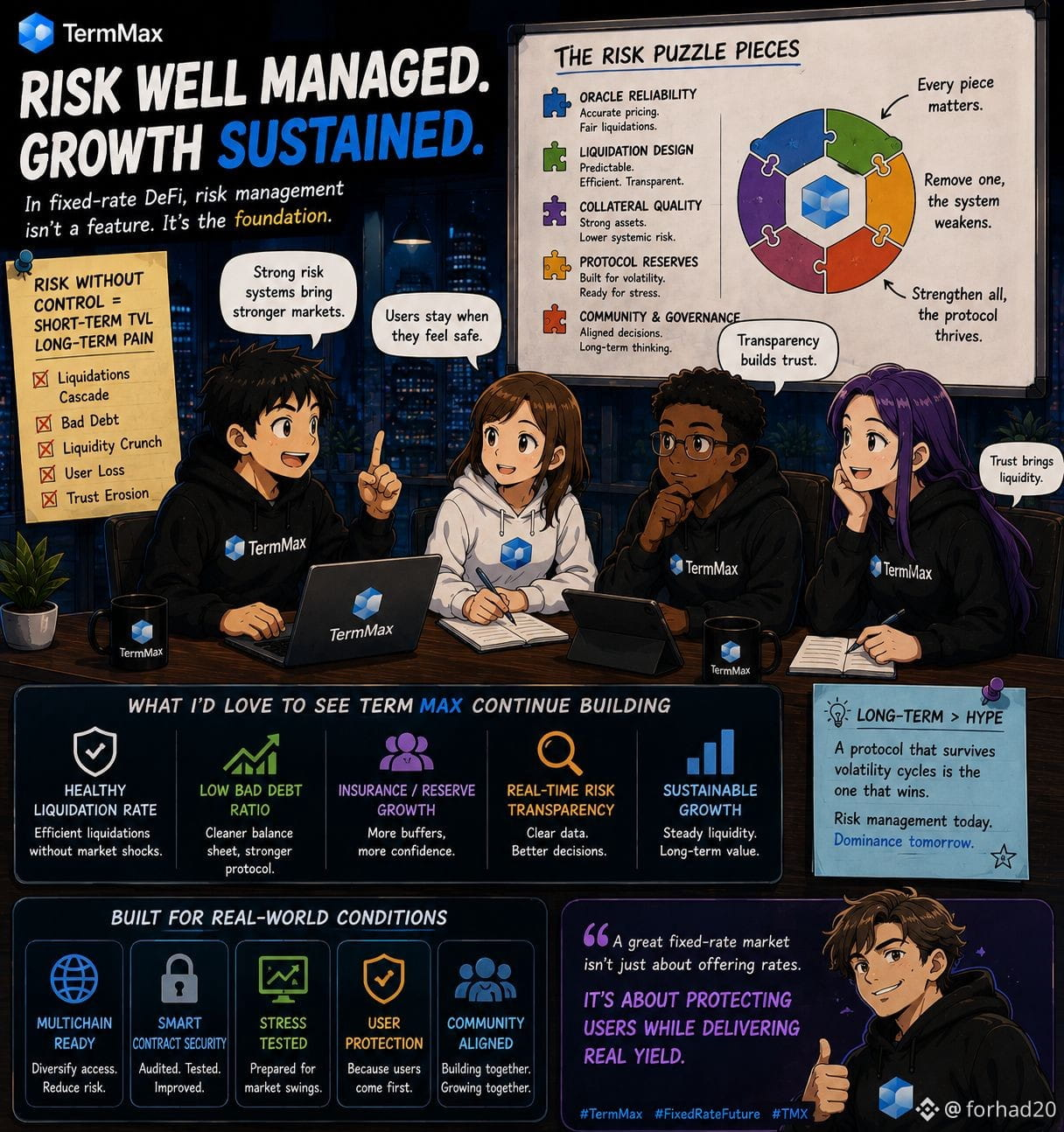
Here’s a TermMax topic I think deserves more attention: risk efficiency.
In DeFi, a high yield is easy to notice.
What’s harder to measure is how much risk the protocol takes to generate that yield.
For a fixed-rate market, I’d watch a different dashboard:
→ Liquidation frequency
→ Bad-debt levels
→ Collateral utilization
→ Available liquidity during volatility
→ How quickly markets recover after a major price move
Because the real stress test isn't a quiet market.
It’s what happens when prices move fast and everyone suddenly wants liquidity at the same time.
That’s where risk design stops being a technical detail and becomes the product itself.
And for TMX, I think sustainable value ultimately has to connect to something tangible:
more usage → deeper markets → stronger liquidity → more reasons for the ecosystem to matter.
I’d rather watch those relationships than chase another headline number.
@TermMax #TermMax
In DeFi, a high yield is easy to notice.
What’s harder to measure is how much risk the protocol takes to generate that yield.
For a fixed-rate market, I’d watch a different dashboard:
→ Liquidation frequency
→ Bad-debt levels
→ Collateral utilization
→ Available liquidity during volatility
→ How quickly markets recover after a major price move
Because the real stress test isn't a quiet market.
It’s what happens when prices move fast and everyone suddenly wants liquidity at the same time.
That’s where risk design stops being a technical detail and becomes the product itself.
And for TMX, I think sustainable value ultimately has to connect to something tangible:
more usage → deeper markets → stronger liquidity → more reasons for the ecosystem to matter.
I’d rather watch those relationships than chase another headline number.
@TermMax #TermMax