I wasn't looking for an AI tool when I ended up on Dusk's GitHub.
I was looking at the project itself.
Then I found Pituitary.
And honestly, the first reaction was:
“Wait… Dusk built this?”
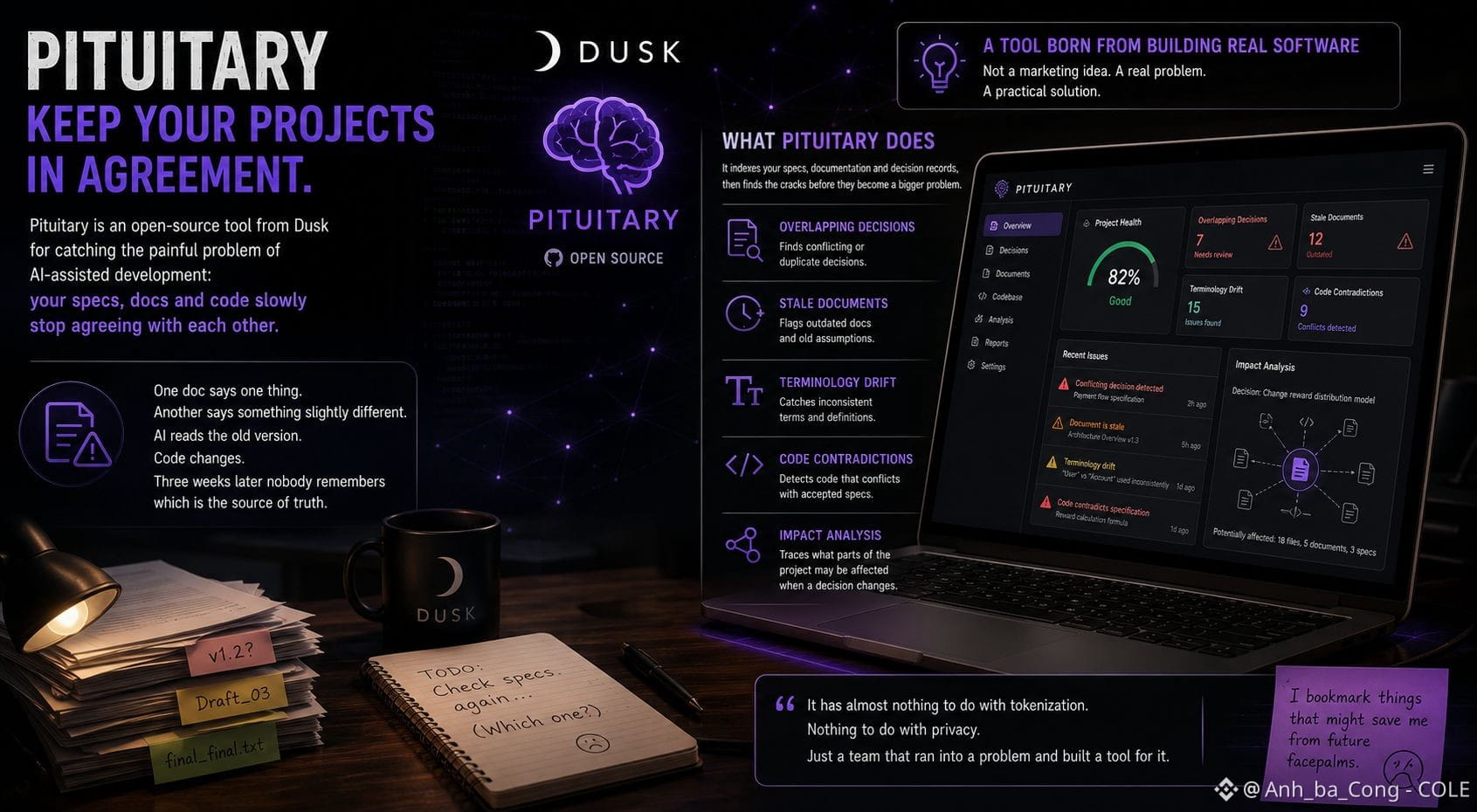
Pituitary is an open-source tool for catching something that has become painfully familiar in AI-assisted development: your specs, documentation and code slowly stop agreeing with each other.
One document says one thing.
Another says something slightly different.
An AI agent reads the older version.
Someone changes the code.
Three weeks later nobody remembers which document was supposed to be the source of truth.
I've actually had versions of this problem myself.
Not with a giant software project.
Even small projects can turn into a mess once there are enough notes, prompts and half-finished ideas lying around.
What Pituitary does is surprisingly straightforward.
It indexes specs, documentation and decision records, then looks for overlapping decisions, stale docs, terminology drift and code that contradicts accepted specifications. It can even trace which parts of a project may be affected when one decision changes.
The weird part is that this has almost nothing to do with the usual Dusk conversation.
No tokenization.
No privacy pitch.
No “financial revolution.”
Just a team that ran into a problem while building software and decided to build a tool for it.
I actually find that more interesting than another shiny feature announcement.
It tells me something about how the team works.
Whether Pituitary becomes widely used is a completely different question.
But I bookmarked it.
Mostly because I know that feeling when you open an old document and realize you've been building on the wrong assumption for two weeks.
That one hurts.#dusk $DUSK @Dusk
I was looking at the project itself.
Then I found Pituitary.
And honestly, the first reaction was:
“Wait… Dusk built this?”
Pituitary is an open-source tool for catching something that has become painfully familiar in AI-assisted development: your specs, documentation and code slowly stop agreeing with each other.
One document says one thing.
Another says something slightly different.
An AI agent reads the older version.
Someone changes the code.
Three weeks later nobody remembers which document was supposed to be the source of truth.
I've actually had versions of this problem myself.
Not with a giant software project.
Even small projects can turn into a mess once there are enough notes, prompts and half-finished ideas lying around.
What Pituitary does is surprisingly straightforward.
It indexes specs, documentation and decision records, then looks for overlapping decisions, stale docs, terminology drift and code that contradicts accepted specifications. It can even trace which parts of a project may be affected when one decision changes.
The weird part is that this has almost nothing to do with the usual Dusk conversation.
No tokenization.
No privacy pitch.
No “financial revolution.”
Just a team that ran into a problem while building software and decided to build a tool for it.
I actually find that more interesting than another shiny feature announcement.
It tells me something about how the team works.
Whether Pituitary becomes widely used is a completely different question.
But I bookmarked it.
Mostly because I know that feeling when you open an old document and realize you've been building on the wrong assumption for two weeks.
That one hurts.#dusk $DUSK @Dusk