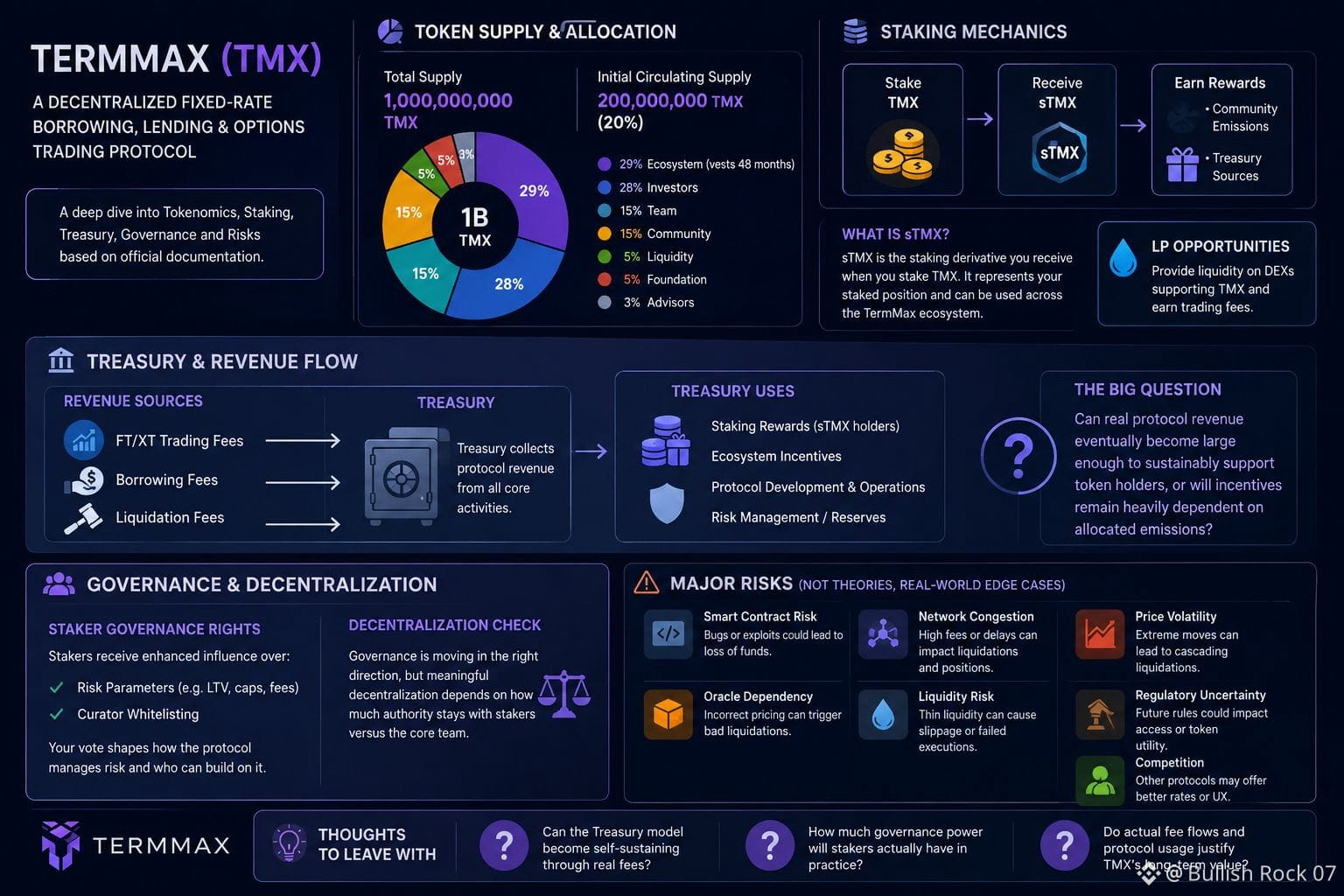

I went back through TermMax’s docs today, mainly looking at the parts that actually matter for a long-term token holder: TMX utility, tokenomics, staking, the Treasury, governance, and the risk section.
One thing that caught my attention is the 1B TMX max supply, with 200M initially circulating. The allocation is also interesting, especially the 29% ecosystem allocation and its 48-month vesting period.
Then there’s the staking side. Stakers receive sTMX, while rewards can come from community emissions and Treasury-related sources. LPs have another way to earn from the system, while protocol fees from trading, borrowing and liquidations can flow back into the Treasury.
That sounds reasonable on paper, but this is where I’d slow down.
The bigger question is whether real protocol revenue can eventually support token holders without relying heavily on emissions.
Governance gives stakers influence over risk parameters and curator whitelisting, but I’d still want to see how much control is actually decentralized versus retained by the core team.
And the risks are very real: oracle failures, congestion, volatility, liquidity problems, smart-contract bugs and regulation can all become much worse during stressed markets.
So I’m left with a few questions: Can the Treasury become self-sustaining? How meaningful is staker governance in practice? And do actual fee flows justify the long-term TMX thesis?
@TermMax #TermMax
One thing that caught my attention is the 1B TMX max supply, with 200M initially circulating. The allocation is also interesting, especially the 29% ecosystem allocation and its 48-month vesting period.
Then there’s the staking side. Stakers receive sTMX, while rewards can come from community emissions and Treasury-related sources. LPs have another way to earn from the system, while protocol fees from trading, borrowing and liquidations can flow back into the Treasury.
That sounds reasonable on paper, but this is where I’d slow down.
The bigger question is whether real protocol revenue can eventually support token holders without relying heavily on emissions.
Governance gives stakers influence over risk parameters and curator whitelisting, but I’d still want to see how much control is actually decentralized versus retained by the core team.
And the risks are very real: oracle failures, congestion, volatility, liquidity problems, smart-contract bugs and regulation can all become much worse during stressed markets.
So I’m left with a few questions: Can the Treasury become self-sustaining? How meaningful is staker governance in practice? And do actual fee flows justify the long-term TMX thesis?
@TermMax #TermMax