@Dusk #dusk $DUSK
I didn’t spend my time understanding Dusk by looking only at its RWA and tokenization story. Instead I started looking more closely at the actual workflow behind Dusk Trade. That’s when something caught my attention perhaps the most important part of Dusk isn’t the exciting, hype-driven side, but the infrastructure that looks rather “boring.
When we talk about RWA, we usually focus on tokenized assets, larger markets, and greater liquidity. But once an asset is tokenized, how does it actually get traded?
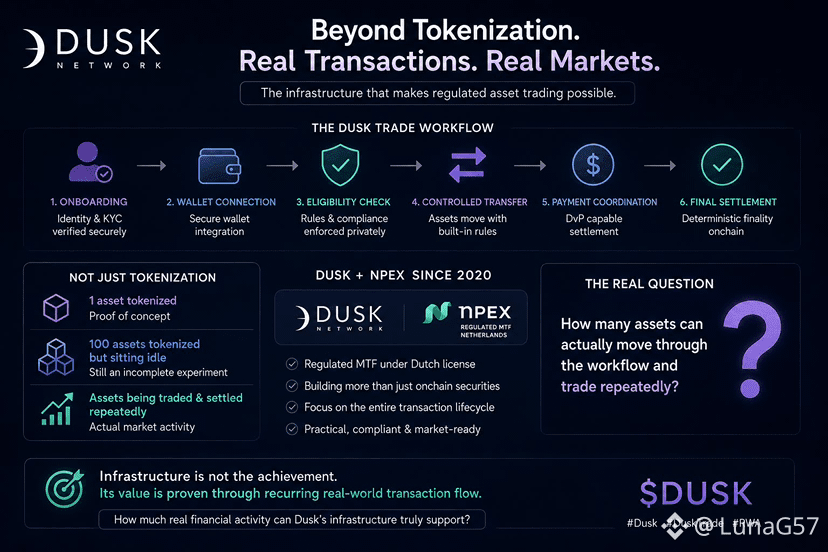
That’s where my curiosity started.Onboarding, wallet connection, eligibility checks, controlled transfers, payment coordination, and final settlement these are the steps that make a real financial transaction work. #dusk $OPN
Dusk has been working with NPEX since 2020, a Dutch regulated stock exchange operating under an MTF license. So the focus doesn’t appear to be limited to simply putting securities onchain. The bigger goal is making the entire transaction process around regulated assets practical.
I started seeing a simple difference1 asset tokenized proof of concept
100 assets tokenized but sitting idle still an incomplete experiment Assets being traded and settled repeatedly actual market activity So when I look at Dusk now my question is no longer How many assets can be tokenized?My question is How many assets can actually move through the workflow and trade repeatedly?
Infrastructure alone isn’t the achievement. Its real value becomes clearer if it can generate recurring transaction flow.And that’s the part I’m most curious about right now How much real financial activity can Dusk’s boring looking infrastructure actually support? @Dusk #dusk $DUSK
I didn’t spend my time understanding Dusk by looking only at its RWA and tokenization story. Instead I started looking more closely at the actual workflow behind Dusk Trade. That’s when something caught my attention perhaps the most important part of Dusk isn’t the exciting, hype-driven side, but the infrastructure that looks rather “boring.
When we talk about RWA, we usually focus on tokenized assets, larger markets, and greater liquidity. But once an asset is tokenized, how does it actually get traded?
That’s where my curiosity started.Onboarding, wallet connection, eligibility checks, controlled transfers, payment coordination, and final settlement these are the steps that make a real financial transaction work. #dusk $OPN
Dusk has been working with NPEX since 2020, a Dutch regulated stock exchange operating under an MTF license. So the focus doesn’t appear to be limited to simply putting securities onchain. The bigger goal is making the entire transaction process around regulated assets practical.
I started seeing a simple difference1 asset tokenized proof of concept
100 assets tokenized but sitting idle still an incomplete experiment Assets being traded and settled repeatedly actual market activity So when I look at Dusk now my question is no longer How many assets can be tokenized?My question is How many assets can actually move through the workflow and trade repeatedly?
Infrastructure alone isn’t the achievement. Its real value becomes clearer if it can generate recurring transaction flow.And that’s the part I’m most curious about right now How much real financial activity can Dusk’s boring looking infrastructure actually support? @Dusk #dusk $DUSK