#dusk $DUSK @Dusk
Having our own little "battle"with regulations around Creator Pad writing rulesI must say I am glad we got a taste of reality. Because breaking the rules always ends up being punished, no matter if you broke them :just alittle bit" or little bit more....All that rules and regulations talk got me seriosly thinking about rules and regulations in @Dusk ,since it is focused on regulated assets mostly
I kept thinking self custody meant that once you own a regulated asset, you basically control what happens to it - seem like a logical conclusion...
Then I came across Dusk's XSC: Confidential Security Contract standard, and noticed something I didn't expect: security tokens can be frozen or force transferred in certain situations.
So I took a deeper look🕵️
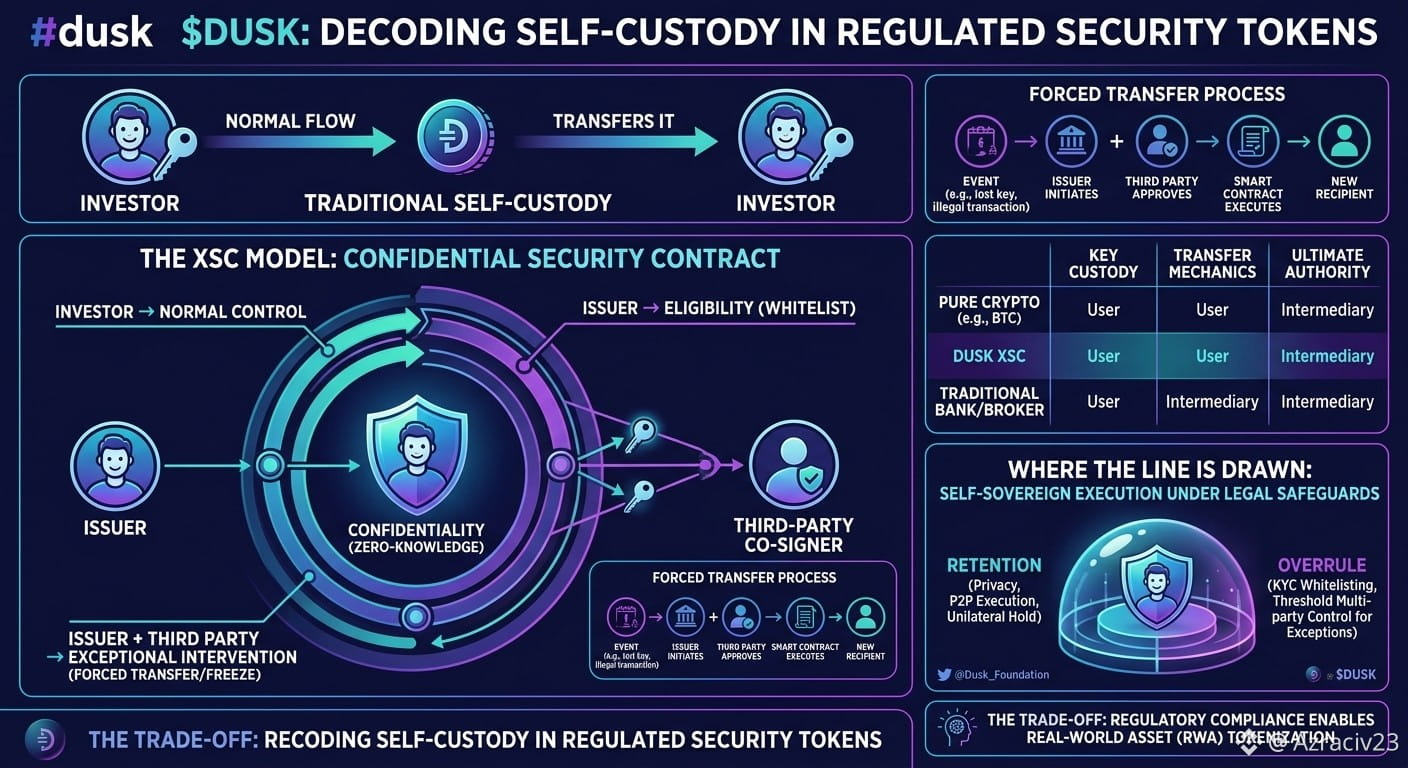
The normal flow is pretty straightforward:
Investor → owns asset → transfers it
But XSC adds another layer around that sais
the issuer can control who is eligible to hold the asset through the whitelist. And if an ilegal transaction needs to be reversed, the issuer can initiate a forced transfer, but a separate third party has to cosign it.
So it becomes:
Investor → normal control
Issuer → eligibility
Issuer + third party → exceptional intervention
I understand why a regulated security needs these kinds of safeguards. Losing a private key, an illegal transfer or another legal issue cant necesarily mean the asset is permanently stuck.
But it made me wonder about the meaning of self custody here.
If I hold the asset myself, but there are still rules above me that can restrict ownership or allow the asset to be moved in exeptional cases, where exactly is the line between self custody and issuer control?$DUSK
Having our own little "battle"with regulations around Creator Pad writing rulesI must say I am glad we got a taste of reality. Because breaking the rules always ends up being punished, no matter if you broke them :just alittle bit" or little bit more....All that rules and regulations talk got me seriosly thinking about rules and regulations in @Dusk ,since it is focused on regulated assets mostly
I kept thinking self custody meant that once you own a regulated asset, you basically control what happens to it - seem like a logical conclusion...
Then I came across Dusk's XSC: Confidential Security Contract standard, and noticed something I didn't expect: security tokens can be frozen or force transferred in certain situations.
So I took a deeper look🕵️
The normal flow is pretty straightforward:
Investor → owns asset → transfers it
But XSC adds another layer around that sais
the issuer can control who is eligible to hold the asset through the whitelist. And if an ilegal transaction needs to be reversed, the issuer can initiate a forced transfer, but a separate third party has to cosign it.
So it becomes:
Investor → normal control
Issuer → eligibility
Issuer + third party → exceptional intervention
I understand why a regulated security needs these kinds of safeguards. Losing a private key, an illegal transfer or another legal issue cant necesarily mean the asset is permanently stuck.
But it made me wonder about the meaning of self custody here.
If I hold the asset myself, but there are still rules above me that can restrict ownership or allow the asset to be moved in exeptional cases, where exactly is the line between self custody and issuer control?$DUSK