
I came across TermMax and found myself asking a question that has very little to do with TPS: what happens when a system is incredibly fast, but the wrong thing is still allowed to happen?
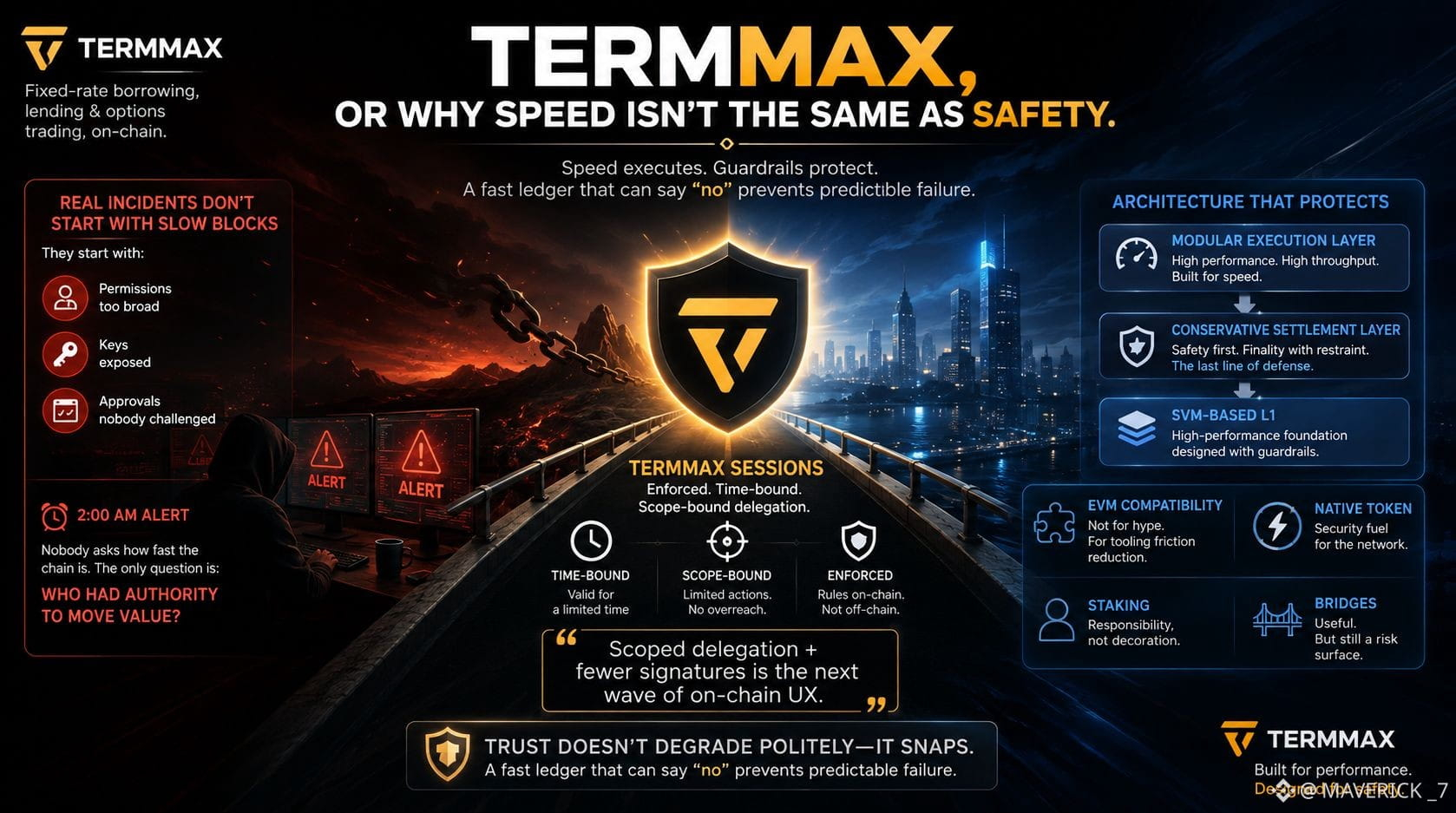
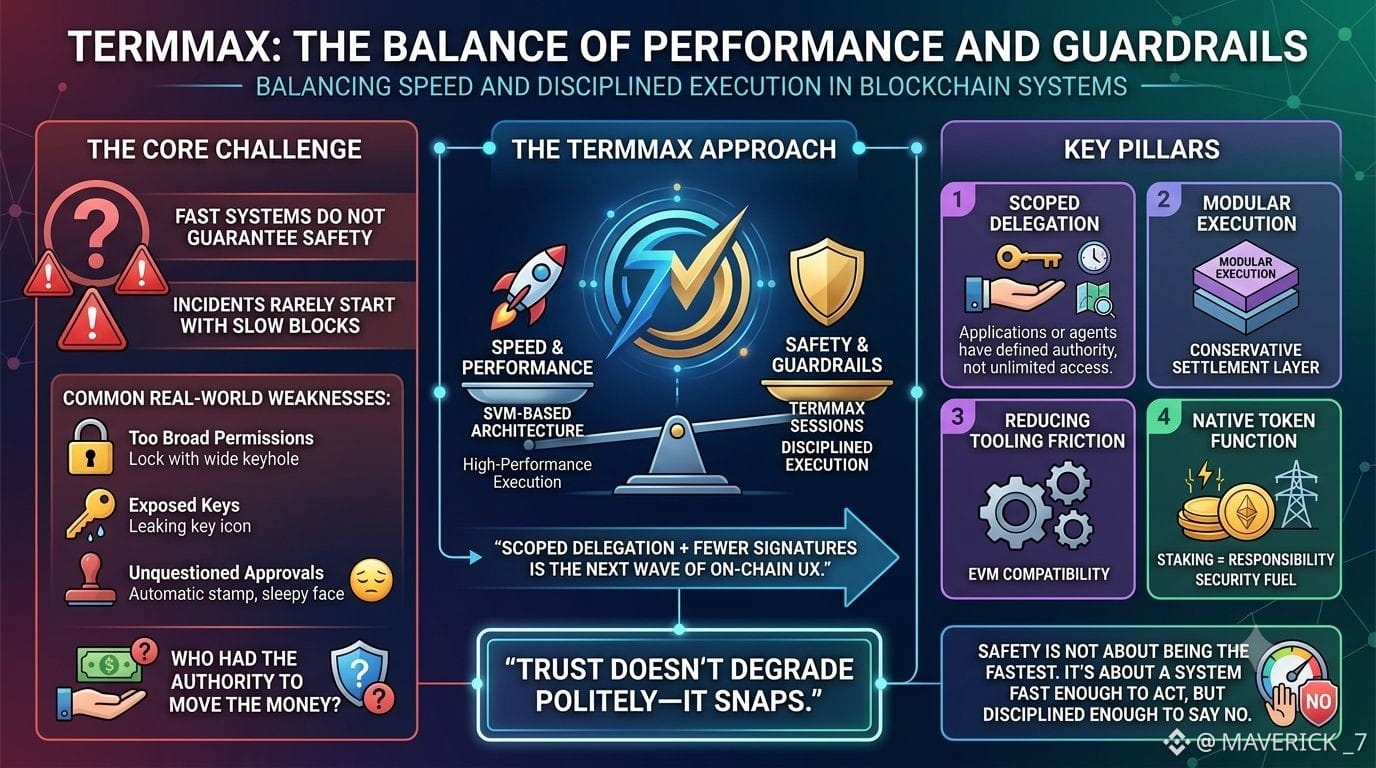
From what I’ve seen, serious incidents rarely start with slow blocks. They usually start with something much simpler: a permission that was too broad, a key that was exposed, or an approval that nobody stopped to question. At 2 a.m., when the alert finally comes in, nobody asks how fast the chain is. The real question is: who had the authority to move the money?
That’s what makes TermMax interesting to me. It approaches performance with guardrails. Its SVM-based architecture is built around high-performance execution, while TermMax Sessions introduce time-bound, scope-bound delegation, giving applications or agents clearly defined authority instead of unlimited access.
“Scoped delegation + fewer signatures is the next wave of on-chain UX.”
I also like the idea of modular execution sitting above a more conservative settlement layer. EVM compatibility, to me, is less about marketing and more about reducing tooling friction. The native token becomes security fuel, while staking represents responsibility.
Bridges still carry risk. And one lesson stays with me: “Trust doesn’t degrade politely it snaps.”
In the end, I think safety is not about being the fastest. It’s about having a system fast enough to act, but disciplined enough to say no.
@TermMax #TermMax
From what I’ve seen, serious incidents rarely start with slow blocks. They usually start with something much simpler: a permission that was too broad, a key that was exposed, or an approval that nobody stopped to question. At 2 a.m., when the alert finally comes in, nobody asks how fast the chain is. The real question is: who had the authority to move the money?
That’s what makes TermMax interesting to me. It approaches performance with guardrails. Its SVM-based architecture is built around high-performance execution, while TermMax Sessions introduce time-bound, scope-bound delegation, giving applications or agents clearly defined authority instead of unlimited access.
“Scoped delegation + fewer signatures is the next wave of on-chain UX.”
I also like the idea of modular execution sitting above a more conservative settlement layer. EVM compatibility, to me, is less about marketing and more about reducing tooling friction. The native token becomes security fuel, while staking represents responsibility.
Bridges still carry risk. And one lesson stays with me: “Trust doesn’t degrade politely it snaps.”
In the end, I think safety is not about being the fastest. It’s about having a system fast enough to act, but disciplined enough to say no.
@TermMax #TermMax