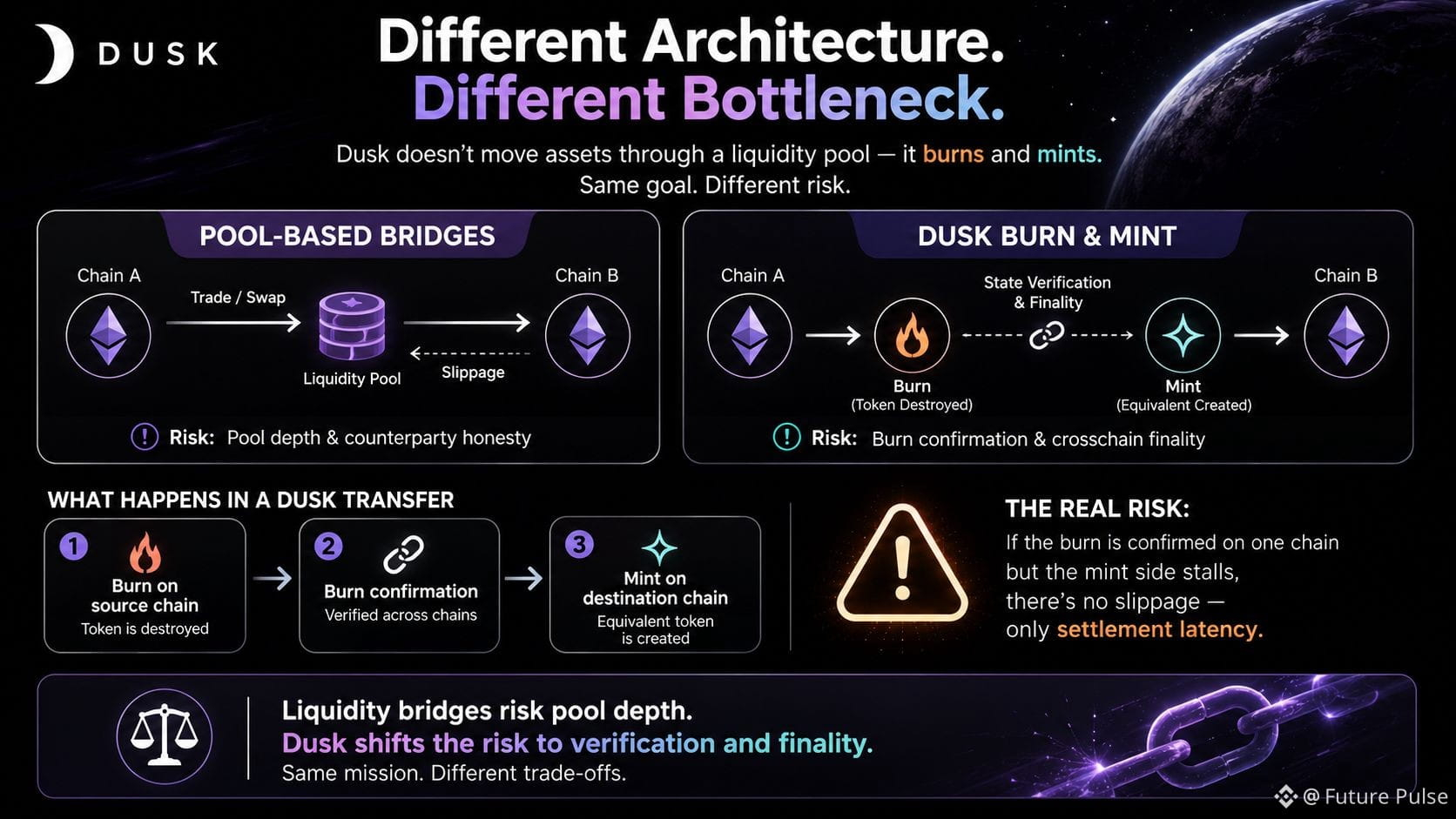

Most bridges make you ask: who is providing the liquidity?
@Dusk makes me ask a different question: who is validating the state change?
With a burn-and-mint design, the asset isn’t swapped through a liquidity pool. It is burned on the source chain and recreated on the destination chain.
That removes one familiar dependency: pool depth and slippage.
But it creates a different dependency — the burn must be correctly verified before the mint can safely happen.
That’s where the interesting risk sits.
If the burn is final but the destination mint is delayed, the user isn’t facing slippage. They’re facing settlement latency.
So the real question for me isn’t whether burn-and-mint is better than liquidity-based bridging.
It’s whether the verification and finality mechanism can keep the two sides synchronized under stress.
$DUSK @Dusk #dusk
$BB
$PUMP
@Dusk makes me ask a different question: who is validating the state change?
With a burn-and-mint design, the asset isn’t swapped through a liquidity pool. It is burned on the source chain and recreated on the destination chain.
That removes one familiar dependency: pool depth and slippage.
But it creates a different dependency — the burn must be correctly verified before the mint can safely happen.
That’s where the interesting risk sits.
If the burn is final but the destination mint is delayed, the user isn’t facing slippage. They’re facing settlement latency.
So the real question for me isn’t whether burn-and-mint is better than liquidity-based bridging.
It’s whether the verification and finality mechanism can keep the two sides synchronized under stress.
$DUSK @Dusk #dusk
$BB
$PUMP