

THE CRYPTO WAR CHRONICLES — SPECIAL DISPATCH
Your Coins Don't Have to Sit Idle: A Warrior's Guide to Binance Earn
Every trader I know has the same graveyard in their wallet — a stack of coins bought during a moment of conviction, now just sitting there, doing nothing. No trend to trade, no setup to chase. Just... idle.
Here's the thing most people miss: idle crypto is a missed battle. You don't have to be actively trading every single day to put your assets to work. That's exactly what Binance Earn exists for.
I'm not writing this as a "get rich passively" pitch — I don't do hype. I'm writing it because half the questions I get in my comments are some version of "what do I do with coins I'm not trading right now." So let's break it down properly, Kayi-style: no fluff, just the map.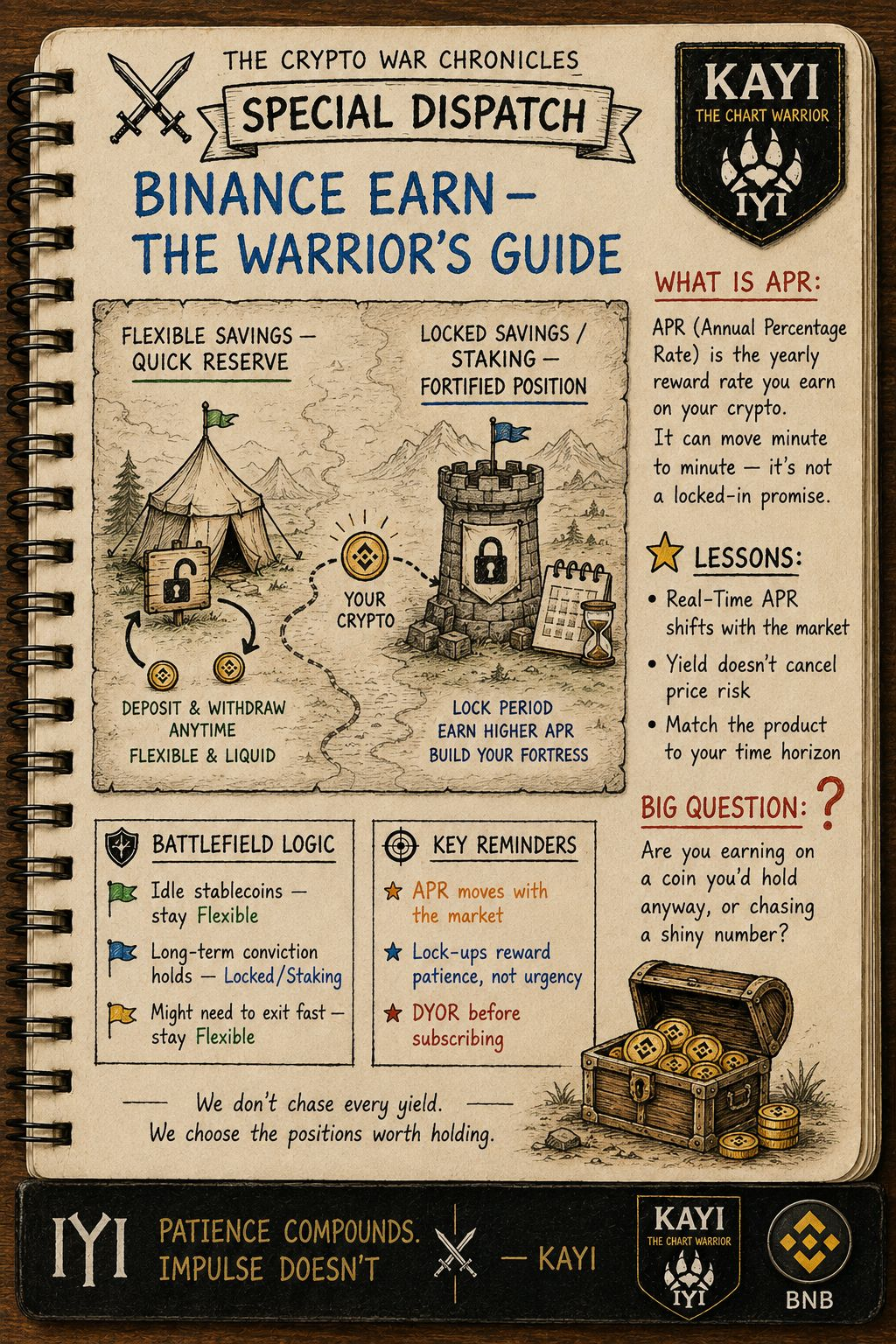
What Binance Earn Actually Is
Think of Binance Earn as the "off-duty camp" for your crypto — the place your coins rest and still generate value instead of sitting in a cold wallet doing nothing. Instead of trading, you're putting your assets to work through savings, staking, and yield products, and earning rewards on top of what you already hold.
The umbrella covers a few different product types — Simple Earn (Flexible and Locked), on-chain yield products, dual investment, and staking for assets like ETH and BNB. Each one trades off flexibility against reward differently, which is the whole game here.
Flexible Savings — The "Quick Reserve" Position
Flexible Savings is the most straightforward entry point. You deposit an asset, it starts earning daily, and you can withdraw basically anytime — no lock-up, no waiting for a "release window."
This is your quick-reserve position. It's not going to hand you the biggest yield on the board, but it means your capital stays liquid — if a setup appears on the chart tomorrow and you need to move fast, your funds aren't stuck somewhere.
A useful detail: rewards on Flexible products often run on what's called a Real-Time APR — a rate that can shift minute to minute based on market supply and demand. So a rate you see today isn't locked in for tomorrow; it moves with the market, the same way price does. Some Flexible products also apply reward rates in tiers, meaning your first portion of deposited funds may earn a different rate than the amount above a certain threshold.
Best for: coins you're holding short-term, or capital you want earning something while you wait for your next trade setup to form.
Locked Savings & Staking — The "Fortified Position"
If Flexible Savings is your quick reserve, Locked products are your fortified position — you commit funds for a set period (commonly ranges like 7, 15, 30, or 120 days depending on the product), and in exchange you generally get access to a higher rate than the flexible version of the same asset.
Staking works on similar logic for supported proof-of-stake assets — you lock the asset to help secure the network and earn rewards for it. The trade-off is the same principle across all locked-style products: you're giving up quick access in exchange for a better rate.
Best for: coins you already planned to hold long-term regardless of short-term price action — assets you weren't going to touch for weeks anyway.
Understanding APR (So You're Not Just Chasing the Highest Number)
APR — Annual Percentage Rate — is the yearly reward rate a product is offering. It looks simple, but there are two things every soldier in this space needs to understand before deploying capital:
APR is not guaranteed forever. Especially on Flexible products, it moves with market conditions. A promo banner showing a big number is often a limited-time boosted rate, not a permanent one.
APR ignores price risk. This is the one people forget. If you earn a solid yearly rate on a coin, but that coin's price drops sharply over the same period, you can still be down in dollar terms even while your coin count goes up. Earning yield on a losing asset just means you lose slightly slower.
That second point is the actual lesson here. Yield is not a hedge against a bad thesis — it's a bonus on top of a good one.
How I'd Actually Use This (Battlefield Logic)
Idle stablecoins waiting for a setup → Flexible Savings. Keep it liquid, keep it earning something while you wait.
A coin you're conviction-holding long term regardless of noise → Locked Savings or staking, if the terms fit your timeline.
Anything you might need to exit fast if the chart flips → stays Flexible, full stop. Don't lock up capital you might need to react with.
The mistake I see most often is people locking funds for a high advertised rate, then panicking two weeks later when the market moves and they can't touch the position. Match the product to your actual time horizon — not to whichever number looks biggest on the banner.
The Big Question
Passive yield isn't a replacement for a thesis — it's a tool that works with one. Before you subscribe to anything: are you earning on a coin you'd hold anyway, or are you letting a shiny APR number talk you into holding a bag you didn't actually want?
Comment below: Flexible or Locked — which camp are you in, and why? 👇
We don't chase every yield. We choose the positions worth holding.
⚔️ Follow KAYI — THE CHART WARRIOR for the next dispatch.
$BNB #BinanceEarn #Staking #PassiveIncome #cryptoeducation $ETH