
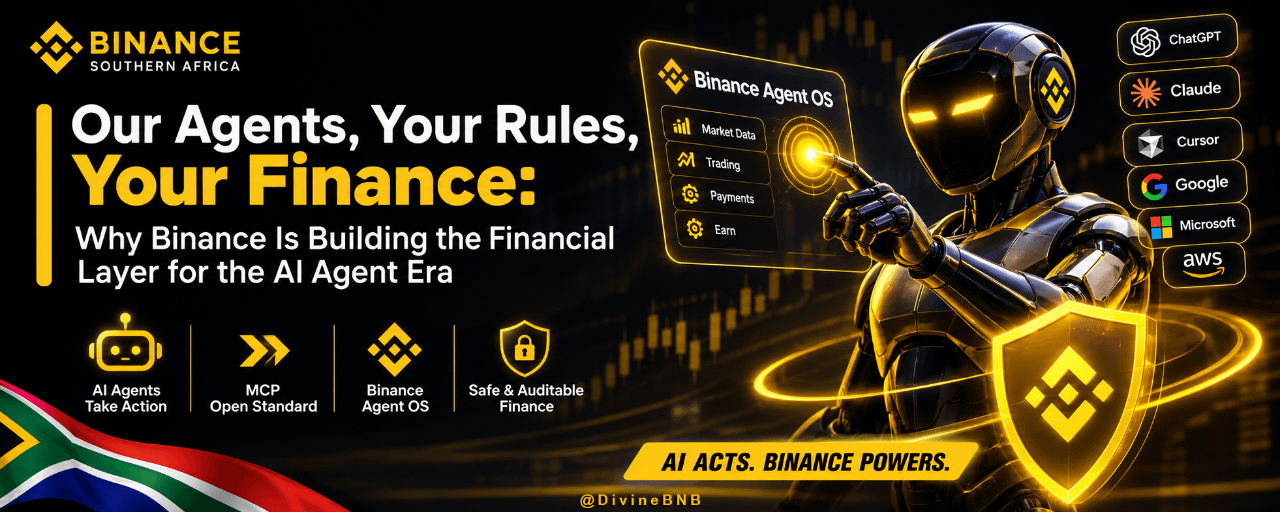
AI is moving beyond answering questions.
The next generation of AI agents will be able to research markets, interpret data, interact with applications and take actions on a user's behalf. In crypto, that means an AI agent could potentially monitor markets, analyse opportunities, manage workflows and execute financial actions — provided it has the right tools and permissions.
That creates a new challenge: how do you give AI access to financial infrastructure without giving it unlimited control?
This is where Binance Agent OS comes into the picture.
Binance is building a financial capability layer that allows AI agents to discover and interact with Binance market data and functions through Model Context Protocol (MCP), an open standard designed to connect AI applications with external tools and data. MCP was introduced by Anthropic and has become an important part of the emerging agent ecosystem.
The idea is simple: AI should be able to act, but users should remain in control of what it can do.
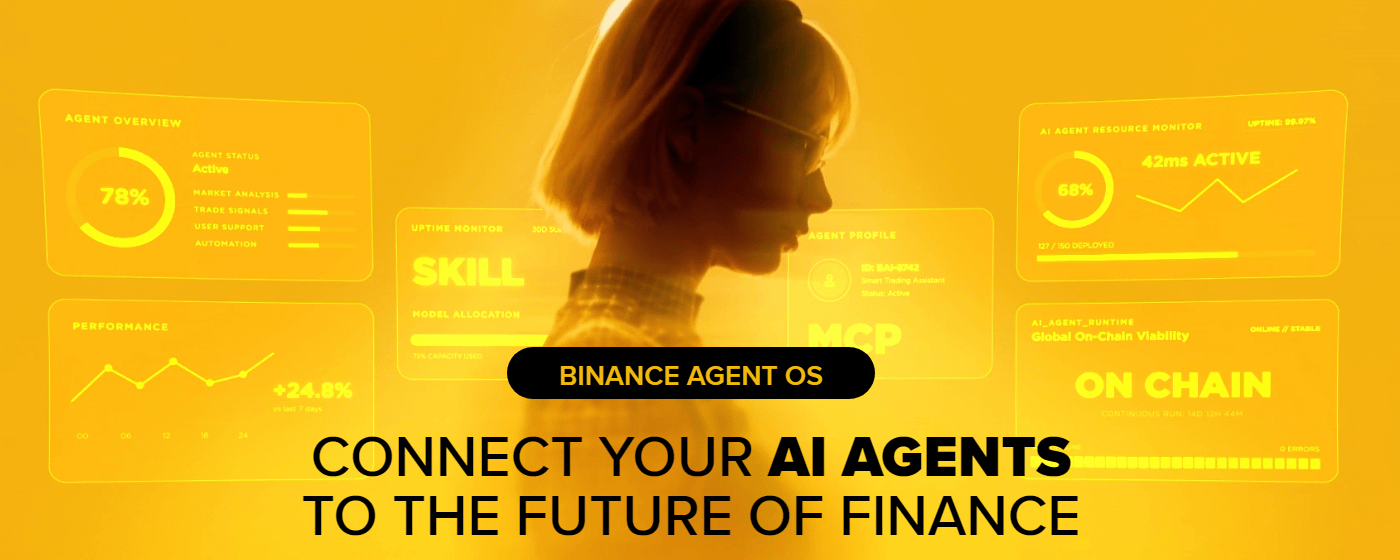
AI Is Moving From Answers to Actions
Traditional AI assistants are primarily designed to generate information.
You ask a question, and they provide an answer.
AI agents are different.
An agent can take a goal, break it into multiple steps, access external tools and potentially execute those steps. Binance Academy describes AI agents as software that can perceive their environment, reason about goals and take actions — including interacting with blockchain networks.
Imagine asking an AI agent:
“Monitor the crypto market and alert me when conditions match my strategy.”
That is already useful.
Now imagine the agent being able to go further:
“If my predefined conditions are met, execute the trade within my limits.”
At that point, AI is no longer simply answering questions. It is interacting with financial markets.
And finance requires a different level of infrastructure, permissions and accountability.

Why AI Agents Need a Financial Layer
An AI model by itself doesn't have access to markets.
It needs a connection to financial systems.
That connection must provide more than raw data. An agent needs structured access to the tools required to understand and potentially act on financial information.
This can include:
Market prices and market data
Trading functions
Account information
Portfolio and asset information
Financial workflows
Payments and other supported functions
Permission and authentication controls
Binance has already been expanding its AI Agent Skills ecosystem, giving compatible agents access to Binance data and functions. Binance's published documentation notes that public market-data queries can be accessed without API credentials, while account and trading capabilities require appropriate authentication and permissions.
The bigger opportunity is therefore not simply AI + crypto.
It is AI + programmable financial infrastructure.

What Is Binance Agent OS?
At a high level, Binance Agent OS can be viewed as a financial capability layer for AI agents.
Instead of building a completely different integration for every AI application, an open protocol such as MCP provides a standardized way for AI systems to discover and interact with tools.
Anthropic describes MCP as an open standard for connecting AI assistants to external data sources and tools, helping reduce fragmented, one-off integrations.
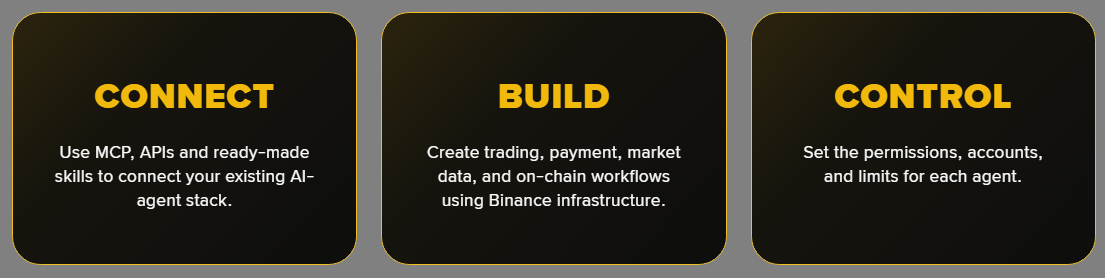
For Binance, this creates an important bridge:
AI agent → MCP → Binance capabilities → financial action
That architecture matters because the AI model doesn't need to become a financial exchange.
It needs a controlled way to access one.
MCP: The “Common Language” for AI Tools
One of the biggest problems in the early AI-agent ecosystem is fragmentation.
Every application can have its own way of connecting to external tools. Developers then have to build and maintain multiple integrations.
MCP aims to simplify that process by providing a common protocol for AI applications to connect with tools and data sources.
Think of MCP as a common language between an AI agent and the applications it needs to use.
That opens an interesting possibility for financial AI.
An agent operating through an environment such as Claude, Cursor or another compatible AI application could discover available Binance capabilities through a standardized interface rather than requiring a completely bespoke integration for every environment.
The result could be a more interoperable AI economy where agents can access financial infrastructure without every developer having to reinvent the connection.
Your Agent Should Follow Your Rules
The most important word in this entire concept may not be agent.
It may be rules.
Giving an AI agent access to financial tools without appropriate controls would create obvious risks.
What assets can it access?
What actions can it perform?
How much can it trade?
Can it withdraw funds?
What happens if the agent makes a mistake?
These questions become increasingly important as AI moves from generating recommendations to executing actions.
Binance's guidance for AI Agent Skills emphasizes security practices such as least-privilege permissions, IP restrictions and avoiding withdrawal permissions when they are not required. It also recommends testing in appropriate environments before moving to mainnet.
This is the foundation of an important principle:
An AI agent should have only the financial authority it actually needs.
Your agent. Your strategy. Your limits.
From Trading Bots to Financial Agents
There is an important distinction between traditional trading bots and modern AI agents.
A conventional trading bot might follow a predefined rule:
Buy BTC if the price crosses a particular level.
An AI agent can potentially combine multiple sources of information, reason through a workflow and use several tools before taking an action.
Binance Academy notes that AI agents can go beyond simple automation by planning tasks, using tools and carrying out multi-step actions.
That doesn't mean agents should automatically be given unlimited autonomy.
Quite the opposite.
The more capable the agent becomes, the more important permissions, monitoring and boundaries become.
Why Binance Is Positioned to Build This Layer
Crypto was built around programmable digital assets.
AI agents are increasingly becoming programmable digital workers.
The intersection is powerful.
An AI agent can make decisions and coordinate tasks. Blockchain and crypto provide programmable assets, markets and settlement infrastructure.
Binance adds another critical component: access to a large financial ecosystem with market data, trading infrastructure and a growing collection of AI Agent Skills.
Binance has expanded its Skills Hub beyond basic market information into areas including spot trading, derivatives, margin, assets and other financial workflows.
This creates the possibility of a future where financial capabilities become tools that agents can call when users authorize them to do so.
What Could the AI Agent Economy Look Like?
The possibilities extend far beyond automated trading.
Imagine an AI business agent that needs to:
Monitor crypto markets.
Compare available liquidity.
Check a user's predefined financial rules.
Execute an approved transaction.
Record what happened.
Report the result back to the user.
Or consider an autonomous digital business that needs to pay for software, computing resources or other digital services.
As AI agents increasingly interact with one another, programmable payments become an important piece of the infrastructure. Binance Academy has highlighted stablecoins as a potential settlement mechanism for agent-to-agent transactions because they can support programmable, 24/7 digital payments.
The financial layer therefore isn't just about trading.
It could eventually support an economy where software can earn, spend, exchange and manage digital assets under human-defined rules.
Security Has to Be Part of the Architecture
The biggest mistake would be treating AI agents like ordinary users.
They aren't.
An agent can operate at machine speed. It can potentially make repeated calls, interact with multiple tools and execute workflows faster than a human could.
That makes security and authorization fundamental.
A responsible AI-finance architecture should focus on principles such as:
Least privilege: Give agents only the permissions they require.
Clear authorization: Users should understand what an agent is allowed to do.
Spending and trading limits: Define boundaries before execution.
Credential protection: API keys and authentication credentials must be securely managed.
Auditability: Actions should be traceable.
Human oversight: Important or high-risk actions may require confirmation.
Testing: Agents should be tested in controlled environments before handling meaningful funds.
Binance's existing AI Agent Skills guidance specifically recommends practices such as IP restrictions, restricted permissions, limited balances and careful API-key management for trading use cases.
The objective isn't to eliminate automation.
It is to make automation controlled.
From “AI That Knows” to “AI That Can”
This is the fundamental shift.
The first wave of generative AI taught machines to know.
The agent era is teaching machines to do.
But action requires infrastructure.
A shopping agent needs payments.
A coding agent needs computing resources.
A business agent needs access to applications.
A financial agent needs markets and financial services.
That is why the financial layer matters.
Binance Agent OS represents a vision where Binance's financial infrastructure can become accessible to the next generation of AI applications through open, standardized interfaces.
Instead of asking users to move between multiple applications and manually execute every step, agents could increasingly coordinate these workflows on their behalf — while remaining constrained by permissions established by the user.
The Bigger Picture: Finance Becomes a Tool
For decades, financial services have largely been designed around humans clicking buttons.
The AI agent era changes the interface.
The user may simply state an objective.
The agent handles the workflow.
That doesn't mean humans disappear from finance. It means the interface between humans and financial infrastructure could change from screens and buttons to instructions, permissions and agents.
Binance's AI Agent Skills ecosystem is already moving in this direction, with tools designed to allow agents to access Binance data and perform supported actions through structured capabilities.
The long-term opportunity is much bigger than automated trading.
It is about making financial infrastructure machine-readable, programmable and accessible to authorized AI agents.
The Future Is Agentic — But It Should Still Be User-Controlled
AI agents will increasingly interact with the real world.
When they do, finance will be one of the most important layers they need to access.
The question isn't whether AI should be able to act.
The real question is:
How do we let AI act without giving up control?
That is the problem Binance Agent OS is designed to address.
Through standardized connectivity such as MCP, Binance can expose financial capabilities to an emerging ecosystem of AI agents while emphasizing permissions, security and auditability.
The vision is straightforward:
Our agents. Your rules. Your finance.
AI can provide the intelligence.
Agents can provide the action.
And Binance can provide the financial infrastructure that connects the two.
Final Takeaway
The AI agent era could fundamentally change how people interact with money.
Instead of opening an exchange, searching for a market and manually executing every step, users may increasingly delegate defined financial tasks to intelligent software.
But autonomy without control is not progress.
The winners of the agent economy will need infrastructure that combines capability with permission, automation with accountability, and intelligence with security.
That's why the financial layer matters — and why Binance is building for a world where AI doesn't just tell you what is happening in markets.
It can act on your instructions, within your rules.
This article is for informational purposes only and should not be considered financial advice. AI agents and automated trading can involve significant risks. Users should understand the permissions they grant, protect their credentials and independently assess any financial decision before execution.
#BinanceAgentOS | @Binance Square Official | @Binance Angels