
#dusk $DUSK @Dusk
I started looking at it expecting another blockchain story, but one simple question kept coming back to me. If I had serious money moving on-chain, would I really want everyone to see exactly what I was doing?
Honestly, probably not.
Crypto loves transparency, and I understand why. Being able to verify activity without trusting a middleman is powerful. But there is a difference between something being verifiable and having every financial detail exposed.
The more I thought about it, the less this looked like a technology story.
It started feeling like a story about people.
Dusk made me think about how privacy can change decisions. A company might like blockchain but still hesitate if its financial activity becomes too easy to watch. The same could be true for users who simply want more control over what they reveal.
Most people will probably look at the rewards.
I kept looking somewhere else.
Sometimes people do not reject something because they think it is useless. They reject it because the risk feels uncomfortable. If privacy reduces that hesitation, behavior can change.
That is where things became interesting.
The feature is obvious. The behavior it creates is not.
I am not fully convinced yet.
But I keep coming back to one question.
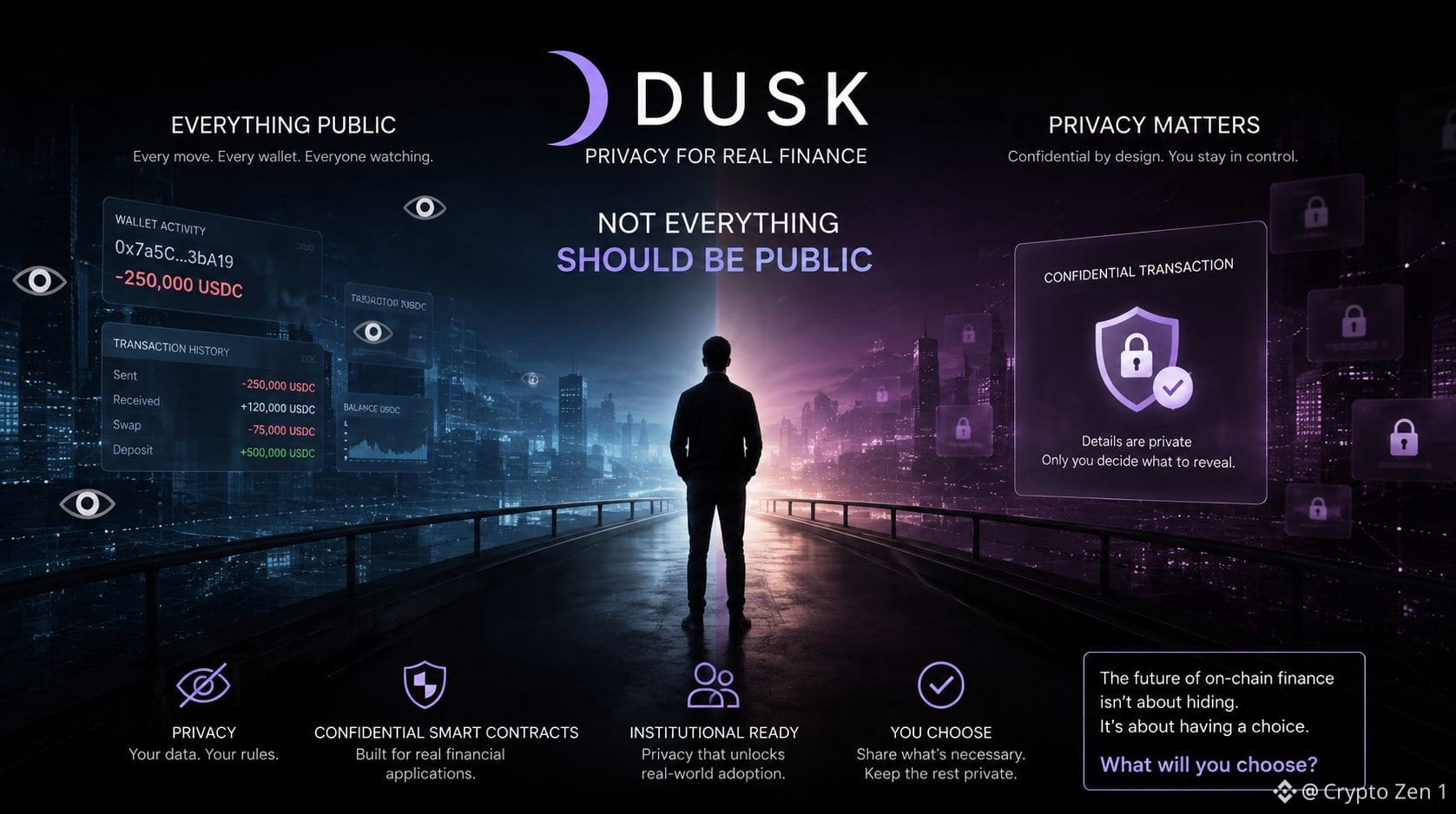
What if the future of on-chain finance depends less on showing everyone everything, and more on letting people choose what stays private?
I started looking at it expecting another blockchain story, but one simple question kept coming back to me. If I had serious money moving on-chain, would I really want everyone to see exactly what I was doing?
Honestly, probably not.
Crypto loves transparency, and I understand why. Being able to verify activity without trusting a middleman is powerful. But there is a difference between something being verifiable and having every financial detail exposed.
The more I thought about it, the less this looked like a technology story.
It started feeling like a story about people.
Dusk made me think about how privacy can change decisions. A company might like blockchain but still hesitate if its financial activity becomes too easy to watch. The same could be true for users who simply want more control over what they reveal.
Most people will probably look at the rewards.
I kept looking somewhere else.
Sometimes people do not reject something because they think it is useless. They reject it because the risk feels uncomfortable. If privacy reduces that hesitation, behavior can change.
That is where things became interesting.
The feature is obvious. The behavior it creates is not.
I am not fully convinced yet.
But I keep coming back to one question.
What if the future of on-chain finance depends less on showing everyone everything, and more on letting people choose what stays private?